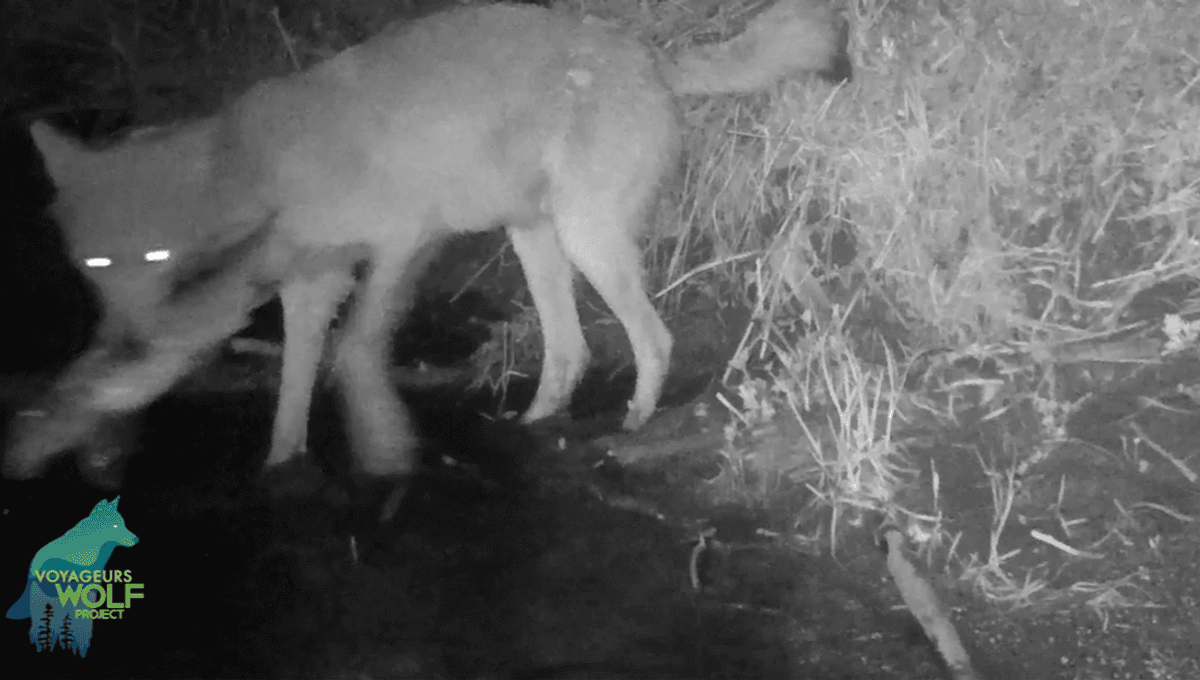
Opportunistic wolves in Northern Minnesota have been observed fishing consistently year on year during the fish spawning season, a long-term study has revealed. Previously thought to be a behavior seen in just a couple of individuals, remote cameras and GPS collars have shown multiple individuals across different packs actively fishing in rivers and creeks.
Wolves in the Greater Voyageurs Ecosystem (GVE), Minnesota, USA were studied every summer from 2017 to 2021 using a combination of GPS collars, remote cameras, and direct observations. One individual was even fitted with a GPS collar containing a camera that recorded footage of the wolf hunting and eating fish.
In each instance of wolf fishing behavior that was observed, the wolves all killed white suckers (Catostomus commersonii). Almost all the fishing took place in the months of April and May when the fish travel upstream for spawning season. Only one wolf continued to hunt and catch fish into June and July, which coincided with a drought in 2021 and therefore much-reduced water levels, effectively trapping the fish in these upstream areas.
The team thinks that the timing of the spawning is important as higher fish numbers coincide with less prey availability in terms of white-tailed deer (Odocoileus virginianus), the wolves’ main prey species. They also found that when fish were available, they were the preferred prey species rather than larger options like the deer or other prey items such as beavers.
“Wolves fish at a time of year after good adult deer hunting in the winter and before deer fawns are born in the spring. At the same time, wolf pups are being born. Fish may therefore be an important food source in the spring for growing wolf packs, when there’s more mouths to feed but less primary prey to hunt. We found fish remains at a few wolf dens, adding to evidence that wolves feed fish to their pups,” Dani Freund, lead author of the paper and researcher at the University of Minnesota, told IFLScience.
One individual young male wolf killed three beavers between May 7-14, before fishing from May 19-29. Fish remains were the only prey remains seen for this wolf during that second time period. The researchers think that this switch from prey species might be safer for the wolves in terms of injury, as well as the fish being more energetically profitable than prey such as beavers and deer.
“Wolves’ main weapon is their mouth, so going after prey such as deer can cause a severe injury,” explained Freund in a statement. “Fish on the other hand can’t do much to a wolf, and wolves seem to be taking advantage of that. Some wolves seemed to completely pass up larger prey such as beaver when fish were available and abundant.”
It seems the beavers may be inadvertently helping the wolves to fish too. The beavers dam the waterways, preventing the fish from traveling upstream and instead creating wide shallow pools full of fish traffic jams. The team found that wolves mainly fished between 8 pm and 6 am, in waterways less than 1 meter (3.3 feet) deep, typically downstream of the beaver dams.
Using remote cameras, 59 events of wolves fishing near Irwin Creek were recorded in 2018 and 2019, this included both collared and uncollared wolves. These events both included successful and unsuccessful catching attempts as well as videos of the wolves catching fish on the river bank. While most recordings were of individuals from different packs, one wolf and his offspring were also recorded fishing, raising the question of whether the behavior can be taught across generations.
“We recorded a breeding male and four of his offspring fishing, which may mean that some learning is involved in the development of wolf fishing behavior,” Freund told ILFScience. “But, on the flip side, the fact that we observed multiple individuals across different wolf packs fish at different rivers suggests that wolves can fish regardless of if they learned the behavior from other wolves or not. Given how social wolves are and how flexible their hunting behavior is, it’s likely a combination of both. It will take many more years of observations to really answer the question!”
The team suggest that their research provides insight into how the wolves adapt to alternative prey sources and highlights how despite the challenges with capturing this, fishing is likely not to be as rare a behavior as previously thought and could even be widespread across wolf packs that live in similar environments.
The paper is published in Royal Society Open Science.

Source Link: Wolves Go Fishing More Often Than Anyone Realized, Camera Traps Reveal
