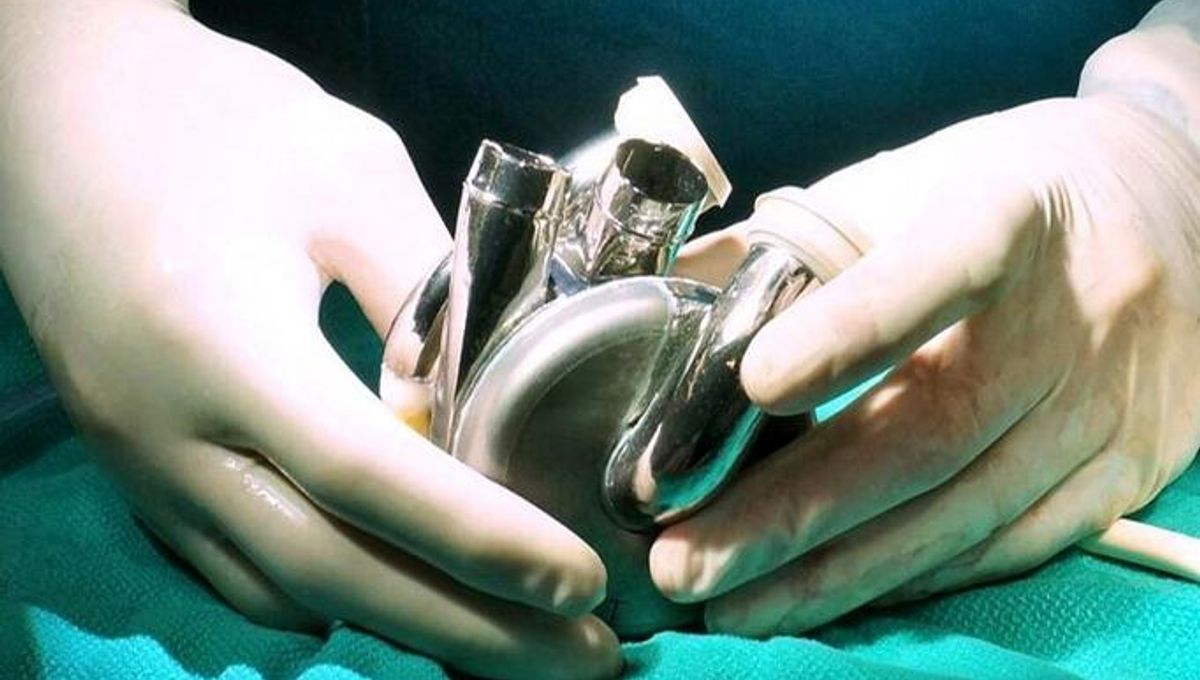
A titanium heart sounds like something made for the Tin Woodman in The Wizard of Oz – but for the first time, on the July 9, it was implanted in a patient.
The implantation of a total artificial heart (TAH) is a proposed solution to help people with heart failure who need a heart transplant. Heart failure affected 6.7 million people in the US alone between 2017 and 2020, but in 2021 only 3,817 heart transplantations were performed. Currently, TAH implantation is seen as a bridge to heart transplant in severe cases of heart failure.
BiVACOR’s titanium heart is a new type of TAH. Australian by design, it was approved to be tested in five human patients in an Early Feasibility Study in the USA. The first of those patients was implanted on July 9 and lived with the device for 8 days, until it was replaced with a donor heart.
“This is an amazing advancement as the BiVACOR TAH may offer hope for countless patients who suffer from end-stage heart failure. This device may serve as a life-saving bridge to a heart transplant; future studies may prove its potential as a long-term pump that can effectively serve as a total replacement for a patient’s heart,” Dr Alexis Shafii, Surgical Director of Heart Transplantation at Baylor St. Luke’s Medical Center and Associate Professor of Surgery, Cardiothoracic Transplant & Circulatory Support at Baylor College of Medicine, explained in a statement.
The titanium heart, like yours, has two ventricles. One sends blood to the lungs (pulmonary circulation) and the other sends it to the rest of your body (systemic circulation). But unlike yours, this heart doesn’t beat. It spins.
The blood flows through the titanium heart, pushed by a rotating impeller that uses MAGLEV: magnetic levitation. That’s the same technology that made a train fly by at 603 kilometers per hour (374.69 miles per hour) in Japan in 2015. Maglev reduces the risk of mechanical wear and minimizes blood trauma.
The TAH comes with a controller and battery that the patient would carry with them. BiVACOR says that the TAH is up to handling adult male patients engaging in physical exercise. Settings can also be adjusted to provide pulsatile, instead of continuous flow, to mimic the flow from a beating heart.
While this first BiVACOR patient wore it for only 8 days, the device has been implanted for longer periods of time in animals – including for a month in a cohort of calves. The device has also been running error free for four years and counting on a benchtop.
It is not the first total artificial heart, though. SynCardia was approved by the FDA in 2004 and has been implanted in more than 1,400 patients, even allowing them to go home while they wait for a donor heart.
However, 12 percent of patients with SynCardia were reported to have strokes, and 14 percent experienced thrombotic events. The Maglev in BiVACOR hopes to reduce these risks. SynCardia is also quite large compared to BiVACOR, which resembles a human heart, and the materials it is made of are less durable. BiVACOR is made of titanium, which is already commonly used for orthopedic implants. Titanium readily oxidizes, creating a biologically inert film that coats the device protecting it from any biological reactions from the body.
“The BiVACOR TAH represents a paradigm shift in artificial heart design” according to the BiVACOR website.

Source Link: World First Implantation Of Titanium Heart Harnessing Maglev Technology
