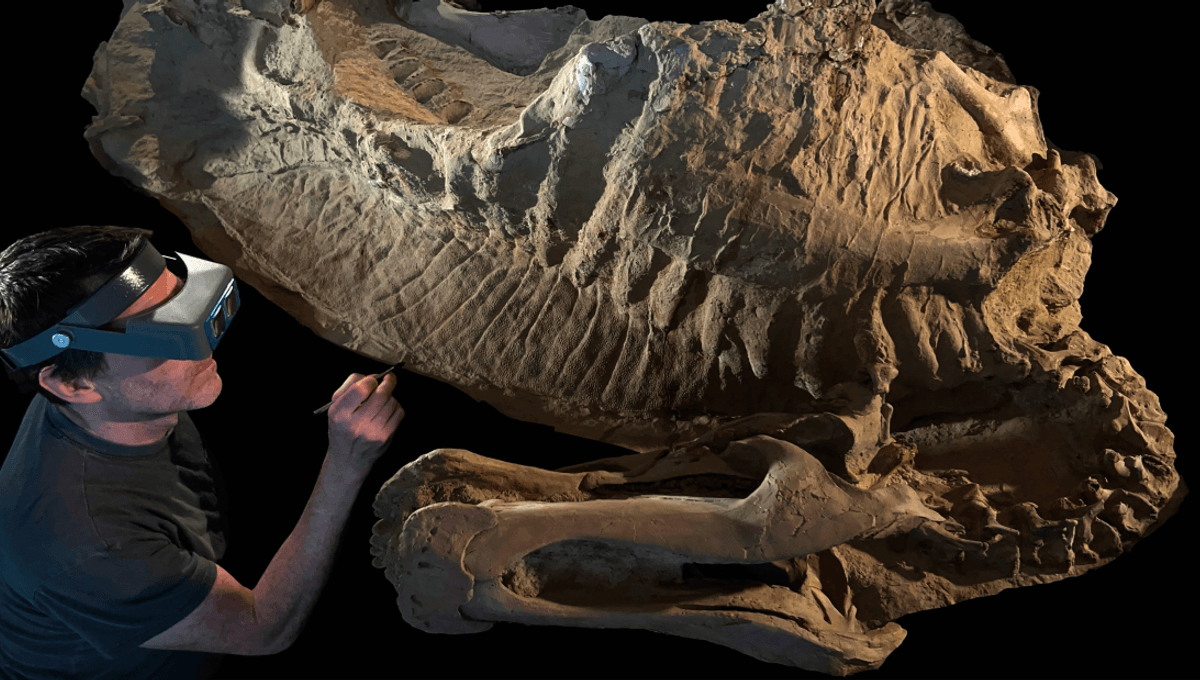
Did you know that Wyoming is home to a dinosaur “mummy zone”? Here, scientists have been finding remarkably preserved dinosaurs since the early 20th century, and we just got two new carcasses that heralded a bunch of dinosaur firsts.
The rest of this article is behind a paywall. Please sign in or subscribe to access the full content.
The carcasses were of the duckbilled dinosaur Edmontosaurus annectens, and they were preserved with fine details of their fleshy surface intact. In their lifetime, the region was vulnerable to seasonal monsoons that caused droughts and floods. That the mummified dinosaurs have details preserved in 3D suggests they were buried quickly after death by floodwaters very close to where they died.
This cycle of dry and wet conditions explains why Wyoming’s “mummy zone” has become such a hotspot for incredibly preserved dinosaurs. Each mummy found to date was surrounded by a continuous layer of sediment that rapidly buried the body.
We know it was fast-moving floodwater because it contained chunks of mud, mixed gravel, broken bones, and tree debris. What led to such intricate details being preserved was a mechanism known as “clay templating”.
It involves an animal being buried, creating a thin clay mask no more than 1/100th of an inch (around 0.3 millimeters) thick. Unlike mummies in Egyptian tombs, these carcasses don’t contain any organic remains, but they do exhibit fine details about the fleshy surface of the animals, creating a snapshot back in time unlike anything we’ve ever found.
“We’ve never been able to look at the appearance of a large prehistoric reptile like this,” said senior author Paul Sereno, a professor of organismal biology and anatomy at the University of Chicago, in a statement.
“It’s the first time we’ve had a complete, fleshed-out view of a large dinosaur that we can feel really confident about.”
Edmontosaurs roamed Wyoming’s badlands 66 million years ago, and other fossil finds in the region have shown they had to contend with predatory theropods like Tyrannosaurus rex. The team will now begin targeted searches for similarly preserved specimens in Wyoming’s mummy zone, and who knows what they could be rewarded with.
“The Badlands in Wyoming where the finds were made is a unique ‘mummy zone’ that has more surprises in store from fossils collected over years of visits by teams of university undergrads,” said Sereno.
The study is published in the journal Science.

Source Link: Wyoming's "Mummy Zone" Has More Surprises In Store, Say Scientists – Why Is It Such A Hotspot For Mummified Dinosaurs?
