But equally striking is the flourishing wildlife. Flora and fauna abound, harkening back to an America not yet touched by colonialist hands: bison roam wild (indeed, sometimes they’re positively livid); grizzly bears are born and live in safety; cougars are… well, the cougars aren’t doing too hot, to be honest, but they’re trying their best.
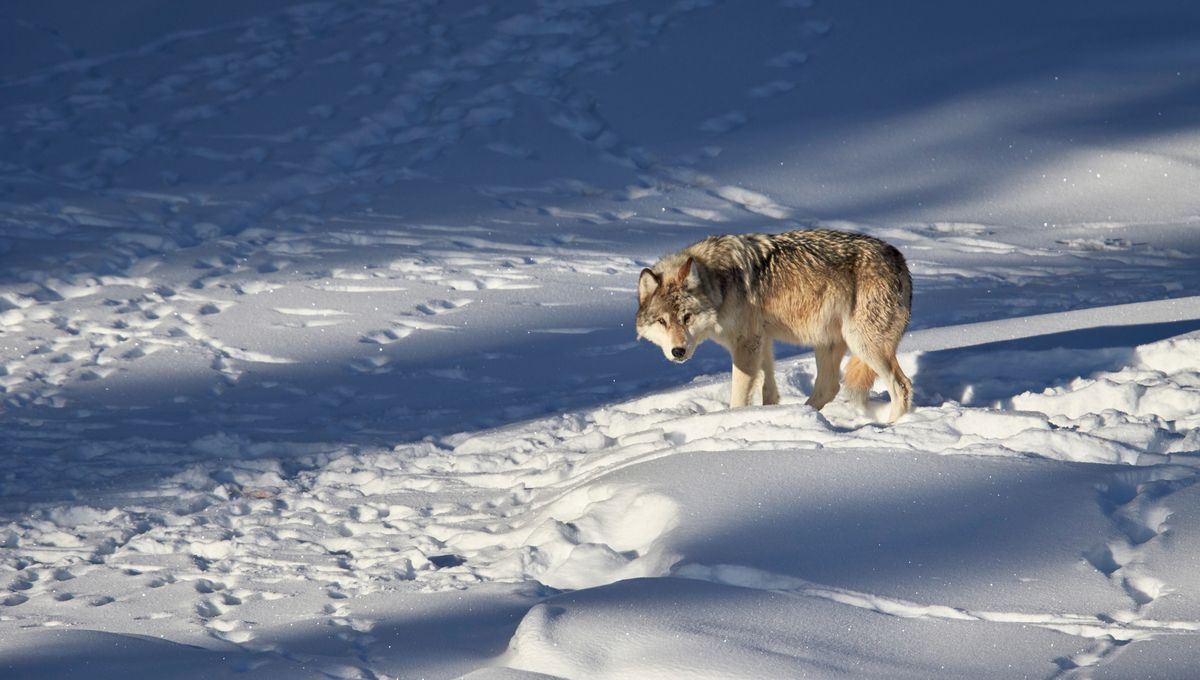
And, at the very apex of the local food chain, there are the wolves.
In a way, they’ve been there for thousands of years, exerting their influence on the local ecosystem as the resident keystone species. But in another, more immediate way, they’re total newcomers – and their introduction to the region some 30 years ago kickstarted a cascade of ecological changes.
Or… did it? A small controversy has been brewing lately in the Yellowstone trophic cascade community – so what’s the real story?
Why wolves matter
When American wolves were finally reintroduced into Yellowstone in 1995, it was the end of a roughly 70-year-long absence from their one-time ancestral homeland.
“The wolf [was] one of Yellowstone’s most important predators,” says Yellowstone Forever, the official nonprofit partner of Yellowstone National Park. “[They] roamed the landscape and influenced the ecosystem for thousands of years.”
But by the late 1920s, they were gone. Their loss was totally purposeful – the animals went from being unprotected by hunting laws, to actively targeted by them: starting in 1907, and ramping up in 1914, the US government pursued an official policy of hunting wolves and any other animals it considered “detrimental to the use of [National] parks, monuments and reservations” by humans.
The reintroduction of wolves in the mid-1990s […] allowed scientists to observe how the ecosystem responds when a key predator is restored.
Professor Bill Ripple
The results of this loss, however, were profound. “When wolves were removed early in the last century, the system shifted in major ways,” says Bill Ripple, a professor of ecology at Oregon State University in the Department of Forest Ecosystems and Society and lead author of a recent paper on the effects of the species’ reintroduction to the park.
“For example, elk began to increasingly browse deciduous plants, preventing the normal growth of young aspen, willows, cottonwoods, and others,” he tells IFLScience.
Evidently, the importance of wolves in an ecosystem cannot be overstated. “As a keystone species and apex predator, wolves apply top-down pressure to the ecosystems they inhabit,” explains Pacific Wild, an environmental group based in the Canadian West Coast. “[They] initiat[e] interactions that can control entire ecosystems.”
This top-down effect is technically known as a trophic cascade – a “domino effect throughout the ecological community,” as Pacific Wild puts it. As wolves hunt animals in the rung of the food chain below them, so the organisms on the rung below the prey have some breathing room.
In short, Ripple explains, “wolves […] help restore the natural structure of Yellowstone’s large predator community.”
The Yellowstone story
As evidence of the wolves’ outsized influence on their ecosystem, Yellowstone is exemplary.
“The reintroduction of wolves in the mid-1990s, which completed the park’s large carnivore guild, allowed scientists to observe how the ecosystem responds when a key predator is restored,” Ripple tells IFLScience. “One of the clearest effects has been major changes in woody plant growth in many areas of the northern range. Willows and aspens, which had been suppressed for decades, have shown substantial growth since wolves came back.”
The effects are clear to see qualitatively. Elk numbers are down from their historic highs, back to more manageable levels for the ecosystem; as a knock-on effect, vegetation that had been hugely repressed before suddenly began to thrive again. And while Ripple is careful to point out that other animals have had some impact here – “recovering cougar numbers and early winter elk hunting north of the park may also be contributing factors,” he tells IFLScience – generally, “many locations have seen strong vegetation gains that line up with the timeline of wolf restoration,” he says. “The wolf reintroduction was critical.”
But it was with the publication of the paper this April that the sheer magnitude of this trophic cascade was finally made clear. Using data from between 2001 and 2020, Ripple and his colleagues concluded that the volume of willows in the park had undergone a massive 16-fold increase, outpacing 98 percent of those reported in a meta-analysis of more than 100 trophic cascades globally.
“We used crown volume as a three-dimensional measure of plant recovery,” Ripple explains. “It is a good way to capture their size and growth in a meaningful ecological way. The results show strong increases in willow structure across much of the northern range since wolves returned.”
The evidence, it seemed, was conclusive. Until it wasn’t.
The controversy
It was only a couple of months later that a rebuttal was sent to the same journal for publication. Even its title pulled no punches: Flawed analysis invalidates claim of a strong Yellowstone trophic cascade after wolf reintroduction: A comment on Ripple et al. (2025).
The problems, the authors argued, were numerous: Ripple and his colleagues had committed “fundamental methodological flaws.”
Put in simple terms, the arguments were the following: first, that the conclusions had been based on the relationship between willows’ height and volumes, despite volume being calculated using height – a detail that makes the metric tautological and meaningless; second, that Ripple’s team had modeled the plants as being shapes that they simply are not; third, that the Yellowstone data had been inconsistently collected; and fourth, that the trophic cascades considered in the meta-analysis weren’t comparable to the one seen in Yellowstone – “the global meta-analysis [assumes] that plant communities have reached equilibrium by the end of each study,” the authors point out, while “Yellowstone’s willow recovery is ongoing, nonlinear, and shaped by complex biotic interactions”.
Finally, the team took issue with Ripple’s team’s use of photographs in their paper. “Although the authors describe these images as ‘examples only,’ their presentation introduces a risk of visual confirmation bias – the tendency to overgeneralize from visually striking but unrepresentative examples,” they write.
And the smoking gun of it all, they argue, is the very thing that made the original paper so eye-catching in the first place: the sheer strength of the cascade. “Numerous other studies documenting weak and inconsistent indirect effects of large carnivores on deciduous woody plants in northern Yellowstone and elsewhere in the Greater Yellowstone Ecosystem,” the rebuttal points out – and it’s only because of the “methodological shortcomings” of the previous paper that such a “conflict” with other evidence could arise.
It’s a bold claim – a lot of them, in fact. Was that the end of Yellowstone’s trophic cascade miracle?
Well, not if Ripple has anything to say about it.
The re-rebuttal
Science is an ever-evolving process, and it thrives on arguments. Even if the rebuttal paper was unimpeachable, a response would likely be warranted, if only to update the ecological state of play.
But Ripple and his team don’t plan on backing down. “We are aware of [the rebuttal],” he tells IFLScience, “and we have prepared a detailed reply explaining why their criticisms are inaccurate.”
Yellowstone is still adjusting to the return of wolves and the increase in cougars, but there is a lot left to learn about how these systems evolve over decades.
Prof Bill Ripple
The team stands by their original assessment: their results may differ from others’, they argue, but that’s because they’re asking a different question – one that relies specifically on willow volume rather than height. And on that note, the relationship between height and volume that the rebuttal called tautological? That’s actually empirically based, they point out, “derived and verified by field measurements.”
So too were the shapes used to model willow crown volume – actual field measurements seem to overall support the half-ellipsoid shape that Ripple’s team originally used. And while there may be some merit to the data collection quibbles, it’s nothing that couldn’t be leveled at every other analysis of Yellowstone cascades, the team points out.
It’s not to say that there’s zero merit in the objections. “We [do] plan to continue studying long-term ecosystem changes tied to large carnivore restoration,” Ripple tells IFLScience, which “includes better ways to quantify vegetation changes, tracking spatial patterns across the landscape, and examining how rising bison numbers interact with these processes.”
But overall, the arguments in the rebuttal “do not change the basic conclusions of our study,” he says. “The overall picture is that the trophic cascade is strong in many places, while local areas with heavy bison use show weaker responses.”
Whether or not these, well, re-rebuttals prove convincing is yet to be seen – the paper is set to be published as soon as possible, Ripple says, at which point presumably peers will decide on whose side they fall. But either way, one thing is clear: the reintroduction of wolves to Yellowstone is a complex and evolving process – and like their removal so many years ago, it’s one whose repercussions are going to be felt for decades to come.
“Yellowstone is still adjusting to the return of wolves and the increase in cougars,” Ripple says. “But there is a lot left to learn about how these systems evolve over decades.”

Source Link: Yellowstone’s Wolves And The Controversy Racking Ecologists Right Now
