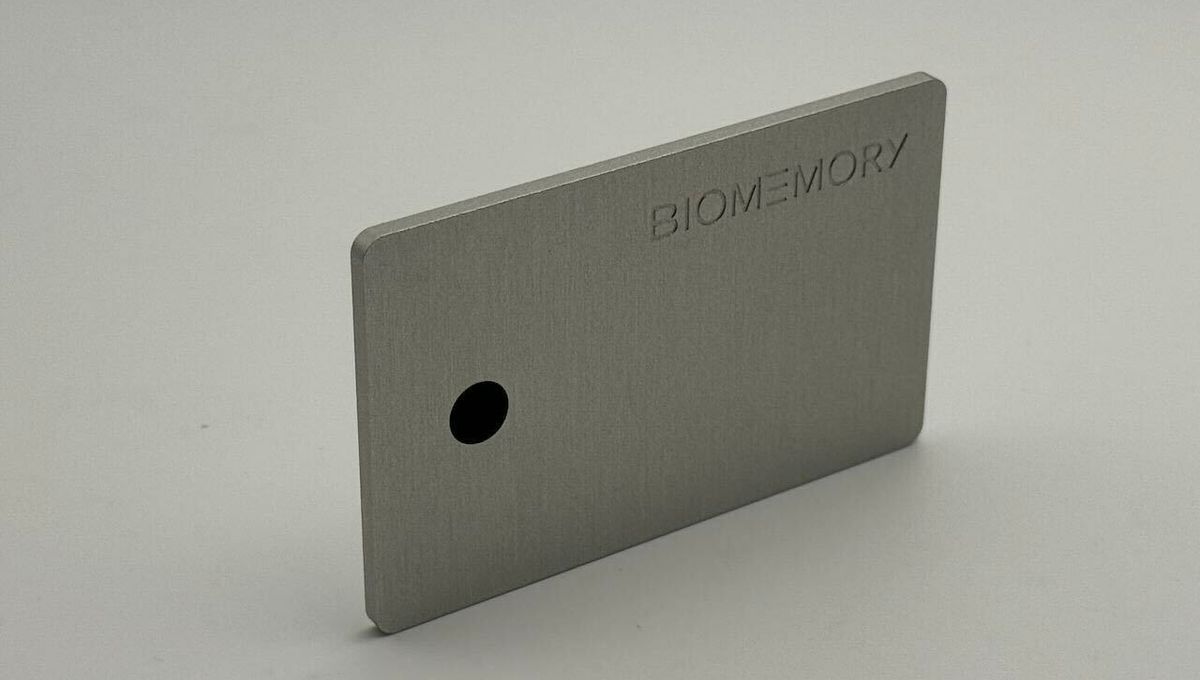
It’ll soon be easier than ever to get your hands on DNA digital data storage – although it won’t come cheaply. French startup Biomemory is selling a credit card-sized device that can store short messages encoded by DNA.
DNA is essentially a natural repository of data, encoding genetic information using four nucleotide bases (A, G, C, and T). This is not dissimilar to the way digital information is stored by binary code through 0s and 1s.
DNA is unbelievably efficient at storing information, capable of storing 215 petabytes (215 million gigabytes) in a single gram. It’s estimated that DNA, in theory, could store the totality of all the world’s data in one room. Alternatively, you could store around 36 million copies of a 720p HD feature-length film within just one gram of DNA.
Building on this idea, scientists have recently been toying around with the idea of using DNA to store information just like you would on a hard drive.
Biomemory is now bringing this technology to the public for the first time. With a price tag of $1,000, their DNA Cards will allow users to store 1024 bytes of text, which is roughly 200 words.
“The launch of our DNA Cards represents a significant milestone in the evolution of data storage technology. After years of talk about the potential of molecular computing, we are incredibly proud to bring the first DNA data storage product to market, that not only pushes the boundaries of innovation but also aligns with our commitment to environmental sustainability and efficiency,” Erfane Arwani, CEO of Biomemory, said in a statement.
So, for instance, the word “hello” could be encoded onto the card by creating a unique strand of DNA using the bases “AGTCTCACAGTCAGAGAGTCTGACAGTCTGACAGTCTGTG”, according to a “DNA Translate” feature on Biomemory’s website. Once this data is encoded, you’ll be sent two cards containing the DNA.
To retrieve the data, you’ll have to send one of the cards to Eurofins Genomics, a German-based biotech company that offers DNA sequencing services. You won’t be able to retrieve the card after the data has been decoded, hence why you receive two cards. The lab will then be able to tell you the message encoded onto the card.
For now, this product is basically a proof-of-concept, rather than a viable alternative to memory sticks.
Given the enormous potential, there’s still a long way to go before DNA digital data storage becomes a practical alternative to conventional means of digital storage. However, that is ultimately the mission of Biomemory, which aims to use DNA-based storage in data centers. Not only could this dramatically reduce the size of data centers, it could potentially make them less energy-intensive, which is good news for the planet.

Source Link: You Can Store Message In DNA With This $1,000 Card
