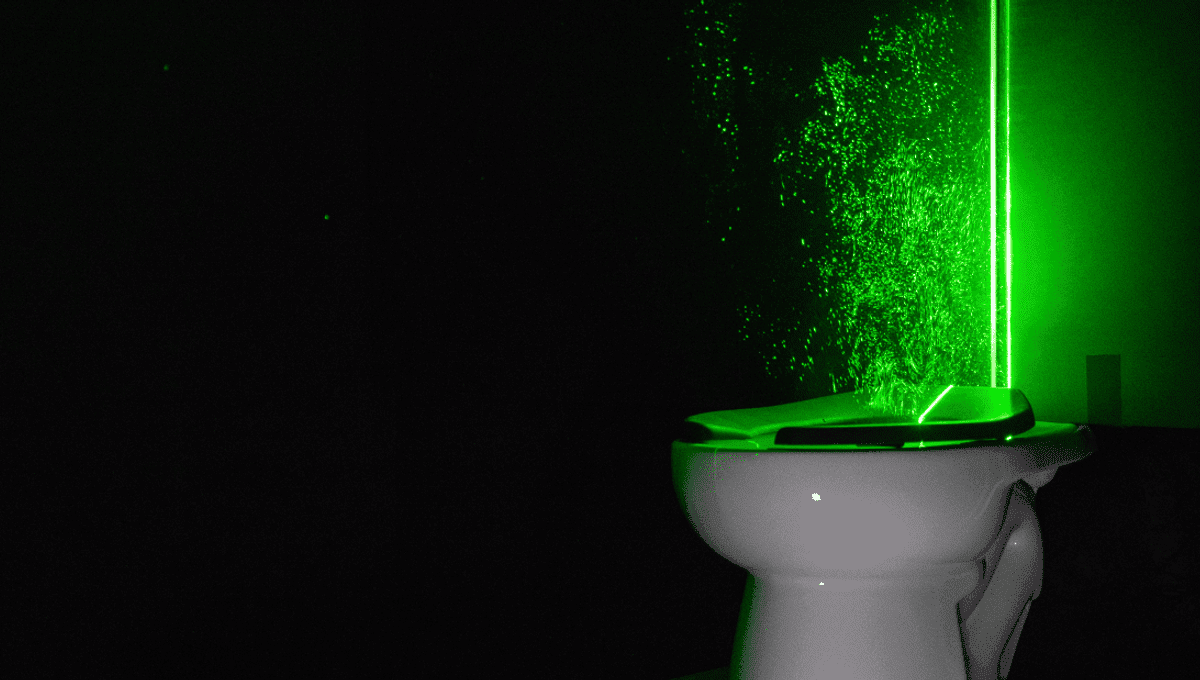
Flushing a toilet is something we do to get rid of waste – but while the basin’s contents go swirling into the sewers, some of the contents actually go up. This is why we have toilet lids (there’s also a reason why we have horseshoe-shaped seats), and if you don’t flip the toilet’s top down, that aerosolized toilet juice can travel far and wide.
We’ve known about the explosive nature of a toilet’s flush for some time. We were reminded of it at the start of the COVID-19 pandemic as a route of pathogen spread. Now, thanks to new research from scientists at the University of Colorado Boulder, we can see the phenomenon in a whole new light – pun intended.
To capture the mini pathogen-laden mushroom clouds emitted by our toilets, they used bright green lasers and camera equipment to capture the movement of tiny water droplets. These drops are so small that we wouldn’t see them while observing a flushing toilet in the light of day – but thanks to the experiment’s techno switch up, you can sit back and enjoy the neon light show.
The droplets observed were clocking in at pretty impressive speeds, traveling 2 meters (6.6 feet) per second, reaching 1.5 meters (4.9 feet) above the toilet within 8 seconds. Heavier drops landed quickly, whereas some of the smallest drops could linger in the air for upwards of several minutes.
This places them at opportune nose height for unsuspecting bathroom goers, demonstrating the dangers posed by aerosolized pathogens compared to those in heavy droplets.
The most minute drops are also more able to invade the nose, as they can slip between the hairs more easily. Cold weather can also play a role here, as we recently discovered the biological mechanism which explains why we’re so much more prone to respiratory illnesses when the weather is cold.
Beyond making Goosebump’s answer to the Magic Fountain of Montjuïc, visualizing the lid-less toilet flush in this way is important for understanding how they have the potential to transport pathogens. By seeing how much of a threat lidless toilets in public bathrooms pose to exposure risk, we can work to find solutions to reduce it.
“If it’s something you can’t see, it’s easy to pretend it doesn’t exist. But once you see these videos, you’re never going to think about a toilet flush the same way again,” said John Crimaldi, lead author of the study and professor of civil, environmental, and architectural engineering, in a statement. “By making dramatic visual images of this process, our study can play an important role in public health messaging.”
As well as COVID-19, pathogens including E. coli, C. difficile, norovirus, and adenovirus can all be spewed into the air riding on the back of tiny water droplets. At a time when it feels as though we’re getting new outbreaks every week, finding ways to reduce our risk of exposure when going to the bathroom could help to limit the spread of illness in highly populated areas.
“People have known that toilets emit aerosols, but they haven’t been able to see them,” said Crimaldi. “We show that this thing is a much more energetic and rapidly spreading plume than even the people who knew about this understood.”
Horrifying stuff, but also kind of beautiful.
The study was published in Scientific Reports.

Source Link: You'll Never See A Toilet Flush The Same Again After These Videos
