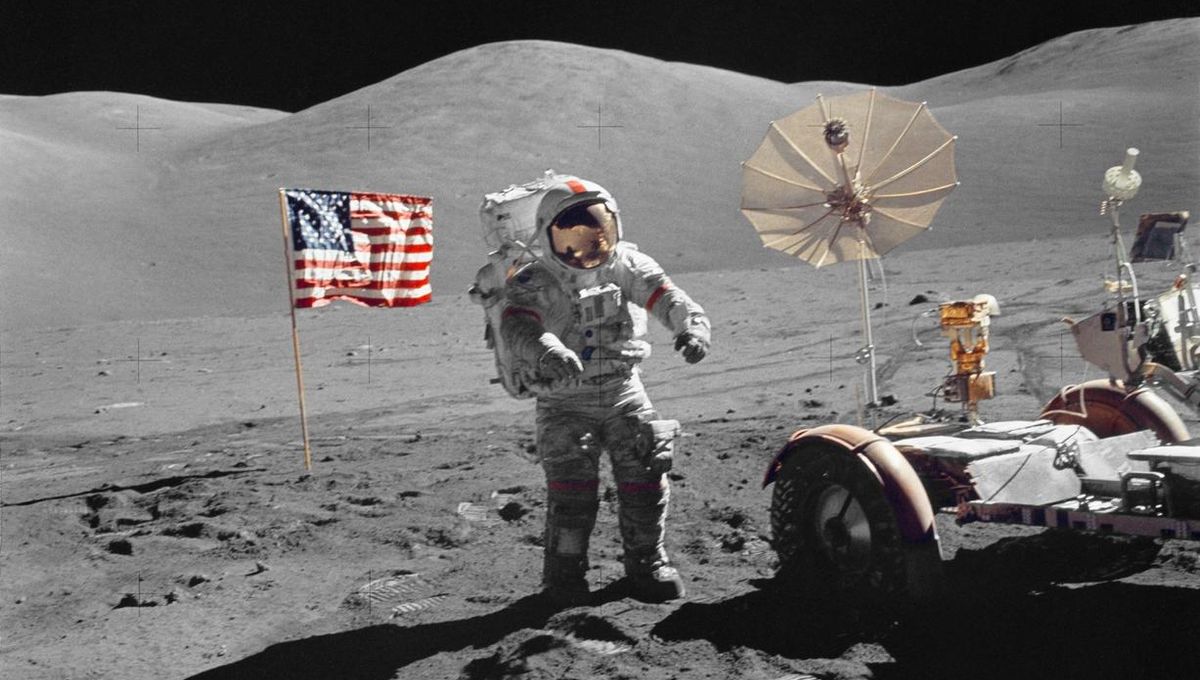
The year 1972 was a long one – and not just for Richard Nixon, whose ill-fated presidency was starting its death spiral amid the Watergate scandal. The Godfather hit cinemas, humans walked on the Moon for the last time in the 20th century, and Bloody Sunday inflamed “The Troubles” in Northern Ireland.
But it wasn’t just the events of 1972 that made it feel lengthy. It was a leap year, so it already had an extra 24 hours compared to most years. On top of that, it also witnessed the addition of two leap seconds: one added on June 30 and another on December 31.
In short, this made it 24 hours and 2 seconds longer than a “typical day”. The year totaled 31,622,402 seconds in length, compared to 31,536,000 seconds in a 365-day year, and 31,622,400 in a conventional leap year.
What Are Leap Seconds?
Leap seconds are added to keep our clocks in sync with the Earth’s slightly wobbly rotation. Today, the world uses atomic clocks to measure the Coordinated Universal Time (UTC). These high-tech timekeeping tools work by monitoring the natural vibrations of atoms, most commonly cesium atoms. Each cesium atom oscillates at exactly 9,192,631,770 times per second. By counting these oscillations, atomic clocks can measure time so precisely that they would only drift by about one second over millions of years.
However, these ultra-accurate clocks don’t perfectly align with the position of the Sun in the sky since the Earth doesn’t spin perfectly evenly from day to day. As such, every now and then, we need a tiny extra second to make sure our time matches up with the sky.
While variations of a millisecond might sound trivial, they are incredibly important to technologies that rely on ultra-precise timekeeping, such as GPS navigation, telecommunications, financial transactions, and certain scientific experiments.
To account for this potentially troublesome discrepancy, the first leap second was introduced in June 1972 under an international agreement involving the US National Bureau of Standards laboratory in Boulder, Colorado. To catch up for lost time, they finished the year by adding yet another leap second at the end of December.
Since the 1970s, just under 30 leap seconds have been added to UTC to maintain the balance between atomic clocks and the Earth’s spin, although 1972 was the only year to receive two separate leap second additions.
Typically, a leap second is added on either June 30 or December 31. In 1972, they added it on both because the Earth’s rotation had drifted unusually far out of sync with atomic time as a result of decades of drift and deferred maintenance.
The year 1972 might stay the “longest day” record holder for some time. Earth’s rotation has actually sped up its pace in recent years, resulting in slightly shorter days. As a result, a “negative leap second” might be needed to bring UTC back into alignment with astronomical time. In other words, timekeepers will subtract a single leap second to make sure the atomic clocks are in tune with the astronomical movement of our Solar System.
46 BCE Was Another Really, Really Long Year
With all this said, it depends on how you decide what a year actually is. Is it a measurement tied to a universal movement or something much more human?
If you take the latter view, then the title of “longest year” might belong not to 1972, but to 46 BCE — the so-called “year of confusion” — when Julius Caesar, advised by his astronomers, added an extraordinary 445 days to realign the Roman calendar with the solar year.

Source Link: 1972 Was The Longest Year In Modern History – Here's Why
