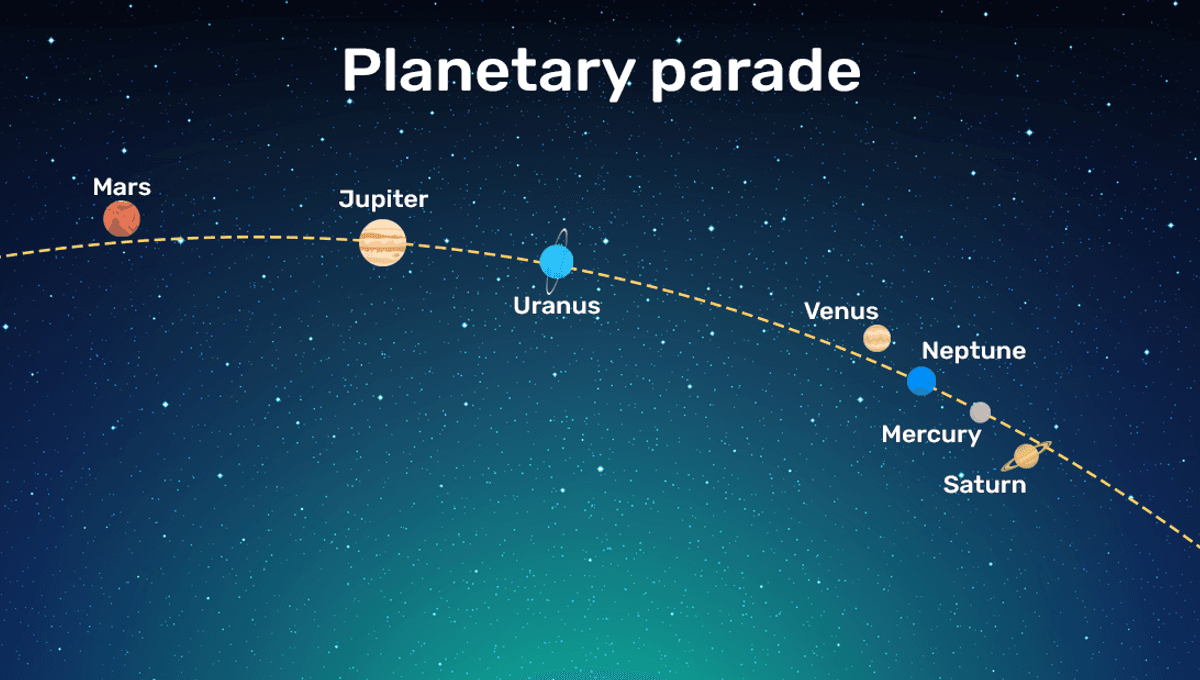
For months now, we have been teased by the planets in the night sky. Uranus and Neptune need a telescope to be seen, but Mars, Saturn, Jupiter, and Venus can be seen with the naked eye. All of these six have been out in the night sky, and last week they were finally joined by the last visible planet: Mercury.
ADVERTISEMENT
With patience, clear skies, and a little telescope you can see all seven planets in the sky. If you don’t have a telescope, you can still see the other five. And even if you lack clear skies, you’ll still get to see Venus, Jupiter, and Mars at the very least.
The crucial trick is to start right after sunset. The best option is to find Venus, as it is relatively far from the Sun and very bright. Trace an imaginary line between the planet and where the Sun disappeared and you should find two bright spots close to the horizon, which will be Saturn followed by Mercury slightly higher. Neptune is also around there, so use your telescope in that location. The proximity to the horizon makes it difficult to see them clearly due to hazes and low clouds in many locations.
Next is Uranus, but to find it, let’s find Jupiter first. Remember that planets do not twinkle, so even if you live in a place with less light pollution, Jupiter should be easy to spot. Stars twinkle because the atmosphere bends their light as they are – for all intents and purposes – point sources. Planets might seem like point sources but they are little disks, and the light from a disk is not so easily bent by the atmosphere.
Jupiter will be high in the sky. Trace a line between Jupiter and Venus, and Uranus will be one-third of the way between the two, towards Jupiter. Finally, Mars is to the east, and you should be able to find it thanks to its characteristic red color (which is due to rust, but not as we originally thought).
There is no specific date; any night is good to see the planets, but this is the last week before Saturn dips below the horizon.
Planets orbit roughly on the same plane, the ecliptic, and as they and the Earth go around the Sun, their apparent position in the sky changes. It is not unusual to see a few of them aligned before dawn or after sunset, but getting all of them on one apparent side of the Sun doesn’t happen every day. In roughly three years, you can have six of them, missing Jupiter.
ADVERTISEMENT
The next planetary parade like this is going to be in early 2034. Venus and Mercury will be quite close to the Sun, followed by Jupiter, Mars, and Neptune being close together, and then Uranus and Saturn. A lot of places are reporting 2040 as the date of the next seven-planet parade, which is not correct, although the one in August/September of that year will be spectacular as all the five visible planets will be out there very close to each other.

Source Link: All The Planets Are Parading In The Night Sky – Catch Them Now Or Wait Until 2034
