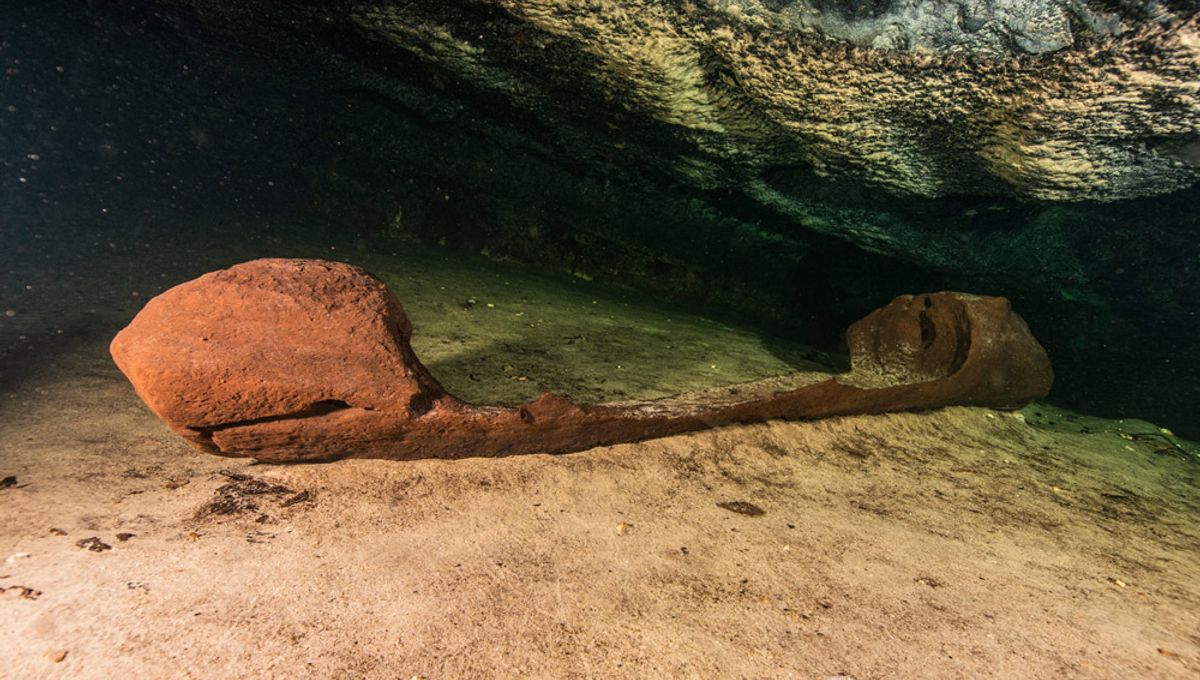
What do a sunken canoe and armadillo remains have to do with the underworld? Well, a recent discovery by archaeologists in Mexico’s Yucatán Peninsula may mark a site that the Maya believed led to the otherworldly realm.
In 2021, a team of underwater archaeologists with the Mexican National Institute of Anthropology and History (INAH) found a submerged canoe in a cenote – a natural sinkhole – while carrying out research ahead of planned construction work.
The canoe was surrounded by human and animal bones and was located around 4.6 meters (15 feet) underwater. According to a statement from INAH, the team discovered around 38 skeletal remains, which included human metatarsals (bones in the feet) that probably belonged to a woman, as well as the remains of dogs, turkeys, eagles, and, importantly, armadillos.
The presence of these shelled mammals’ bones, in conjunction with the human remains, has led the archaeologists to assume that the canoe was likely used for ritualistic purposes and was probably placed in the cave before it flooded.
According to Maya belief, flooded and semi-flooded caves and cenotes were thought to be portals to the underworld. In addition, armadillos were regarded as an avatar to the Maya chthonic god, known as God L, who was represented as a jaguar wearing a cape that mimicked the armadillo’s shell.
The archaeologists believe that the armadillo’s ability to swim and hold its breath underwater could be an “allusion to the entry of [the animal] into the underworld.”
There are known images in Maya ceramics of armadillos appearing as a “stool of the gods”, with deities placing their feet on them, Alexandra Biar, an archaeologist from the French National Center for Scientific Research (CNRS), said in the statement. This, Biar added, would be linked directly to the archaeological evidence in the cenote, where the armadillos may have been seen as a manifestation of the divine.
For Biar and colleagues, the morphology of the canoe itself adds to the idea that this was all part of a ritual. They believe that the prow is too heavy and stern to have been used to navigate swift currents, which would have made it useless on the sea.
According to Reuters, at the time of its discovery, the vessel was “tentatively dated” between 830-950 CE, which was around the end of the Maya civilization’s classical zenith. This was a point in history where Maya cities, like Chichén Itzá (which was located near to where the canoe was found) thrived. However, further carbon dating has shown that the sunken boat was likely built in the 16th century.
If this is correct, then it would represent a continuity of Maya ritual practices associated with bodies of water in cenotes (and armadillos) during the time of contact with the Spanish.
But these conclusions are offered with caution. According to the archaeologists, microplastics were found in the tested samples, which may have affected the dating. As such, new dives are being planned to take additional samples of wood and bone from the submerged site.

Source Link: Ancient Maya Canoe Found In Mexican Cave Could Mark Portal To The Underworld
