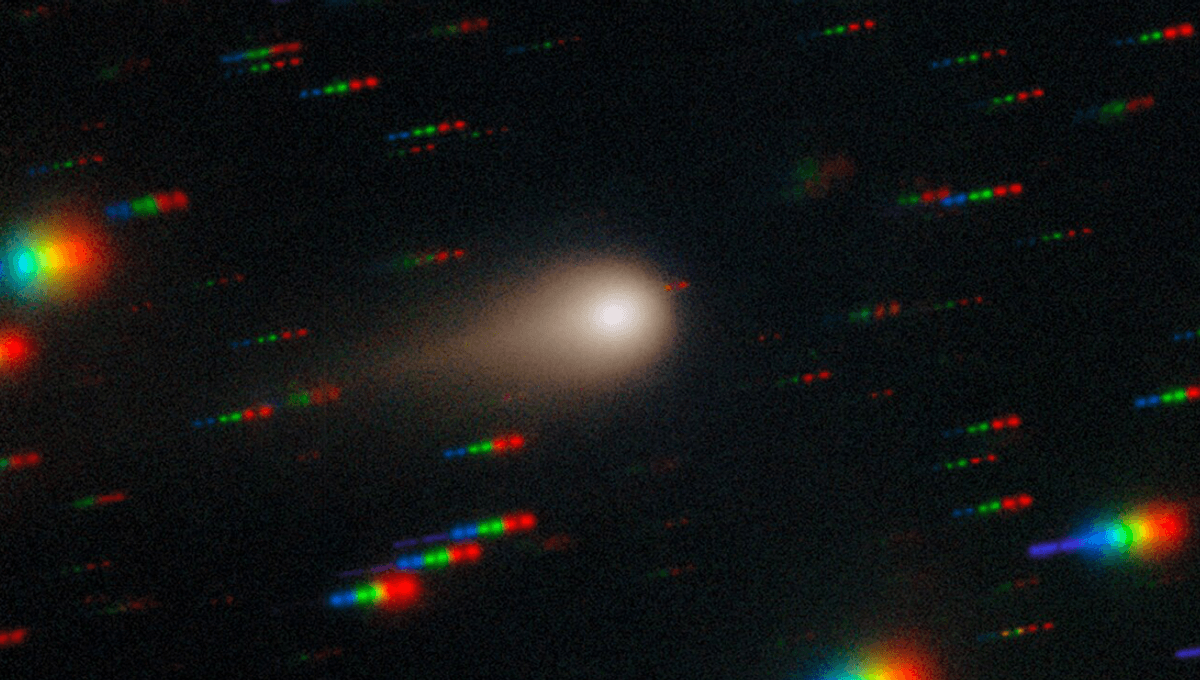
Astronomers analyzing observations of interstellar comet 3I/ATLAS using the W. M. Keck Observatory have discovered further unusual features of our third interstellar visitor, and confirmed the presence of a rare “anti-solar tail”.
On July 1, 2025, astronomers at the Asteroid Terrestrial-impact Last Alert System (ATLAS) spotted an object making its way through our Solar System. That’s no surprise, given the name. What was unusual, and highly interesting, was that the object appeared to be the fastest object of this type ever observed, and had an eccentricity of between 6.1 and 6.2.
An eccentricity greater than 1 means it is an interstellar visitor, the third we have found so far, and will leave our Solar System once more. It was named 3I/ATLAS to reflect that it is the third interstellar object discovered, as well as the team that found it in our skies.
3I/ATLAS has been subject to (dubious) speculation that it is not a natural object. Astronomers have since been tracking the object, which was confirmed to be a comet due to its outgassing. Though there is little reason to suspect 3I/ATLAS is anything other than a natural object, it is of high interest to scientists and the public alike, having traveled alone through interstellar space for possibly 10 billion years.
In a new paper, which has not yet been peer reviewed, an international team of researchers analyzed the spectra of the comet, used to determine the elements present on the object and in its coma, as it was viewed by the Keck-II-mounted Keck Cosmic Web Imager on August 24.
“One avenue to understanding these objects is from cometary activity or lack thereof,” the team explains in their paper, adding that the activity is caused by solar radiation heating the surface materials of the comet.
“When a comet warms, its volatile ices sublimate, lifting dust off the surface and creating the coma. Sunlight excites these gas molecules, which then re-emit light by resonance fluorescence – revealing the composition of the volatiles. For Solar System comets, this provides a window into the primordial composition of the Solar System. Interstellar objects enable similar studies for otherwise inaccessible stellar systems.”
By analyzing the spectra of light reflected off the comet, astronomers can figure out what elements and compounds it contains. We already have a few puzzles presented by 3I/ATLAS in this regard, with a previous paper finding it has an “extreme abundance ratio” of iron/nickel.
“Emission lines of FeI and NiI are commonly found in the coma of Solar System comets, even at large heliocentric distances. These atoms are most likely released from the surface of the comet’s nucleus or from a short-lived parent,” the previous team explained in their paper. “The presence of these lines in cometary spectra is unexpected because the surface blackbody equilibrium temperature is too low to allow the sublimation of refractory minerals containing these metals.”
While the chemical ratios are unusual, perhaps this is to be expected from an object which may be a 10-billion-year-old time capsule from an earlier age of the universe. The main puzzle is how these metals ended up in the comet’s coma.
“At the distances at which comets are observed, the temperature is far too low to vaporize silicate, sulfide, and metallic grains that contain nickel and iron atoms,” the team added. “Therefore, the presence of nickel and iron atoms in cometary coma is extremely puzzling.”
The new paper reports the clear detection of nickel (Ni) and cyanide (CN), as reported by previous observations, and weak/no detection of the presence of iron (Fe). In this work, the team was able to get a better spatial profile of the comet and its coma, mapping where the elements are originating.
“The Ni is more centrally concentrated than CN, with the majority of Ni flux coming from the innermost 2,000 km [1,243 miles] of 3I/ATLAS,” the team explains. “On the other hand, the radial profiles suggest that CN, though still concentrated near the nucleus, extends farther out into the coma.”
The team suggests that nickel, which spreads out to around 594 kilometers (369 miles) and far less than cyanide at 841 kilometers (523 miles), may be released by an intermediate “parent” molecule which is quickly broken apart by solar radiation.
“Metals such as Ni may attach to PAHs to form Ni+PAH molecules (e.g., Ni-naphthalene Ni(C10H8) potentially). These molecules are easily unbound by absorbing light and may produce centrally concentrated Ni, as observed in 3I/ATLAS,” the team writes.
As well as this the team found other mysteries, including that the production rate of nickel relative to cyanide is “higher than 2I/Borisov and orders of magnitude above the solar system comet median.”
One particularly interesting aspect of the comet is that it has developed an “anti-tail” or “anti-solar tail”, which is a tail pointed towards the Sun, backed up by the new paper. Previously, sometimes-controversial Harvard astronomer Avi Loeb caused controversy (see) by suggesting in a paper with colleague Eric Keto, “This phenomenon, observed at a distance of 3.8 au from the Sun, is not common and possibly observed for the first time in 3I/ATLAS.” However, before you suggest aliens like Loeb, it is not entirely unheard of.
There are two different types of anti-tail. One is actually an optical illusion, caused by the position of the comet and the Sun relative to Earth.
A second type – the one seen in 3I/ATLAS – happens when large grains are ejected from the comet, but do not get pushed away by the solar wind on the comet’s Sun-facing side.
“While such a morphology is certainly unusual – given that dust tails are typically directed antisolar due to radiation pressure acting on dust grains – it is not without precedent among distant active bodies,” a paper on the topic explains. “Notably, Farnham et al. (2021) reported a similar sunward enhancement in comet C/2014 UN271 (Bernardinelli–Bernstein), which they interpreted as the result of the slow ejection of relatively large dust particles predominantly from the sunlit hemisphere.”
As always, more observations of these objects are needed to learn about them, and the environments they evolved in. We will learn more by looking for more interstellar objects, something that will hopefully become easier when the Vera C. Rubin Telescope begins searching the skies. When we do find more, we may even be able to catch up with them.
The study, which has not yet been published in a peer-reviewed journal, is posted to preprint server arXiv.

Source Link: "Anti-Tail" And Odd 594-Kilometer Feature Found On Interstellar Object 3I/ATLAS By Keck Observatory
