• Email Us: [email protected]
  • Contact Us: +1 718 874 1545
  • Skip to main content
  • Skip to primary sidebar

Medical Market Report

  • Home
  • All Reports
  • About Us
  • Contact Us

“Ballooning” Spiders Can Get Airborne As Well As Creeping Up Walls

July 26, 2024 by Deborah Bloomfield

Regardless of where you stand on the spider fear scale, there’s no denying that these arachnids exhibit a remarkable array of really cool behaviors. From building their own trapdoors to mimicking flowers, spiders exploit their niches with incredible adaptations. While you might think of these niches as under garden pots and the corners of your house you can’t reach with dusters, spiders have also taken to the skies.

Advertisement

While it might be the eight legs that freak people out the most, ballooning is a somewhat different way of getting about. In the past, the ballooning method was poorly understood, thought to mainly involve the wind – even Charles Darwin himself questioned how so many spiders came to land on the HMS Beagle on a calm day. Eventually, researchers figured out that electric fields are involved. 

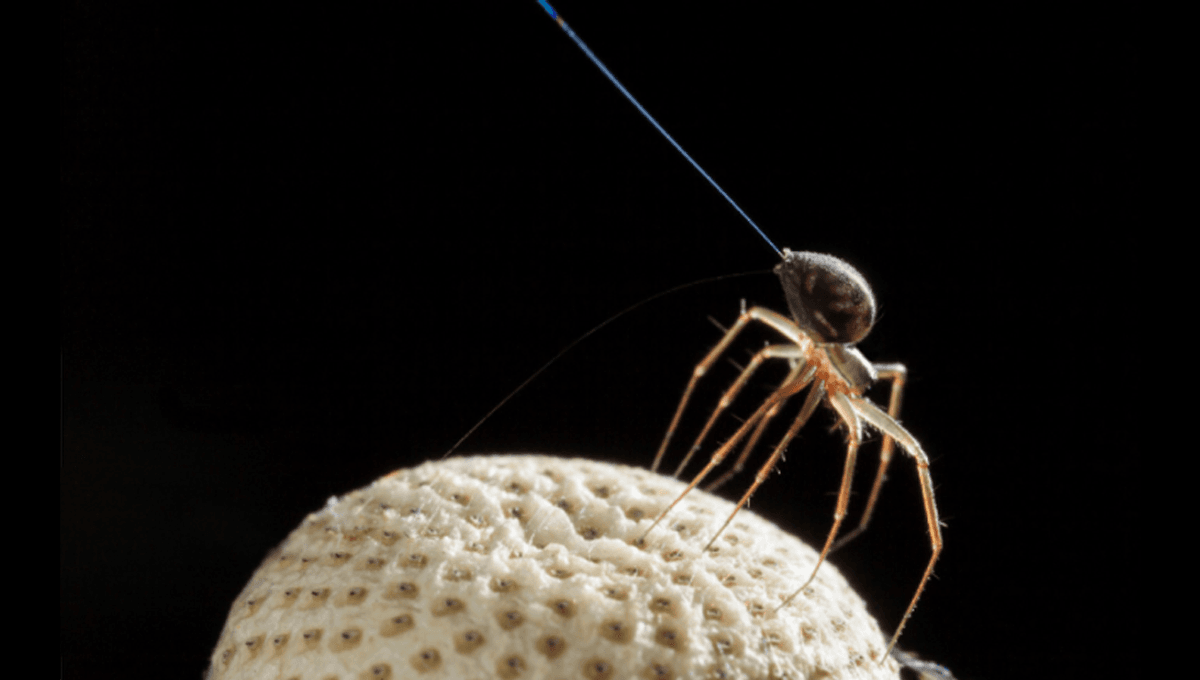
A spider holding onto a thin strand of silk senses electric fields via tiny hairs called trichobothria. When the field is strong enough, they launch themselves into the air. Which begs the question: why?

Ballooning is typically seen in young spiders who need to disperse away from the hatching site to find areas without so many other spiders, such as their parents and siblings, to compete with. Being a spiderling also has the advantage of being more lightweight than a full-grown adult, and thus able to go much further. Some species are even able to disperse hundreds of kilometers using this method. 

Researchers have discovered another behavior known as tiptoeing, where the spider stands on the ends of its legs and holds its abdomen into the air. In an experiment, the team found spiders tip-toed and even managed to take off with no airflow, but lost the ability when the electric fields were turned off.

“Previously, drag forces from wind or thermals were thought responsible for this mode of dispersal, but we show that electric fields, at strengths found in the atmosphere, can trigger ballooning and provide lift in the absence of any air movement. This means that electric fields as well as drag could provide the forces needed for spider ballooning dispersal in nature.” explains lead researcher Dr Erica Morley, an expert in sensory biophysics, in a statement in 2018. 

Advertisement

So don’t worry, spider fearers – if you want to stop them ballooning into you, just find the electrical field off switch. 

Deborah Bloomfield
Deborah Bloomfield

Related posts:

  1. Analysis: Zoom’s abandoned Five9 deal shows hurdles to expansion
  2. What Is The Fastest Solid Object We Know?
  3. Apollo 13: What Actually Happened On NASA’s Near-Disaster Moon Mission
  4. “Unlucky In Love” Flamingo Lays First-Ever Egg At 70 Years Old

Source Link: "Ballooning" Spiders Can Get Airborne As Well As Creeping Up Walls

Filed Under: News

Primary Sidebar

  • US Just Killed NASA’s Mars Sample Return Mission – So What Happens Now?
  • Art Sleuths May Have Recovered Traces Of Da Vinci’s DNA From One Of His Drawings
  • Countries With The Most Narcissists Identified By 45,000-Person Study, And The Results Might Surprise You
  • World’s Oldest Poison Arrows Were Used By Hunters 60,000 Years Ago
  • The Real Reason You Shouldn’t Eat (Most) Raw Cookie Dough
  • Antarctic Scientists Have Just Moved The South Pole – Literally
  • “What We Have Is A Very Good Candidate”: Has The Ancestor Of Homo Sapiens Finally Been Found In Africa?
  • Europe’s Missing Ceratopsian Dinosaurs Have Been Found And They’re Quite Diverse
  • Why Don’t Snorers Wake Themselves Up?
  • Endangered “Northern Native Cat” Captured On Camera For The First Time In 80 Years At Australian Sanctuary
  • Watch 25 Years Of A Supernova Expanding Into Space Squeezed Into This 40-Second NASA Video
  • “Diet Stacking” Trend Could Be Seriously Bad For Your Health
  • Meet The Psychedelic Earth Tiger, A Funky Addition To “10 Species To Watch” In 2026
  • The Weird Mystery Of The “Einstein Desert” In The Hunt For Rogue Planets
  • NASA Astronaut Charles Duke Left A Touching Photograph And Message On The Moon In 1972
  • How Multilingual Are You? This New Language Calculator Lets You Find Out In A Minute
  • Europa’s Seabed Might Be Too Quiet For Life: “The Energy Just Doesn’t Seem To Be There”
  • Amoebae: The Microscopic Health Threat Lurking In Our Water Supplies. Are We Taking Them Seriously?
  • The Last Dogs In Antarctica Were Kicked Out In April 1994 By An International Treaty
  • Interstellar Comet 3I/ATLAS Snapped By NASA’s Europa Mission: “We’re Still Scratching Our Heads About Some Of The Things We’re Seeing”
  • Business
  • Health
  • News
  • Science
  • Technology
  • +1 718 874 1545
  • +91 78878 22626
  • [email protected]
Office Address
Prudour Pvt. Ltd. 420 Lexington Avenue Suite 300 New York City, NY 10170.

Powered by Prudour Network

Copyrights © 2026 · Medical Market Report. All Rights Reserved.

Go to mobile version