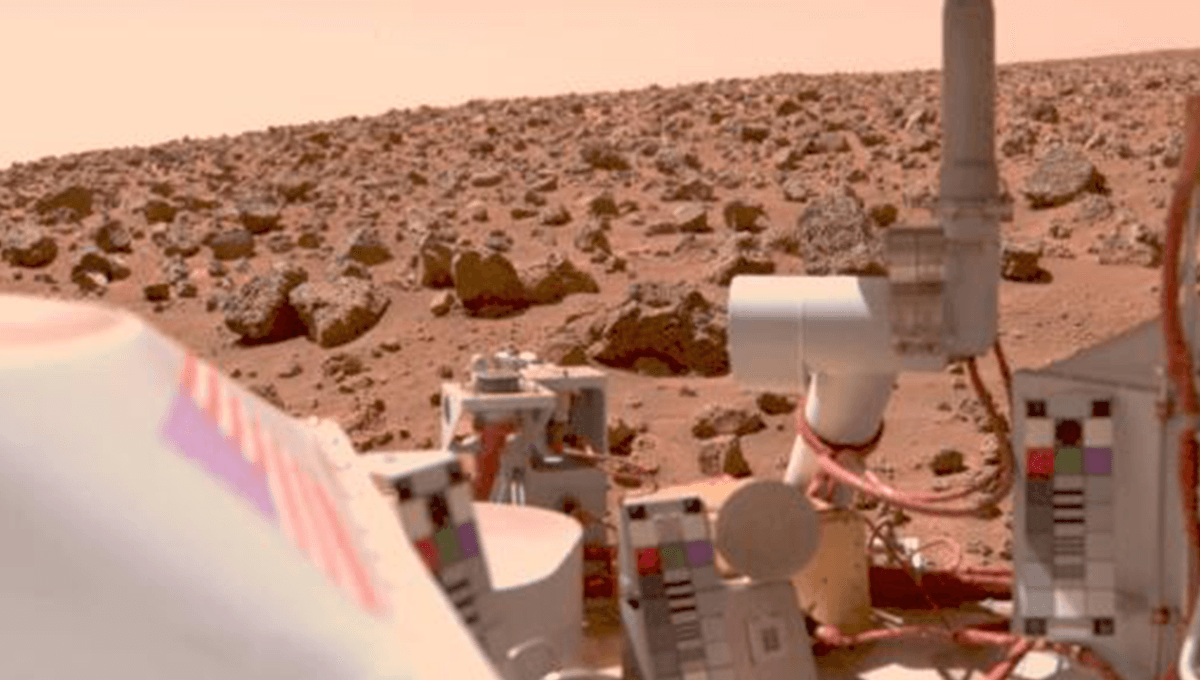
As the search for life on Mars continues – with promising potential biosignatures recently identified by NASA at the Bright Angel formation – there are a few scientists out there who think we may have found life on the Red Planet already. According to four authors of a recent letter to the journal Science, NASA’s Viking lander may have detected signs of extant life on the planet in 1976, and we have incorrectly interpreted the probe’s results.
Long before the first Mars rover, Sojourner, set its robotic wheels on Mars in 1997, two landers touched down. NASA’s Viking Project – the first spacecraft to land on Mars, capturing the first-ever images from the Martian surface – saw the landers conduct biological tests on the Martian soil, specifically to look for signs of life.
The results were fairly unexpected and confusing to scientists. Most of the experiments were not promising, but in one part of the experiment, traces of chlorinated organics were found, though these were believed at the time to be contaminants brought from Earth. In a letter to Science, four scientists are seeking a correction of a “misinterpretation” of the results.
“Even though the very first test at Viking 1’s Chryse landing site had been positive for organic synthesis (with a 99.7% certainty compared to the control sample), follow-on tests provided no clear results,” Professor Dirk Schulze-Makuch of the Center for Astronomy and Astrophysics at Technische Universität Berlin explained in a piece for Big Think. “The gas exchange experiment was just as puzzling: It showed the release of several gases, including oxygen, but scientists today still don’t agree on an explanation.”
These ambiguities in the data were swept aside, according to the authors of the letter, as soon as the team announced that there were no signs of organic compounds on the planet. But according to the team, that was a mistake.
One part of the experiment saw water containing nutrients and radioactive carbon added to Martian soil. If life were present, the idea was that the microorganisms would consume the nutrients and emit the radioactive carbon as a gas.
Thus, by a ‘preponderance of evidence’ standard, Viking had found microbial life on Mars.
“A substantial amount of radioactively labeled CO2 was released from C-labeled nutrients in an experiment designed to seek a Martian analog of respiratory metabolism. A substantial release of dioxygen (O2) and exchange of CO2 was observed when the Martian soil was humidified, in an experiment premised on the view that soil containing active microbes would exchange gases with the atmosphere, agnostic of its metabolic survival strategy,” the team writes in the letter. “Thus, by a ‘preponderance of evidence’ standard, Viking had found microbial life on Mars.”
While the first experiment did find this radioactive gas, later results were mixed. If microbes were present in the soil, giving them more of the radioactive nutrients and incubating them for longer should produce more radioactive gas. But a second and third injection of the mix did not lead to the production of more gas. The initial positive result was put down to perchlorate, a compound used in fireworks and rocket fuel, which could have metabolized the nutrients.
But Schulze-Makuch and colleagues point out that perchlorate has since been found on Mars by the Phoenix lander and determined to be indigenous to Mars.
“With human travel to Mars imminent, it is very important to consider the possibility of indigenous extant Martian life,” the letter concludes, “if only for reasons of planetary protection under the Outer Space Treaty, an astrobiological assessment of life on Mars must be done before a human mission is launched. Before this assessment can begin, the entire trail of mistakes that began with the small mistake in this paper must be constructively corrected.”
If we did find extant – or still surviving – life on Mars, there is the uncomfortable possibility that the Viking lander killed it. In a previous piece published in 2023, again for Big Think, Schulze-Makuch cites examples of life on Earth found in the most extreme environments on Earth, such as the Atacama Desert, living entirely within salt rocks and drawing humidity from the air. Pouring water on these microbes would kill them, perhaps explaining why the further injections of nutrients didn’t result in the detection of radioactive gas. When you’ve just been drowned by an alien robot, you don’t tend to be all that hungry.
“Imagine something similar happened to you [as a human]. For example, if there was an alien in a spaceship coming down to Earth and found you somewhere in the desert. Then they said, ‘OK, look, that’s a human and it needs water,’ and put you directly in the middle of the ocean. You wouldn’t like that, right? Even though that is what we are. We are water-filled bags, but too much water is a bad thing, and I think that’s what happened with the Viking life-detection experiments,” Schulze-Makuch told Space.com in 2024.
Schultz-Makuch had previously suggested that Martian life could have hydrogen peroxide in their cells, which might be another factor in the results of the Viking experiments.
“This adaptation would have the particular advantages in the Martian environment of providing a low freezing point, a source of oxygen and hygroscopicity,” Schultz-Makuch and co-author Joop M. Houtkooper wrote in a 2007 study.
“If we assume that indigenous Martian life might have adapted to its environment by incorporating hydrogen peroxide into its cells, this could explain the Viking results,” Schulze-Makuch wrote for BigThink, adding that the gas chromatograph mass-spectrometer heated up samples before analyzing them.
“If the Martian cells contained hydrogen peroxide, that would have killed them. Moreover, it would have caused the hydrogen peroxide to react with any organic molecules in the vicinity to form large amounts of carbon dioxide — which is exactly what the instrument detected.”
Though it’s a big if, if this were correct, it would mean that we found life on Mars nearly 50 years ago, then killed it, like the bad aliens in alien invasion movies.

Source Link: Did NASA's Viking Mission Find Evidence Of Extant Life On Mars? It's Not As Out There As It Sounds
