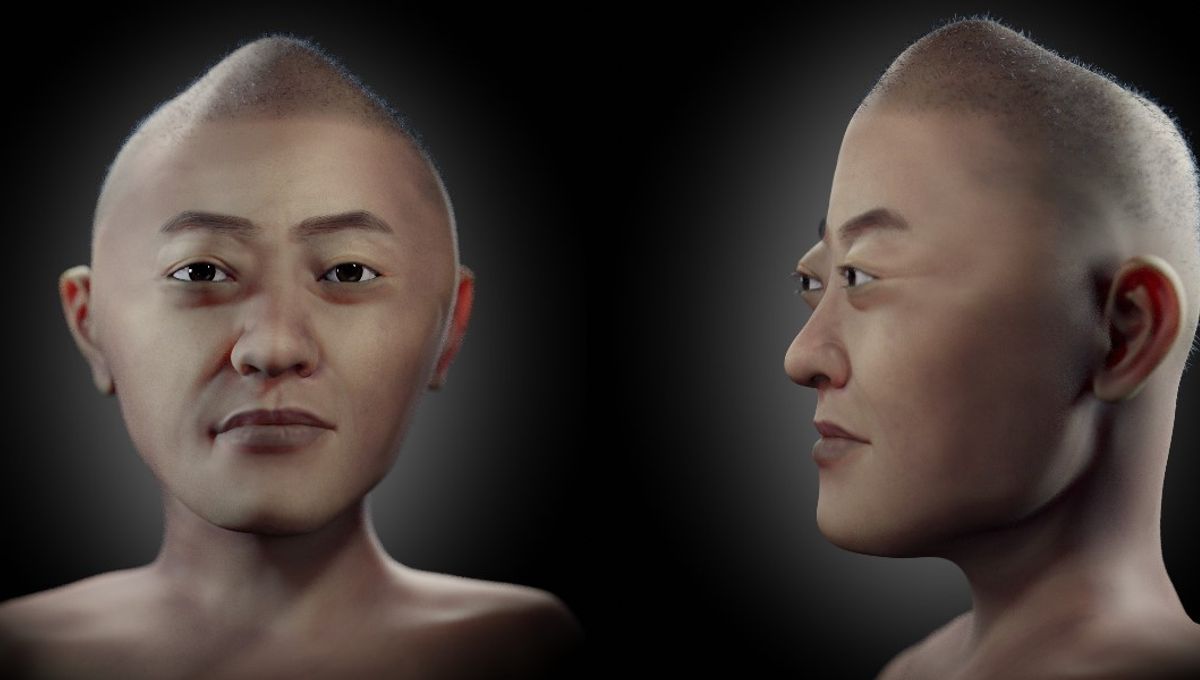
Researchers have reconstructed the face of an unknown pre-Hispanic individual from Bolivia who had a rare congenital defect known as craniosynostosis. Affecting the formation and fusion of cranial bones, the condition causes the skull to become misshapen and often leads to cognitive deficits, impaired vision, and other debilitating symptoms.
The ancient Andean face was recreated by forensic expert and 3D designer Cícero Moraes, who generated a digital model of the skull. Housed at Bolivia’s National Museum of Archaeology, the cranium has not been dated but is believed to have belonged to a member of the pre-Columbian Tiwanaku or Inca cultures.
Located close to the shore of Lake Titicaca, Tiwanaku was a powerful Andean city state that was founded in the second century CE before disappearing about a millennium ago. At its peak, the settlement was home to around 20,000 residents and exerted control over a large stretch of the southern Andes.
The more famous Inca civilization, meanwhile, rose in the 13th century with its capital in what is now the Peruvian city of Cuzco. One of the most iconic ancient empires, the Incan realm was later overthrown by the Spanish conquistadors during the conquest of the Americas.
In a statement emailed to IFLScience, the researchers explain that the skull’s morphology “differs significantly from the average.” With this in mind, the team consulted six different facial deformation surgeons in order to confirm a broad diagnosis of craniosynostosis.
An umbrella term that covers numerous related syndromes, craniosynostosis includes conditions such as Crouzon syndrome, which occurs when the seams of the skull fuse in an abnormal manner and affects one in every 25,000 to 60,000 people. Apert syndrome, meanwhile, occurs in roughly one in every 80,000 to 160,000 births, and results in deformities in the skull, hands and feet.
Yet another variation, known as Pfeiffer syndrome, affects around one in 100,000 people and can cause increased pressure around the brain. However, in the absence of any limbs or other bones, the researchers are unable to confirm which specific syndrome this particular individual had.
The person’s sex was also impossible to ascertain from the cranium alone, although the development of the teeth suggests that the skull’s owner was between the ages of 17 and 21 when they died. The researchers therefore decided to generate a “neutral face”, using “statistical studies based on computed tomography scans” to approximate their subject’s fleshed-out appearance.
However, while Moraes has previously used this method to reconstruct the faces of ancient hominids and other historical figures, this particular project posed a series of unique challenges thanks to the skull’s abnormal morphology. For example, “the structure of the skull meant that the eyes were significantly protruded [a condition known as exophthalmos or proptosis], due to the little space available for storing the eyeball in the orthotic region.”
“The shape of the endocranium region, where the brain is housed, was also significantly different from models within the normal range, resulting in a face with noticeable expansion at the height of the eyes,” say the researchers.
Accounting for all these irregularities, Moraes was eventually able to reveal several of the pre-Columbian individual’s features, including “the small thickness of the oval window of the ear, indicating that the individual could have hearing problems.” The skull’s peculiar, pointed shape may also have restricted the size of the person’s brain, possibly leading to neural deficits.
Fascinatingly, the skull also shows signs of having undergone some sort of surgical procedure, which the patient appears to have “survived for a short time.” More details about this potential operation, as well as the cranium’s other notable features, are due to be revealed in a forthcoming study.

Source Link: Face Of Pre-Columbian Person With Rare Skull Deformity Recreated
