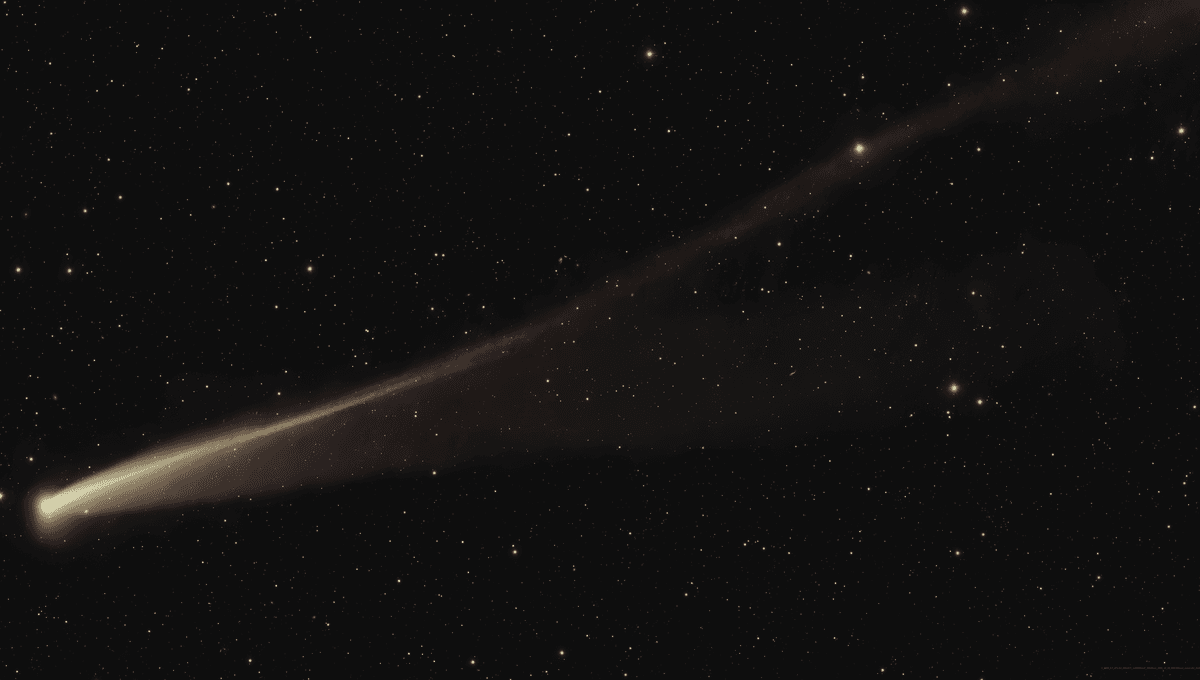
A month ago, we were talking about C/2025 K1 (ATLAS) as one of the three green comets then visible in the sky. It was the dimmest of the trio, so it did not get as much focus as C/2025 A6 Lemmon and C/2025 R2 Swan. It was also expected to be destroyed during its close passage to the Sun, which happened on October 8. So imagine the surprise that it not only survived, but it has also changed color from green to a rare golden hue.
The rest of this article is behind a paywall. Please sign in or subscribe to access the full content.
2025 is such a brilliant year for comets. While we are not getting anything spectacularly bright like the great Hale-Bopp comet of 1997, the handful of comets that have been crossing the sky seem engaged in trying to outdo each other in peculiarities – and astrophotographers are doing a great job snapping their bizarre behaviors.
We have the brightest comet of the year, Comet C/2025 A6 (Lemmon), visible in the West after Sunset. There is our interstellar superstar 3I/ATLAS, the third known interstellar object caught crossing the Solar System. 3I/ATLAS is finally visible again after being behind the Sun, and it is a lot brighter, which means astrophotographers will soon catch it with their telescopes.
Out of left field, though, comes Comet C/2025 K1 (ATLAS), also discovered by the Asteroid Terrestrial-impact Last Alert System (ATLAS). This doesn’t come from another star system but from the Oort cloud, the region at the edge of the Solar System from which many comets originate.
The comet got just 49 million kilometers (31 million miles) from the Sun, and the smart money was on it falling apart. It is very common for these comets to disintegrate as they get close to the relentless light of the Sun. But K1 (ATLAS) lived to fight another day, becoming brighter, reaching magnitude 9. A good pair of binoculars or a small telescope is all you need to see it.
But what is truly stunning about this comet is the color change. In a truly breathtaking photograph taken by astrophotographer Dan Bartlett, the comet shines in a golden hue. The colors of a comet depend on the composition of molecules, as well as its dust output when it comes to the tail. Sunlight reflects on the material of the tail, which makes it shine. They can appear green from diatomic carbon (C2), red, or even blue, which 3I/ATLAS appears to have become, which can come from cyanogen or ammonia.
In Bartlett’s beautiful composition, the fuzzy atmosphere of the comet, the coma, is still shining with its green tinge, but the tail is a golden ribbon being blown by the solar wind. Observations of the comet in August had reported an object that is surprisingly carbon-poor, with only two known comets being similar to this one. It is possible that perihelion led to a more substantial release of dust, and that dust is now catching sunlight in a glittering spectacle.
Comet K1 (ATLAS) will make its closest passage to Earth on November 24, 2025, just 60 million kilometers (37.3 million miles) away. It will be visible for most of the night from the Northern Hemisphere, near Ursa Major.

Source Link: Golden Comet C/2025 K1 (ATLAS) Is A Chemical Rarity – And It Should Have Been Destroyed!
