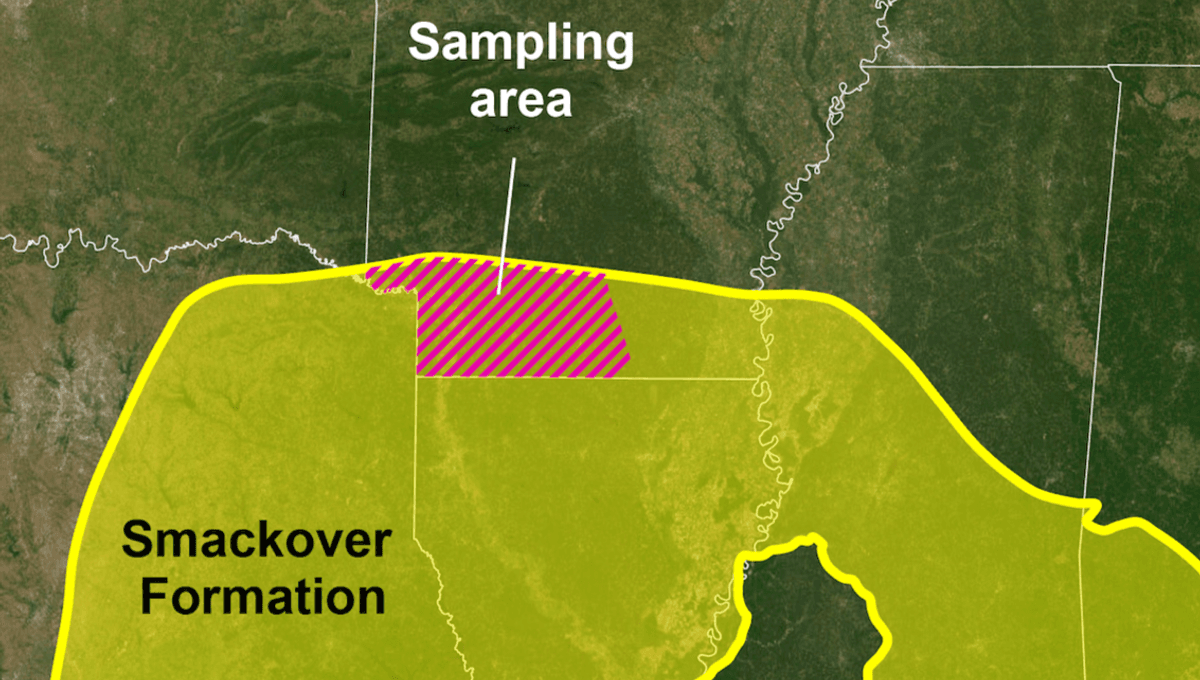
A new USGS survey, made possible through machine learning and environmental testing, has led to the discovery of an estimated 5 to 19 million tons of lithium reserves under southwestern Arkansas. It’s an amount that, if recoverable, would triple the US’s stockpile and make it a global leader in access to the mineral – not to mention giving a huge boost to the future of electric vehicles.
“Our research was able to estimate total lithium present in the southwestern portion of the Smackover in Arkansas for the first time,” said Katherine Knierim, a hydrologist and the study’s principal researcher, in a statement Tuesday. “We estimate there is enough dissolved lithium present in that region to replace U.S. imports of lithium and more.”
Lithium has come a long way since being your great-grammy’s favorite soda flavoring. Today, it’s one of the most important minerals around, forming the basis of the highest-performing rechargeable batteries commercially available.
But as such, global demand for the mineral has shot up in recent years – as has its cost. “the price of lithium carbonate alone increased tenfold between late 2020 and 2022,” pointed out Robert House, a Senior Research Fellow in the Department of Materials at the University of Oxford, in an article for The Conversation last year.
‘With over 84% of known lithium deposits concentrated in Argentina, Australia, Chile and China, securing the raw materials for lithium-ion batteries can be difficult and expensive for manufacturers,” House, who was not involved in the new study, explained.
Should the lithium reserves in Smackover prove recoverable, however, the US alone would be able to meet, at a minimum, the projected 2030 world demand for lithium in car batteries nine times over, according to the USGS.
“Lithium is a critical mineral for the energy transition,” said USGS Director David Applegate, “and the potential for increased U.S. production to replace imports has implications for employment, manufacturing and supply-chain resilience.”
It’s not the first time the Smackover Formation has proven valuable. A vast and ancient geological formation left over from a Jurassic-era sea, Smackover has long been known for its rich deposits of oil and bromine – but in recent years, its potential as a source of lithium has become both more evident and more enticing.
Technically, the lithium isn’t there in a raw state – rather, it’s dissolved within brines. These are highly salty waters associated with deep salt deposits underground, and while it’s totally possible to extract lithium from it – in fact, two-thirds of the world’s lithium production comes from brine extraction – doing so is not without ecological and environmental concerns.
Moreover, the estimates of lithium reserves in the area are just that – estimates. The survey was undertaken using machine learning: samples of brines from the Smackover Formation in southern Arkansas were analyzed by the USGS Brine Research Instrumentation and Experimental lab, the USGS explains, and then compared with data from historical records. This information was then fed into the machine learning model to predict lithium concentrations in the region.
Overall, then, “it is important to caution that these estimates are an in-place assessment,” Knierim warned. “We have not estimated what is technically recoverable based on newer methods to extract lithium from brines.”
Nevertheless, the potential for a huge untapped resource that could help reduce the cost of switching a more environmentally conscious market? That has to be a win.
“This study illustrates the value of science in addressing economically important issues,” Applegate said.
The study is published in the journal Science Advances.

Source Link: Huge Lithium Reservoir Found Under Arkansas Spells Hope For Renewable Future
