A team studying the spectra of interstellar comet 3I/ATLAS has found evidence of “galactic cosmic ray processing”. While interesting and certainly worth knowing, it really isn’t the best news that astronomers have ever received. It may be very disappointing indeed.
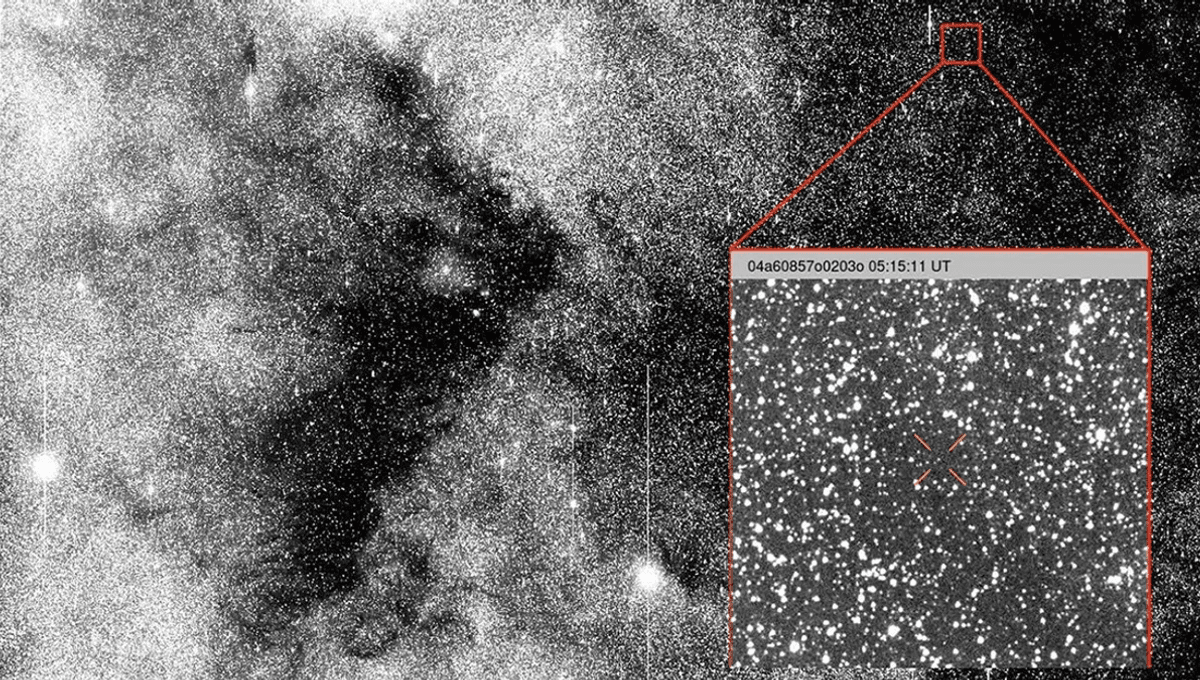
In case you’re just catching up, on July 1, 2025, astronomers at the Asteroid Terrestrial-impact Last Alert System (ATLAS) spotted a fairly large object shooting through our Solar System on an escape trajectory. As the world’s telescopes quickly turned towards it, it was established to be an interstellar object, our third confirmed interstellar visitor after 1I/ʻOumuamua and 2I/Borisov.
Observations of 3I/ATLAS soon showed that it was a comet, with a distinct coma formed of ice and dust. There have been plenty of puzzling aspects to the object, from its development of a rare “anti-tail” to its unusual chemical makeup. But we should not be too surprised to be surprised, given that this is only our third interstellar visitor, and may be a 10-billion-year-old time capsule from an earlier age of the universe. Studying it could tell us about the environment it came from, which may be very different from our own part of the galaxy.
Though the comet is unusual, we should stress that it remains a comet and not an alien mothership.
“It looks like a comet. It does comet things. It very, very strongly resembles, in just about every way, the comets that we know,” as Tom Statler, NASA’s lead scientist for Solar System small bodies, explained to The Guardian. “It has some interesting properties that are a little bit different from our solar system comets, but it behaves like a comet. And so the evidence is overwhelmingly pointing to this object being a natural body. It’s a comet.”
Now that the silly stuff is out of the way, on to the science. In a new paper examining the spectra of the comet, which has not yet been peer reviewed, a team of astronomers from Belgium and the USA took a close look at the object’s chemical makeup. One particular puzzle, revealed by the JWST and Spectro-Photometer for the History of the Universe, Epoch of Reionization, and Ices Explorer (SPHEREx), is the odd ratio of carbon dioxide to water observed in the comet’s coma.
“The ratio measured for the amount of CO2 gas relative to H2O is among the highest ever observed in a solar system comet, demonstrating that the coma of 3I/ATLAS is very CO2-rich,” NASA explained, prior to the new paper. “This may indicate that 3I/ATLAS was exposed to higher levels of radiation than comets from inside the solar system or that it formed in a region of its original planetary disk where CO2 ice naturally freezes out from the gas.”
Any explanation for the comet’s makeup would have to explain these odd ratios, and why they were observed when the object was so far from the radiation of our Sun.
“JWST/NIRSpec measurements show CO2/H2O = 7.6 ± 0.3, placing 3I/ATLAS 4.5σ above solar system trends at the observed heliocentric distance,” the team explains in their paper. “Any viable explanation must therefore elevate the near-surface CO2/H2O ratio substantially.”
The team evaluated several hypotheses that could potentially explain these ratios. For example, the physical conditions within protoplanetary disks where the object originated could possibly alter carbon monoxide and carbon dioxide abundances, or destruction of CO in protoplanetary disk midplanes, which could lead to increased CO2 abundances.
Unfortunately, they found these to be a worse fit for the observations than galactic cosmic ray (GCR) processing. In this scenario, galactic cosmic rays convert carbon monoxide into carbon dioxide, creating an organic-rich, irradiated crust on the comet’s nucleus over around a billion years. If this is correct, it is not great news for humanity’s chance to learn about the environments of other star systems.
“Laboratory experiments demonstrate that GCR irradiation efficiently converts CO to CO2 while synthesizing organic-rich crusts, suggesting that the outer layers of 3I/ATLAS consist of irradiated material which properties are consistent with the observed composition of 3I/ATLAS coma and with its observed spectral reddening. Estimates of the erosion rate of 3I/ATLAS indicate that current outgassing samples the GCR-processed zone only (depth ∼15–20 m), never reaching pristine interior material,” the team explains in their paper.
“Rather than being pristine messengers from distant planetary systems, interstellar objects may instead carry signatures of processed material shaped by Gyr-scale cosmic-ray exposure both in the distant reservoirs of their parent stellar systems, prior to ejection, and during their interstellar transit to the solar system.”
This makes studying the environments of other star systems more difficult. Though it is more complicated than this, essentially, it looked like we had been sent a piece of pristine material from another star system, but instead, we’ve found its outer layers have been altered by its journey, and now conceal the pristine material underneath.
Though that isn’t exactly what we’d like, it might be what has occurred, making studying other star systems more complicated than it already is. Instead, the spectra may tell us a lot more about the journey the comet took to get here.
“The substantial CO levels indicate ongoing chemical evolution, not pristine composition,” the team writes. “This study suggests that 3I/ATLAS is better understood as a natural laboratory for cosmic-ray processing than as a direct messenger from a distant protoplanetary disk.”
That may be disappointing, but more observations are needed to confirm whether this is the case, as well as a peer review of the paper. On top of this, the team suggests that pristine material could still be outgassed as the object reaches perihelion, the closest approach to the Sun, “though it is considered unlikely”.
Further observations will be necessary to gather further evidence for or against this idea. Fortunately, many of the world’s telescopes are currently pointing at it, amateur and professional alike. Hopefully we will soon have more answers about our new interstellar visitor.
The study is posted to preprint server arXiv.

Source Link: Interstellar Object 3I/ATLAS Shows Evidence Of "Galactic Cosmic Ray" Processing. That's Not Great News
