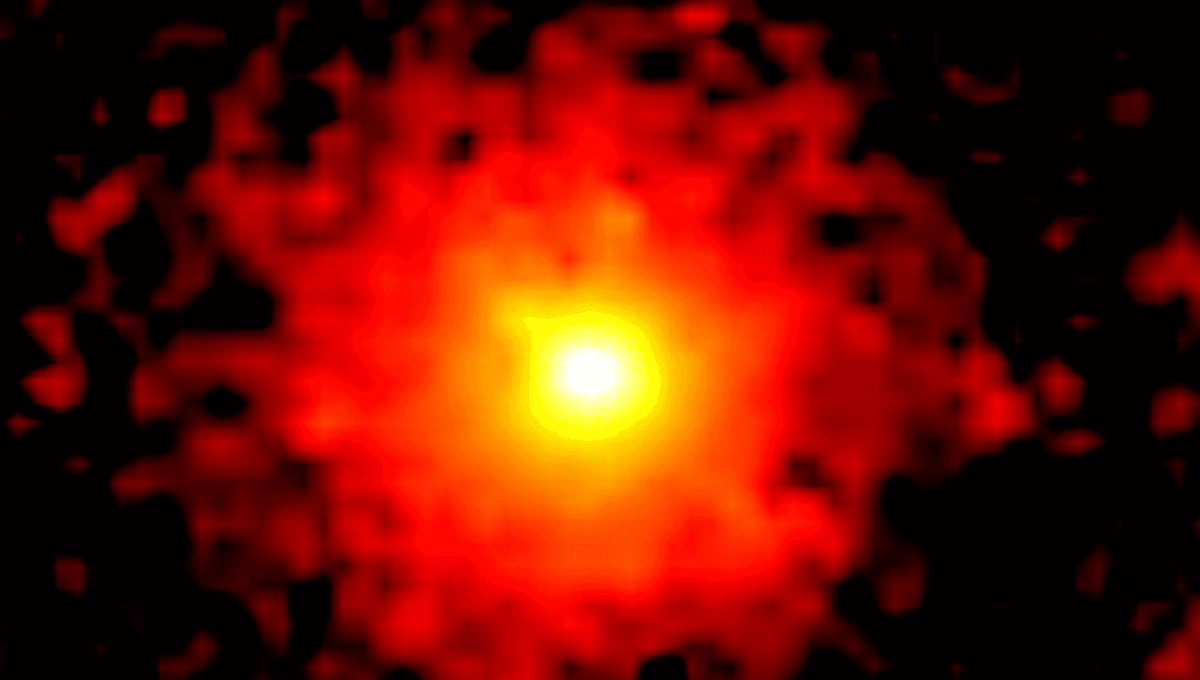
Astronomers have attempted to explain the non-gravitational acceleration of comet 3I/ATLAS, our third confirmed interstellar visitor, in a way that removes the need for “non-natural hypotheses for 3I/ATLAS”.
You probably are aware of our celestial visitor by now, but for those who are just joining the story, here’s what we know so far. On July 1, 2025, an object was spotted shooting through our Solar System on an escape trajectory. With observations from Asteroid Terrestrial-impact Last Alert System (ATLAS) and many other of the world’s telescopes, it was soon determined to be an interstellar object (if you’re interested, here is how we know that).
It was also quickly confirmed to be a comet, as the object exhibited classic cometary behavior. Though comets can be quite varied, they have certain similar characteristics. These include their nucleus (the central rocky and icy body of the comet), their large coma, and their dust and ion tails. All of these have been observed in the interstellar comet, dubbed 3I/ATLAS.
One expected behavior of a comet, which can sound a bit suspicious to people who aren’t too familiar with comets, is non-gravitational acceleration. This is acceleration, or a change in velocity of an object, which is not caused by gravitational interactions with other celestial bodies. Signs of non-gravitational acceleration have been found in interstellar comet 3I/ATLAS.
“The non-gravitational acceleration was measured at the perihelion distance of 1.36 times the Earth-Sun separation (defined as an astronomical unit or `au’), equivalent to 203 million kilometers,” Harvard astronomer Avi Loeb explained in a blog post of these first observations, adding that it showed a “radial acceleration away from the Sun of 135 kilometers (=9×10^{-7}au) per day squared” and a “transverse acceleration relative to the Sun’s direction of 60 kilometers (=4×10^{-7}au) per day squared”.
In a new preprint paper, which has not yet been peer reviewed, Florian Neukart of the Leiden Institute of Advanced Computer Science (LIACS), Leiden University, who publishes papers on a broad range of topics, attempted to see if the non-gravitational acceleration could be explained with ordinary outgassing of volatiles, or whether more exotic volatiles are necessary to explain the changes in velocity.
While we should stress that this is a single-author paper, and further observations of the comet will be necessary to determine exactly what has taken place as it approached the Sun, the paper suggests that the non-gravitational acceleration could be explained with fairly conventional cometary outgassing.
“Alternative non-outgassing explanations for anomalous acceleration have been proposed for interstellar objects, including radiation pressure acting on extremely low-density or sheet-like bodies and scenarios invoking exotic compositions or technology. Radiation pressure requires large area to mass ratios and extreme porosities that are difficult to reconcile with dynamical survival and with the lack of strong attitude perturbations,” Neukart explains in the paper.
“Our results show that a conventional volatile-driven mechanism reproduces both the magnitude and the direction of the acceleration for realistic active fractions and jet collimation. This removes the need to invoke special radiation pressure geometries or non-natural hypotheses for 3I/ATLAS.”
According to the paper, which used thermophysical and Monte Carlo models, the acceleration can be explained by conventional volatiles present in the comet, heating as they approach the Sun.
“We have shown that a purely physical volatile-driven mechanism suffices to explain the non-gravitational acceleration inferred for 3I/ATLAS,” the paper concludes. “Thermophysical models with realistic vapor pressure relations, diurnal and obliquity averaging, and modest jet collimation reproduce both the magnitude and the direction of the observed acceleration using CO and CO2-dominated activity with sub-percent active surface coverage. NH3 and CH4 alone underproduce thrust at equilibrium temperatures near 1 AU, but can contribute as minor components in mixed ices.”
“These results eliminate the need for non-physical or exotic explanations and define thermophysical limits for natural acceleration mechanisms in interstellar comets,” Neukart added.
Further observations will be needed in order to test this model, and it is very likely nowhere near the last word on the topic, but at least this paper demonstrates that some of the sillier explanations proposed for the object are not necessary to explain its behavior.
The comet is currently releasing water, which is expected for a comet that just passed its closest passage to the Sun.
Dr Cyrielle Opitom
Elsewhere, the comet has been shown to exhibit more expected cometary behavior. Radio detection of 3I/ATLAS from the MeerKAT radio telescope, reported in a recent astronomer’s telegram, showed absorption from hydroxyl (OH) molecules, a nice, clear sign that the object is releasing water ice as it is heated by our star.
“These observations indicate that OH was detected in 3I/ATLAS on 24 October. OH is a product of the breakdown of water (which is usually the most abundant molecule in cometary ices) in the atmosphere of the comet,” Dr Cyrielle Opitom, Chancellor’s Fellow at the Institute for Astronomy at the University of Edinburgh, whose work primarily focuses on comets and other Solar System bodies, explained to IFLScience.
“So this means that the comet is currently releasing water, which is expected for a comet that just passed its closest passage to the Sun. Water was not detected on earlier observations with the same telescope, but this is not too surprising, as the comet was further away from the Sun (so producing less water) and fainter, making it much harder to detect. But water had been detected with other telescopes before in 3I/ATLAS.”
For now, we must wait for further observations on this very interesting comet, which may represent a 10-billion-year-old time capsule from another age of the universe, and a different part of our galaxy.
“It is difficult to say more with just that detection, but we will know more in the coming weeks as it becomes more visible for optical telescopes,” Dr Opitom added.
The paper is posted to the pre-print server arXiv.

Source Link: "Non-Gravitational Acceleration" Of Interstellar Object 3I/ATLAS Explained In New Study
