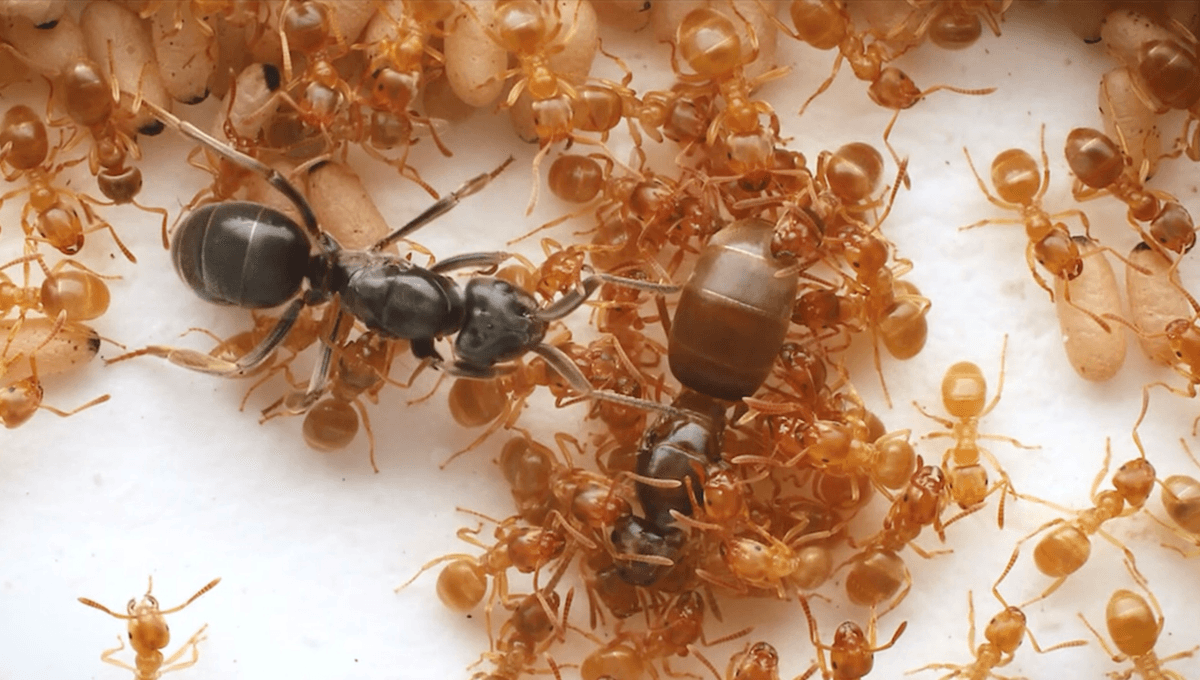
Parasitic ants have developed a method to take over colonies with rulers too strong to defeat by direct attack. They use a chemical spray to sow divisions within the colony, creating the circumstances where they can seize control themselves.
Many humans have considered themselves very clever for turning their enemies against each other, allowing them to win with little or no fighting. Their technique looks less like a stroke of genius, however, on learning that insects with brains the size of pinheads were way ahead of them.
Lasius orientalis and Lasius umbratus are two species of parasitic ants recently discovered to take over nests built by their relatives, Lasius flavus and Lasius japonicus, respectively. It’s not unusual for animals, or even plants, to have developed an ecological niche where they make use of others’ hard work, rather than doing things themselves. However, new research reveals that rather than waging war on the colony, or taking on the existing queen in mortal combat, the invaders spark an uprising, letting the host colony do their dirty work.
L. orientalis usurps the throne by making their way into the nest and spraying the host queen with chemicals. As the dose builds up, it triggers a reaction in the worker ants, sparking a revolt that leads to the queen being mutilated over about four days. By comparison, the guillotining of Marie Antoinette looks positively humane.
L. umbratus uses a similar, but more efficient approach, achieving their goal after two sprays, rather than the 15 or so L. orientalis requires in the course of a day. In each case, the parasite queen then beats a hasty retreat so as not to be caught at the scene of the crime.
“Ants live in the world of odors,” said lead author Keizo Takasuka of Kyushu University in a statement. “Before infiltrating the nest, the parasitic queen stealthily acquires the colony’s odor on her body from workers walking outside so that she is not recognized as the enemy.”
You might expect that the matricidal worker ants would choose a new queen from among their ranks, but perhaps they are wary of meeting the fate of their predecessor. Instead, they welcome in the intruder, who proceeds to lay her own eggs, which are cared for by the workers she inspired to revolt. New boss, same as the old boss, but actually much worse since they are no longer helping transmit their own genes. George Orwell could never have imagined.
“The initial discovery was made by my friend Taku Shimada, the first author of the paper, who has been passionate about ants since childhood and runs a popular blog called Antroom,” explained Dr Takasuka in a different statement. “I found the post three years later and was so astonished. I thought it was a very valuable discovery that deserved to be documented as academic knowledge.”
Previously, it had been assumed that the parasitic queen killed the resident directly, as has been observed in other species where she literally chops her rival’s head off. Uneasy lies the head that wears the crown, and all that.
The authors note, “Matricide… is seldom observed in nature, but not unheard-of. Among animals in which offspring remain with their mothers, the benefits gained from maternal care are so substantial that eliminating them other almost never pays, making matricide vastly rarer than infanticide.” However, if you think of the ant queen as the ruler of a despotic hierarchy, rather than a maternal figure, it makes more sense, although of course in ants she is both.
Perhaps disappointingly to any human would-be revolutionaries, there’s probably nothing fancy about the spray the invading ants use. The authors suspect it’s just formic acid, the chemical many ants use to fight off enemies. Some of these species also use the same chemical to warn their nestmates of attack – an efficient approach for creatures too small to carry a complex armory with them, but apparently a point of vulnerability the parasitic ants have learned to exploit.
“In both cases, the host and parasite belong to the same genus, so they both have formic acid and recognize it as a danger signal,” Takasuka said. “We believe that when their queen is suddenly covered in a large amount of this chemical, the workers perceive their own mother as a colony-threatening crisis which triggers their aggressive defensive behavior.”
If this was all it took to turn a colony against itself, presumably everyone would be doing it. The hard part for the parasites is getting into the colony in the first place, without meeting the same fate they have planned for the incumbent queen.
Exactly how they do this in the wild is not yet known, but the authors replicated part of the process by housing the parasite with a small number of workers and cocoons. “After just one night, she acquired the host colony’s specific scent, providing a chemical camouflage that was essential for her to get past the initial defenses,” Takasuka said.
It might be expected that the two parasite species have a common ancestor that developed the approach in the first place, but the authors think that is not the case. Instead, the behavior apparently represents convergent evolution, where each developed the method independently. Nevertheless, the fact that this is all going on within a single genus indicates the victims must be unusually vulnerable to infiltration.
“My own research focuses on how parasitoid wasps manipulate the behavior of spiders, so I know that in the natural world, parasitic organisms utilize many various and interesting strategies to infect their hosts,” Takasuka concluded. “This discovery in ants is another fascinating example. I am interested in investigating these different host-killing strategies to understand the evolutionary pressures that drive them.”
Humans are much less motivated by simple chemical cues than ants, although baseless viral misinformation seems to have a similar effect on some of us. Still, if we see aspiring revolutionaries infiltrating rival groups to topple them by placing one of their own in the top job, just don’t tell anyone you got the idea from us.
The study is published in Current Biology.

Source Link: Parasitic Ant Queens Use Chemical Warfare To Incite Revolutions Against Reigning Queens
