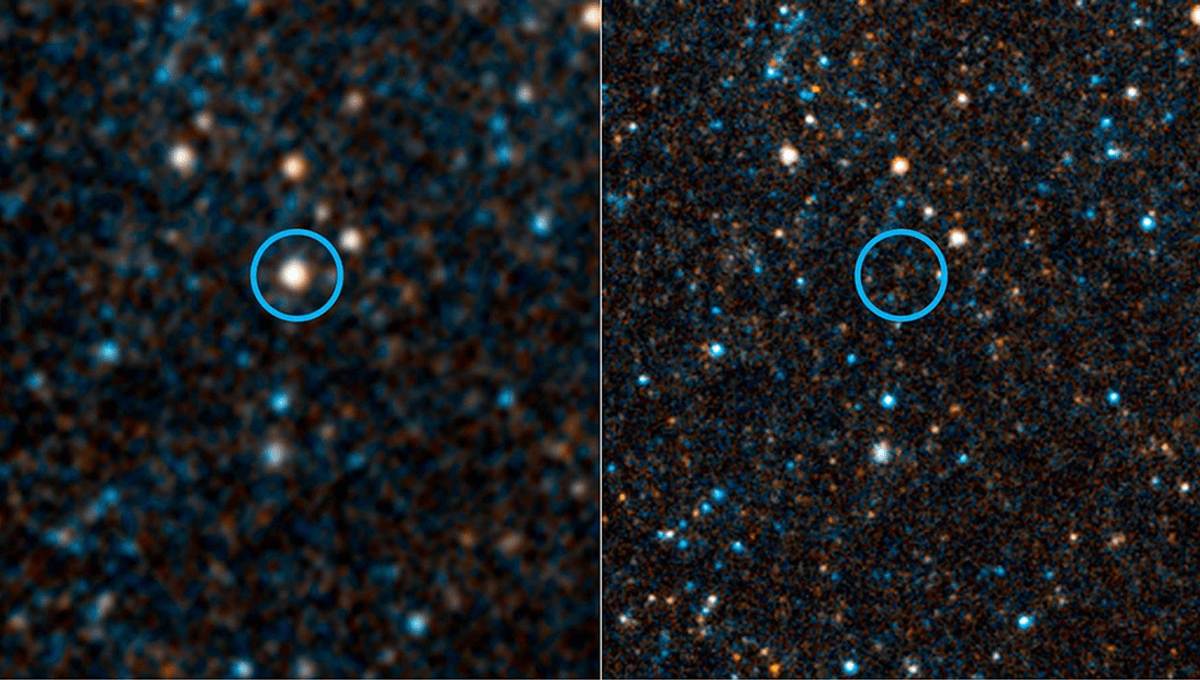
A new study published in Scientific Reports has taken a look at transient objects captured by astronomers in the pre-Sputnik era, finding a curious correlation with nuclear tests and unidentified aerial phenomena (UAP).
Since 2017, the Vanishing & Appearing Sources during a Century of Observations (VASCO) project has attempted to look for stars and other sources of light that have disappeared from view or have dimmed unusually over the 20th and 21st centuries CE. The team has previously found that around 100 stars have disappeared from view without an explanation (though other teams have suggestions as to where they went).
In the latest study from the group, they focused on transient star-like objects observed in the pre-Sputnik era, or before any satellites had been launched into orbit by humans. The team identified transients captured by the Palomar Observatory Sky Survey (POSS-I), which scanned the skies from November 19, 1949 to April 28, 1957.
“These short-lived transients (lasting less than one exposure time of 50 min) have point spread functions and are absent in images taken shortly before the transients appear and in all images from subsequent surveys,” the team writes in their paper. “In some cases multiple transients appear in a single image, exhibiting characteristics not easily accounted for by prosaic explanations (e.g., gravitational lensing, gamma ray bursts, fragmenting asteroids, plate defects).”
Identifying the source of these transients is, as you might imagine, pretty tricky given that they were only seen briefly, and never captured again. But the pair behind the study suggest that looking at possible “contemporaneous correlates” of these transient events could provide clues to their origin. In the study, they wanted to test the hypothesis that they were associated with nuclear tests.
“From 1951 until the launch of Sputnik in 1957, at least 124 above-ground nuclear tests were conducted by the United States (US), Soviet Union, and Great Britain,” the researchers Stephen Bruehl of Vanderbilt University Medical Center, and Beatriz Villarroel, researcher in astronomy at the Nordic Institute for Theoretical Physics, wrote in their paper. “In some circumstances, nuclear radiation is known to cause a visible glow (i.e., Cherenkov radiation). […] Consistent with this concept, glowing ‘fireballs’ in the sky were reported in multiple instances to occur shortly after nuclear tests in locations where significant nuclear fallout was expected.”
According to the team, if transients occurred more frequently around weapons tests, it could indicate that they are an unknown atmospheric phenomenon resulting from the nuclear blasts. The team also considered UAP sightings, noting that they had been reported around weapons tests, as well as around nuclear facilities.
Using publicly available resources, the team attempted to catalogue any transients identified in the POSS-I dataset, and looked at reported UAP sightings as well as confirmed nuclear tests around the dates of the transients. Intriguingly, they found a small correlation between transients and nuclear tests, with transients 45 percent more likely to be observed on dates within nuclear test windows. Adding another curveball, after a final transient associated with a nuclear test on March 17, 1956, the team found that no more transients were observed within nuclear testing windows, despite a continuation of weapons tests.
As well as this, the team found a smaller association between UAP sightings and transient observations, with the association being stronger when multiple transients were captured.
As for an explanation? The team suggests a few. The second, attributed largely from UFO lore, is that UAPs may be attracted to nuclear weapons tests, and that they are real objects captured in our atmosphere or in orbit around the Earth. A more likely explanation proposed (given that we have no evidence of alien life thus far) is that nuclear tests trigger an atmospheric phenomenon which results in the captured transients and potentially UAP sightings.
“While the latter is potentially plausible, effects in the atmosphere (rather than geosynchronous orbit) would be likely to result in a streak on the image over the 50 min exposure, yet all transients appear as distinct point sources rather than streaks,” the team writes, adding, “regardless of what transients are ultimately determined to be, our results add to growing evidence supporting the interpretation of transients as real observations, rather than as emulsion defects.”
While interesting, more work will be needed to see if the effect is real, and ultimately pin down a cause.
The study is published in Scientific Reports.
An earlier version of this article was published in July 2025.

Source Link: Puzzling "Transient" Lights In The 1950s Skies Focused Around Nuclear Testing Facilities, Intriguing Study Finds
