Earlier this year, Apple officially discontinued Music Memos, an iPhone app that allowed musicians to quickly record audio and develop new song ideas. Now, a new startup called Tape It is stepping in to fill the void with an app that improves audio recordings by offering a variety of features, including higher-quality sound, automatic instrument detection, support for markers, notes, and images, and more.
The idea for Tape It comes from two friends and musicians, Thomas Walther and Jan Nash.
Walther had previously spent three and a half years at Spotify, following its 2017 acquisition of the audio detection startup Sonalytic, which he had co-founded. Nash, meanwhile, is a classically trained opera singer, who also plays bass and is an engineer.
They’re joined by designer and musician Christian Crusius, previously of the design consultancy Fjord, which was acquired by Accenture.
The founders, who had played in a band together for many years, were inspired to build Tape It because it was something they wanted for themselves, Walther says. After ending his stint at Spotify working in their new Soundtrap division (an online music startup Spotify also bought in 2017), he knew he wanted to work on a project that was more focused on the music-making side of things. But while Soundtrap worked for some, it wasn’t what either Walther or his friends had needed. Instead, they wanted a simple tool that would allow them to record their music with their phone — something that musicians often do today using Apple’s Voice Memos app and, briefly, Music Memos — until its demise.
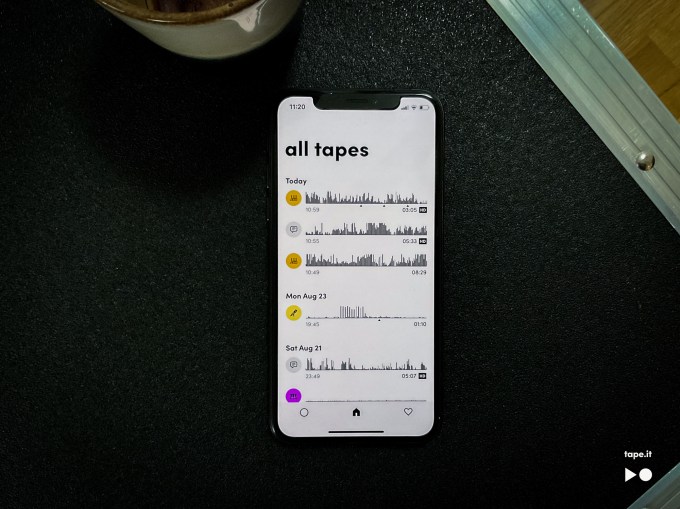
Image Credits: Tape It
“Regardless of whether you’re an amateur or even like a touring professional…you will record your ideas with your phone, just because that’s what you have with you,” Walther explains. “It’s the exact same thing with cameras — the best camera is the one you have with you. And the best audio recording tool is the one you have with you.”
That is, when you want to record, the easiest thing to do is not to get out your laptop and connect a bunch of cables to it, then load up your studio software — it’s to hit the record button on your iPhone.
The Tape It app allows you to do just that, but adds other features that make it more competitive with its built-in competition, Voice Memos.
When you record using Tape It, the app leverages A.I. to automatically detect the instrument, then annotate the recording with a visual indication to make those recordings easier to find by looking for the colorful icon. Musicians can also add their own markers to the files right when they record them, then add notes and photos to remind themselves of other details. This can be useful when reviewing the recordings later on, Walther says.
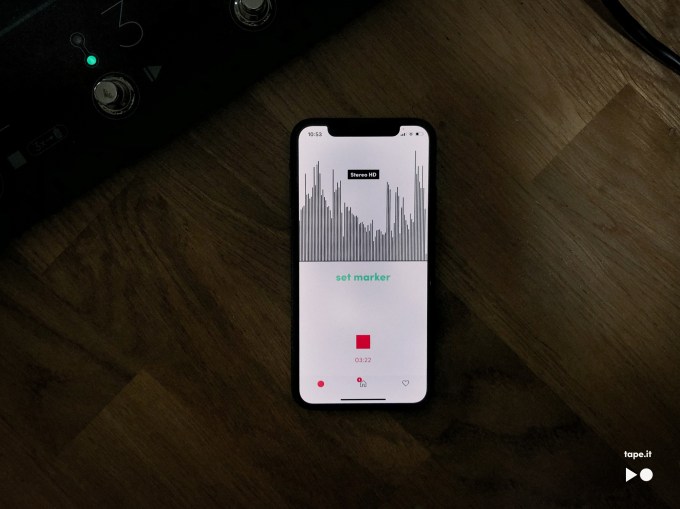
Image Credits: Tape It
“If I have a nice guitar sound, I can just take a picture of the settings on my amplifier, and I have them. This is something musicians do all the time,” he notes. “It’s the easiest way to re-create that sound.”
Another novel, but simple, change in Tape It is that breaks longer recordings into multiple lines, similar to a paragraph of text. The team calls this the “Time Paragraph,” and believes it will make listening to longer sessions easier than the default — which is typically a single, horizontally scrollable recording.
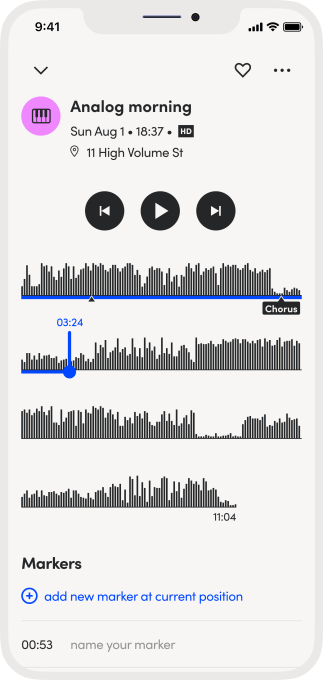
Image Credits: Tape It
The app has also been designed so it’s easier to go back to the right part of recordings, thanks to its smart waveforms, in addition to the optional markers and photos. And you can mark recordings as favorites so you can quickly pull up a list of your best ideas and sounds. The app offers full media center integration as well, so you can play back your music whenever you have time.
However, the standout feature is Tape It’s support for “Stereo HD” quality. Here, the app takes advantage of the two microphones on devices like the iPhone XS, XR, and other newer models, then improves the sound using A.I. technology and other noise reduction techniques which it’s developed in-house. This feature is part of its $20 per year premium subscription.
Over time, Tape It intends to broaden its use of A.I. and other IP to improve the sound quality further. It also plans to introduce collaborative features and support for importing and exporting recordings into professional studio software. This could eventually place Tape It into the same market that SoundCloud had initially chased before it shifted its focus to becoming more of a consumer-facing service.
But first, Tape It wants to nail the single-user workflow before adding on more sharing features.
“We decided that it’s so important to make sure it’s useful, even just for you. The stuff that you can collaborate on — if you don’t like using it yourself, you’re not going to use it,” Walther says.
Tape It’s team of three is dually based in both Stockholm and Berlin and is currently bootstrapping.
The app itself is a free download on iOS and will later support desktop users on Mac and Windows. An Android version is not planned.
Source Link Tape It launches an A.I.-powered music recording app for iPhone


Leave a Reply