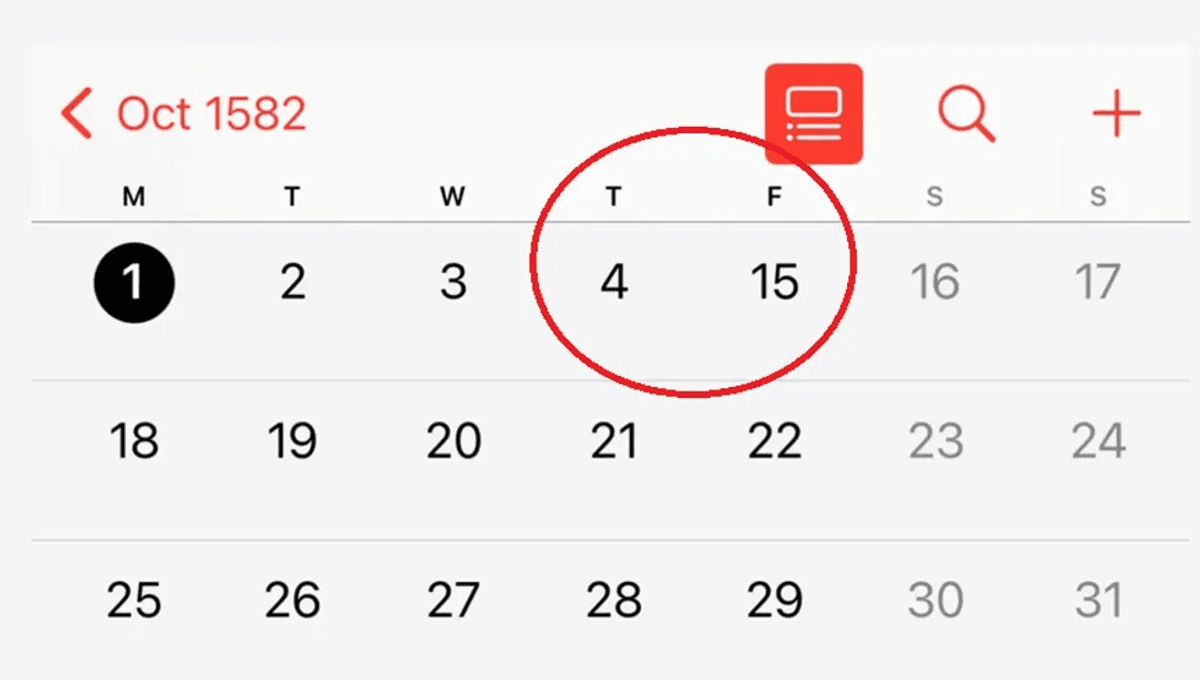
People on social media have noticed an odd quirk in the iPhone calendar: if you scroll back to October 1582, you’ll see it jump straight from the 4th to the 15th, skipping ten entire days. It’s not a glitch or a hidden joke from Apple’s developers; those ten days genuinely never existed.
The days weren’t erased from the passage of time using a cosmic cut-and-paste tool. Instead, people in 1582 went to bed on the 4th and woke up on the 15th (not that much of the world would have realized at the time).
To understand why, we must go back to the 16th century when a major shift occurred in the way we organize days, weeks, months, and years.
What Happened in October 1582?
As IFLScience explained in 2023, the Catholic church adopted the Gregorian calendar in October 1582. Prior to this, most of Europe had used the Julian calendar, introduced by Julius Caesar in 45 BCE.
It’s very similar to the Gregorian calendar. Both are solar calendars with 12 months featuring 28 to 31 days each. They also total 365 days most years, with a leap day being added to February in certain years.
The main difference is when the leap year occurs. The Julian calendar adds a day to the calendar every 4 years, while the Gregorian calendar does the same unless the year is divisible by 100 and not divisible by 400.
It sounds like a very small difference, but it was a big deal for the Catholic Church because it severely meddled with the timing of Easter. Since the Council of Nicaea in 325 CE, it was stated that Easter should be observed on the first Sunday following the first full moon after the spring equinox on March 21.
However, as the centuries passed, the spring equinox drifted from this date. This effect accumulated by the 16th century when the spring equinox fell on March 11, upsetting the timing of Easter.
To solve this crisis, Pope Gregory XIII introduced the Gregorian calendar. To realign the new calendar with the motions of the Sun, we had to lose the 10 days that had accumulated due to the flaw of the Julian calendar.
October was picked as the month to lose 10 days as it didn’t clash with any major events in the Christian calendar. Following the Feast of St Francis of Assisi on October 4, the switch to the Gregorian calendar took place and the world skipped to October 15 instantly.
It’s for this reason that most calendars skip from October 4 to October 15 in 1582 (if they go this far back).
Interestingly, not everyone adopted the Gregorian calendar at the same time. For example, Alaska didn’t make the switch until 1867, when it was transferred from Russian to American control. Russia was still using the Julian calendar at the time, but the US followed the Gregorian system, so Alaska had to jump ahead by numerous days to align with its new government. As a result, those “missing” days in Alaska occurred in 1867.
Obviously, 16th-century monks (and 19th-century Alaskans) weren’t putting dates in their iPhone’s diary, but the calendars do go really far back. It’s not clear why they’re designed to do this, although it is always interesting to see whether your birthday fell on a weekend in the year 27 BCE.
An earlier version of this article was published in 2024.

Source Link: There's A Very Good Reason Why October 1582 On Your Phone Is Missing 10 Days
