• Email Us: [email protected]
  • Contact Us: +1 718 874 1545
  • Skip to main content
  • Skip to primary sidebar

Medical Market Report

  • Home
  • All Reports
  • About Us
  • Contact Us

This Whale’s Meal Plan? Over 70,000 Squid A Year, And It’ll Dive Incredible Depths To Get Them

November 13, 2025 by Deborah Bloomfield

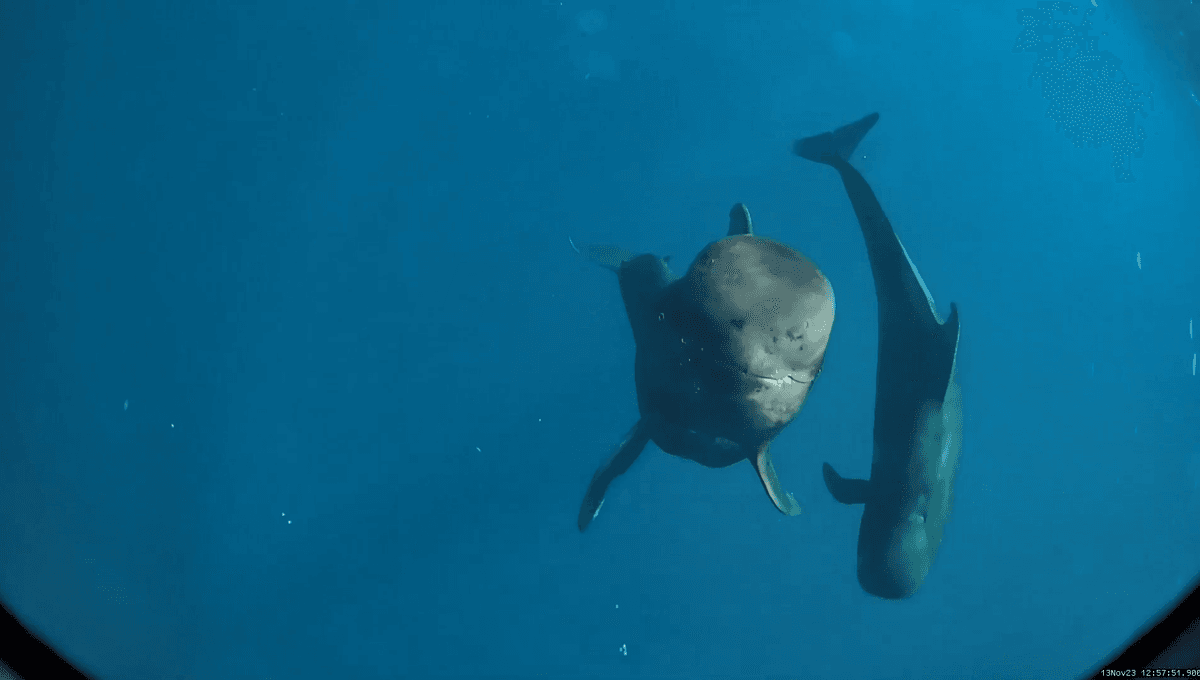
How much do you need to eat to stay alive and healthy? It’s an interesting question and one that is crucial to protecting a lot of Earth’s species. For short-finned pilot whales, the answer is somewhere between 82 and 202 squid per day, which scales up to as many as 73,730 squid per year, and for the entire 8,000-strong population, more than 589 million squid in total.

The rest of this article is behind a paywall. Please sign in or subscribe to access the full content.

Short-finned pilot whales (Globicephala macrorhynchus) are an understudied species of oceanic dolphin that have a population that lives in the waters around Hawaii. To learn more about their behaviors, dietary habits, and energy requirements, the team used suction cup tags deployed onto the short-finned pilot whales to collect data.

“Ideally, we attached the tag right behind the blowhole facing the head, so we could see any foraging at depth,” said study author William Gough from the University of Hawaiʻi at Mānoa in a statement.


The pilot whales can dive to depths of 1,700 meters (5,577 feet) as they forage, something that is incredibly energetically demanding. As mammals, they then have to return to the surface to breathe. The team learnt from the tag data that the whales were diving as many as 39 times a day. These dives lasted between 8-16 minutes and were of an average depth of 400-800 meters (1,312-2,625 feet). 

Using whale tail beats as a proxy for their energy consumption, the team found out that they use 73.8 kilojoules per minute (kJ/min) of energy while diving and around 44.4 kJ/min of energy at the surface of the water. They then translated this into the number of squid that needed to be consumed per whale to meet these energy costs. 

Using hydrophone recordings, the team could tell when the pilot whales intercepted a squid on a dive; they worked out that roughly four squid were consumed per dive, and each squid provided 560kJ of energy to the whale. Knowing this and the energy expenditure, the team then calculated that each whale must eat between 82-202 squid per day and around 73,730 squid per year. This also means that the total population of pilot whales in this area consumes around 88,000 tonnes of squid per year. Fortunately, the squid population in Hawaii is well able to support this. 

“These results show that short-finned pilot whales are in relatively good shape in Hawaiʻi, having found an abundant and reliable source of food,” said Gough.

The study is published in the Journal of Experimental Biology.

Deborah Bloomfield
Deborah Bloomfield

Related posts:

  1. Google, in fight against record EU fine, slams regulators for ignoring Apple
  2. Iran’s foreign minister says we were not first to cut ties with Saudi
  3. Bison Calf Euthanized After Tourist Handles It In Yellowstone National Park River
  4. Why Do Some Toilets Have Two Flush Buttons?

Source Link: This Whale’s Meal Plan? Over 70,000 Squid A Year, And It’ll Dive Incredible Depths To Get Them

Filed Under: News

Primary Sidebar

  • 25-Year-Old Paper On Controversial Glyphosate Weedkiller Retracted, After It Turns Out Monsanto Staff Helped Write It
  • Gravitational Lenses Confirm That Something Is Still Broken In The Universe
  • Adorable Camera Trap Footage Of Moms And Cubs Heralds Conservation Win For Sunda Tigers
  • Exercise VS Sleep: Which Is More Important When You Don’t Have Time For Both?
  • A Deep-Sea Mining Test Carved Up The Seabed. Two Years On, We’re Seeing Devastating Impacts
  • Enormous New Study Finds COVID-19 mRNA Shots Associated With 25 Percent Lower Risk Of Death From Any Cause
  • What Is The Best Movie Set In Space? We Asked Real-Life Astronauts To Find Out
  • Chernobyl’s Protective Shield Is Broken After A Drone Strike, Warns UN Nuclear Watchdog
  • Isaac Newton Was Born On Christmas Day – And January 4th
  • Why Is December The 12th Month Of The Year When Its Name Means 10?
  • Poor Sauropod Was Limping When It Made Curious 360° Looping Dinosaur Track
  • Inhaling “Laughing Gas” Could Treat Severe Depression, Live Seven-Arm Octopus Spotted In The Deep Sea, And Much More This Week
  • People Are Surprised To Learn That The Closest Planet To Neptune Turns Out To Be Mercury
  • The Age-Old “Grandmother Rule” Of Washing Is Backed By Science
  • How Hero Of Alexandria Used Ancient Science To Make “Magical Acts Of The Gods” 2,000 Years Ago
  • This 120-Million-Year-Old Bird Choked To Death On Over 800 Stones. Why? Nobody Knows
  • Radiation Fog: A 643-Kilometer Belt Of Mist Lingers Over California’s Central Valley
  • New Images Of Comet 3I/ATLAS From 4 Different Missions Reveal A Peculiar Little World
  • Neanderthals Used Reindeer Bones To Skin Animals And Make Leather Clothes
  • Why Do Power Lines Have Those Big Colorful Balls On Them?
  • Business
  • Health
  • News
  • Science
  • Technology
  • +1 718 874 1545
  • +91 78878 22626
  • [email protected]
Office Address
Prudour Pvt. Ltd. 420 Lexington Avenue Suite 300 New York City, NY 10170.

Powered by Prudour Network

Copyrights © 2025 · Medical Market Report. All Rights Reserved.

Go to mobile version