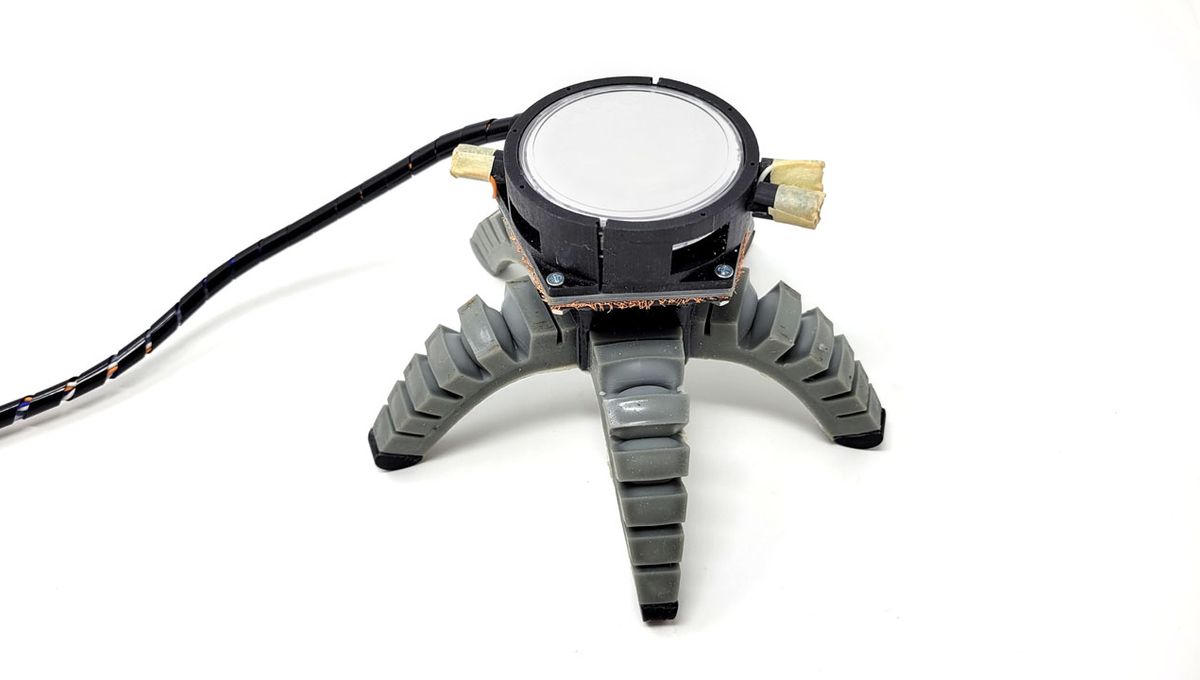
We’re willing to bet you didn’t have “mushroom-powered robots” on your 2024 bingo card. Fortunately for all of us, scientists at Cornell University have come in clutch with a pair of fungus-fueled biohybrid robots that respond to their environments, walk – or wheel – around, and look a bit like extras from The Addams Family.
Biohybrid robots take the best of human engineering prowess and combine it with the wonders of the natural world to create something totally new. From using live pill bugs as grabbers, to covering a robot face with human skin (oh no), there’s almost no end to what you can come up with when you have millions of years of evolution and the breadth of human ingenuity to play with.
Now, a team of researchers has harnessed the natural sensory system of fungi to give power to two new robots. Just look at this one go!
“This paper is the first of many that will use the fungal kingdom to provide environmental sensing and command signals to robots to improve their levels of autonomy,” said senior author Rob Shepherd, a professor of mechanical and aerospace engineering, in a statement.
When we think of fungi, our minds probably fill with images of mushrooms. But what you don’t see on a typical stroll through the forest is the complex network that lies just beneath the soil. This is the mycelium, made up of webs of filaments called hyphae.
For fungi, the mycelium is a little bit like the roots of a plant. Hyphae extend into the ground and secrete digestive enzymes that break down other matter, which can then be used as a food source for the fungi, as well as some neighboring plants and animals. But this process doesn’t happen for each individual fungus in isolation – electrical signals are also exchanged via the mycelium, which some scientists have likened to communication.
It is these two key functions of the mycelium that sparked the idea of incorporating it into a biohybrid robot.
“Living systems respond to touch, they respond to light, they respond to heat, they respond to even some unknowns, like signals. If you wanted to build future robots, how can they work in an unexpected environment? We can leverage these living systems, and any unknown input comes in, the robot will respond to that,” said first author Anand Mishra.
The team built two very different robots, each incorporating mycelium into their electronic systems. One was on wheels, while the other was a flexible, soft robot with spider-like legs. In a series of experiments, they demonstrated how the robots could move thanks to the natural electrical pulses coming from their mycelia. By stimulating the mycelia with UV light, the team could make the robots change their gaits.
“This kind of project is […] about creating a true connection with a living system,” Mishra told the Cornell Chronicle. Thanks to the sensitivity of their mycelia, these robots can respond to a change in their environment – right now it’s light, but in future it could be chemical signals that we cannot see.
“So you’re seeing the physical response, because those signals we can’t visualize, but the robot is making a visualization,” Mishra added.
It took the combined expertise of neurobiologists, plant pathologists, and robotics engineers to create these biohybrid systems, and the team is excited about the possible future applications of this technology.
“The potential for future robots could be to sense soil chemistry in row crops and decide when to add more fertilizer, for example,” said Shepherd, “perhaps mitigating downstream effects of agriculture like harmful algal blooms.”
The study is published in the journal Science Robotics.

Source Link: Watch As Mushroom Power Helps This Spider-Like Biohybrid Robot Bounce Along
