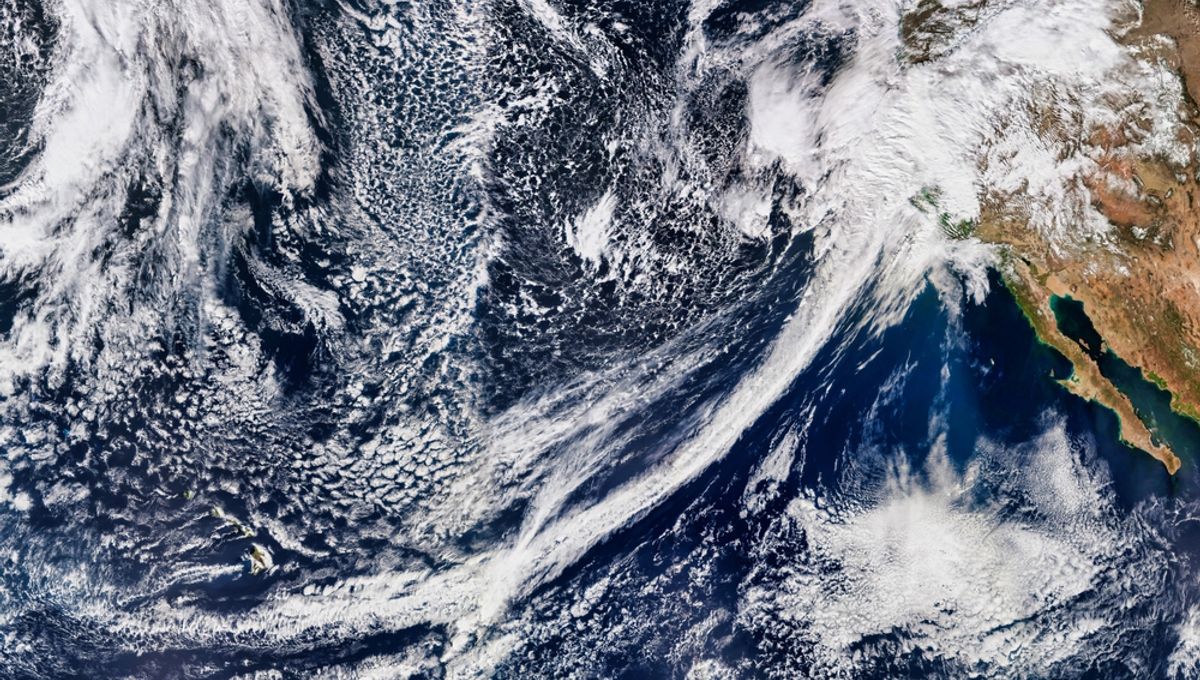
Atmospheric rivers have been gaining a lot of media traction lately. But while atmospheric rivers have played an integral role in the water cycle long before the birth of the dinosaurs, the term was first described surprisingly recently – in 1994.
It refers to the long, narrow columns of water vapor that flow through the Earth’s atmosphere – a little like rivers in the sky, hence its namesake. These atmospheric rivers transport water from the tropics near the Earth’s equator to regions in the temperate zone and beyond. They are a transient phenomenon with an average four to five of these so-called rivers existing at any one time, according to the Department of Energy (DoE).
Perhaps the most famous of these is the Pineapple Express, which begins in the Pacific near Hawaii and makes landfall on the US West Coast. As NASA explains, atmospheric rivers tend to occur in the extratropical regions of the North and South-East Pacific and the North and South Atlantic. Atmospheric rivers can travel vast distances, typically landing in temperate regions approximately 30° to 60° north and south such as areas on the western coast of the Americas, Europe, Southeast Asia and New Zealand. It is here that they release water in the form of rain or snow.
Being the recipient of this rainfall can be a mixed blessing. Atmospheric rivers are an intrinsic part of the world’s water system and provide a crucial supply of water. Indeed, according to the National Oceanic and Atmospheric Administration (NOAA), as much as 30 to 50 percent of annual precipitation in the US West Coast is the result of a handful of atmospheric river events. Meanwhile, countries such as France, Spain and the United Kingdom and regions such as Southeast Asia receive more than half of rainfall from atmospheric rivers. However, they also have the potential to trigger extreme rainfall and flooding, which, in turn, can cause mudslides and damage to property.
This was the case in North America earlier this year. In September, one particularly strong atmospheric river unleashed days of heavy rains in areas in Canada and southeastern Alaska.
While temperate areas have historically received more rainfall from atmospheric rivers, scientists have recently detected changes triggered by climate change that could have a significant impact on the world’s water supplies. A study published by a team at Santa Barbara revealed a shift in the position of atmospheric rivers. The findings suggest they have moved, on average, 6° to 10° closer to the poles in the last 40 years.
This change could result in more severe droughts in subtropical regions like Brazil and wetter conditions in countries that sit closer to the poles, such as those in Europe, and states in the US Pacific Northwest.
Researchers also point to the fact that these shifts could be exacerbating existing trends that are seeing higher levels of sea ice loss in the Arctic. As waterfall from atmospheric rivers become more common in polar regions during wintertime, these areas have less time to recover from summer melt.
It seems clear that while atmospheric rivers appear to be a relatively new area of scientific research, these giant columns of water vapor – the strongest carrying 7.5 to 15 times the average flow of water at the mouth of the Mississippi River – will be the topic of much more scientific study in the future.

Source Link: Where Do Most Atmospheric Rivers Occur?
