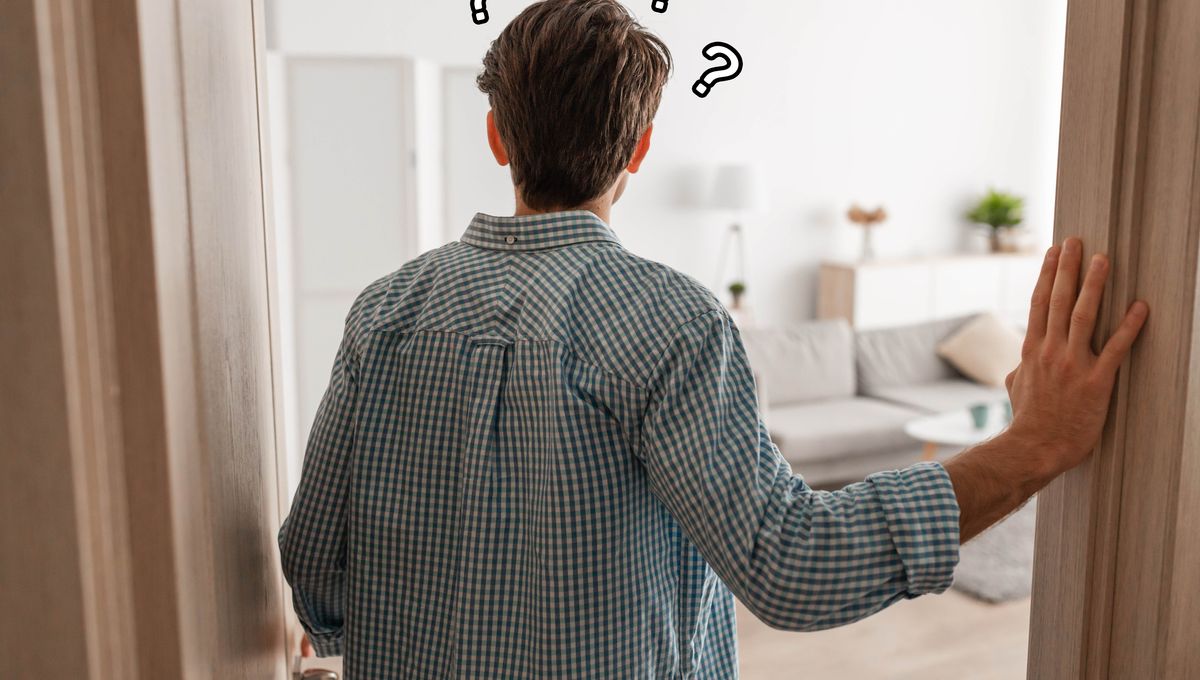
Have you ever forgotten what you were doing as you moved from one room to another? Maybe you’re in one room and remember you need to do something or fetch an item from another room. However, by the time you arrive in the other room, the thought has completely gone and you no longer recall why you’re there at all. Or perhaps you’re going to buy something, but the moment you enter the shop you forget what it was you wanted.
You might chalk it up to some sort of faulty memory, a “senior moment”, or just being tired. However, the culprit may be right there – the doorway itself. These examples are related to what is referred to as the “doorway effect”, or “location updating effect” which supposes that we tend to forget items of recent significance if we cross a boundary. The idea has received a lot of attention from scientists over the years, who have devised some pretty imaginative ways to test it.
In a 2011 study, a team of researchers at the University of Notre Dame examined the doorway effect by having participants carry objects through either virtual environments or real settings. The results showed that participants were more likely to forget information after they passed through a door compared to just walking across a room, even if they had just been thinking about that information moments before.
This, they argued, demonstrates how our brains segment experiences into distinct events, what is referred to as the “event horizon model”. This is useful for organizing memories but can lead to short-term forgetting. In essence, the brain stores memories in bits or episodes, rather than as continuous events. Crossing a boundary triggers our brains to update the event model of that space which can lead to information loss for objects associated with earlier events.
“Entering or exiting through a doorway serves as an ‘event boundary’ in the mind, which separates episodes of activity and files them away,” study co-author, University of Notre Dame Psychology Professor Gabriel Radvansky, explained in a statement at the time. “Recalling the decision or activity that was made in a different room is difficult because it has been compartmentalized.”
Basically, the desire to go get something from the kitchen is associated with an event in the living room, but the connection to it is disrupted once you arrive in the kitchen.
In another study published in 2014, researchers found that the doorway effect doesn’t even need a real door. Simply imagining going through a doorway is enough to produce the effect. This, the authors argue, suggests the Event Horizon Model works even for imagined spaces and that the location updating effect doesn’t necessarily rely on perceptual information. We can just trigger it with our minds.
However, more recent research has problematized this model. It argues that, while the doorway effect is real, it does not always occur consistently across all contexts, nor for every individual.
The 2021 study involved participants wearing virtual reality headsets and moving through different rooms in a virtual environment. The participants were tasked with memorizing objects on tables in each room and then moving to another table. Sometimes, however, a table was located in another room, which participants accessed through virtual automatic sliding doors. In this first experiment, the doorways actually had no effect on memory.
Then, in a second experiment, the participants were expected to do this memorizing task while simultaneously performing a counting task. The test was to see if increased pressure impacted their memory.
In this second experience, the doorway effect came into effect more often. Essentially, the counting task overloaded people’s memory, which made them more suspectable to the doorway effect. The authors also argue that, because their virtual rooms were essentially identical, it is not so much a case of moving through doors that causes the memory issue, but rather changes in context. Add to this the pressure of an overloaded mind and you have a higher chance of short-term forgetting.

Source Link: Why Did I Come In Here? How The "Doorway Effect" Makes Us Forget What We Were Doing
