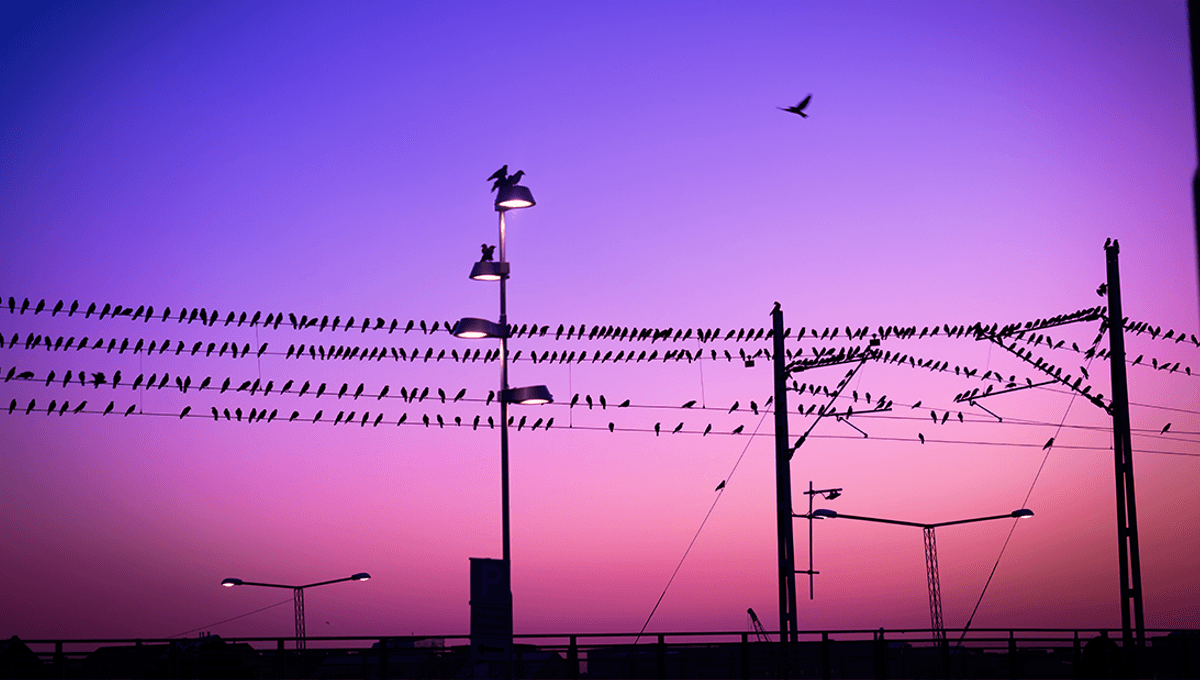
Power lines are a great place to look if you are in need of birds or shoes. It’s not unusual to see a group of small birds, or a larger bird, apparently relaxing on wires used to transfer electricity over long distances to consumers. So why do they do this, and how come they don’t get instantly turned into fried blue tit?
The “why” is fairly simple to explain. While it would be fun to think that birds are simply secretly powered by electricity (see how easy it is to make up a conspiracy theory?) the truth is that power lines offer an appealing perch from which birds can view their surroundings for potential predators or prey. Up there, their views are unobscured by the foliage of trees.
As for why they don’t get electrocuted, the answer is muddied by the fact that many of them do. One 2014 study estimated that between 0.9 and 11.6 million birds are killed by electrocution in the US every year. Larger birds like raptors are at particular risk, as it increases the possibility of them touching two wires, or a wire and a grounding source. One 2016 study by the US Fish and Wildlife Service’s National Forensics Laboratory looked at 417 electrocuted raptors, finding that nearly 80 percent of fatalities were bald or golden eagles.
However, the reason why birds mostly don’t get electrocuted is because they took the trouble to evolve the ability to fly, and access the power lines using this Neat Little Trick. Had they climbed onto the power line via a ladder, and not worn appropriate insulative clothing for birds, they would be fried like the rest of us. Birds perched on a single power line are not killed because they are not grounded.
“The birds are not forming a connection between the power line and the ground, so they’re not connecting the circuit,” Will Babb of the Ohio Department of Natural Resources’ Division of Wildlife explained to Cincinnati Enquirer. “But if we were to touch a power line while standing on the ground, we’d complete the circuit, and bad things would happen.”
Imagine you are pushing a whole load of balls up a mountain range and along a long path at the top. The balls continue along this ridge until they reach the other end, and roll down the path, converting gravitational potential energy to kinetic energy. If you were to create another path along the ridge that leads down the mountain more quickly, they would of course roll down it rather than wait for the path at the end of the trail.
In the same way, a grounded, electrically conductive object that touches a live electrical wire provides another path for electricity to flow through. So if birds touch a wire and a utility pole at the same time, it can provide a path to the ground, which is very bad news for the birds. Or they can touch two wires simultaneously if they are big enough, allowing electricity to flow, which is again very bad news for the bird.
Now for the tricksy bit; after a certain threshold, you can largely ignore the voltage, the difference in electrical energy between two points. Voltage in power lines can be as high as 400,000 volts, but as long as it there is nowhere for the voltage to go this is of no concern to the birds. Current is the rate of flow of electric charge through a conductor, measured in amperes, and it is this that kills you (though we should point out that it is voltage which “pushes” the charge through the circuit).
Electromagnetism can be pretty difficult to get your head around, but, as outlined in the above video from the always excellent engineering/physics YouTuber AlphaPhoenix, it can be helpful to use the hydraulic analogy to do so.
The hydraulic analogy should not be taken literally, but compares electricity to water flowing through a pipe. In (very) simple terms, in the hydraulic analogy charge is the volume flow rate through the pipe. Voltage is the difference in pressure between two different points in that container, and resistance, or how much a material opposes the flow of current, can be thought of as a constriction like a narrowing of the pipe, or a porous obstruction to flow. A unit of electric charge, meanwhile, is likened to a unit volume of water.
The voltage can be thought of as the water being slightly different heights, and therefore different pressures, pushing the water through the pipe. This difference in pressure is important to get the water flowing (in this analogy pushing charge through the circuit). But it is ultimately the flow, or charge, that kills you. With no favorable path provided by birds landing on a single wire, no charge can flow; and so it does not matter whether there are 40 volts or 400,000 volts – the bird shall remain, defiantly, alive.
All “explainer” articles are confirmed by fact checkers to be correct at time of publishing. Text, images, and links may be edited, removed, or added to at a later date to keep information current.
An earlier version of this story was published in July 2024.

Source Link: Why Don't Birds Die When They Sit On 400,000-Volt Power Lines?
