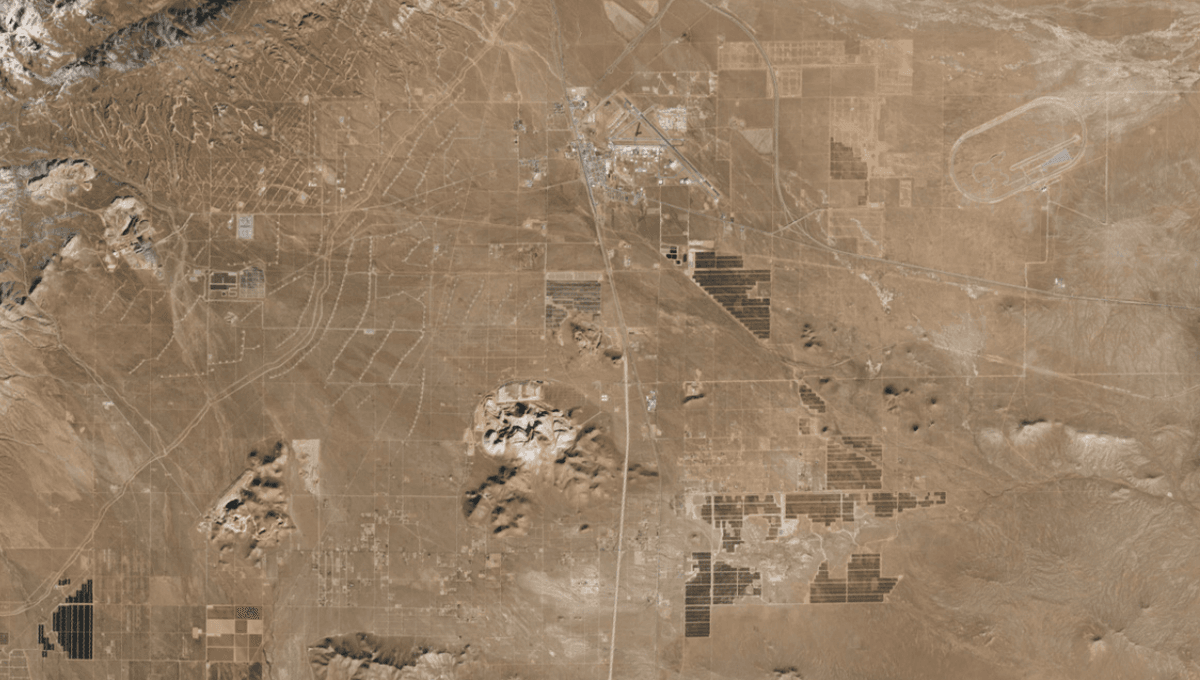
In California’s share of the Mojave Desert, one of the sunniest places on Earth, the largest single solar and battery energy storage project in the world has just become fully operational: the Edwards & Sanborn Solar and Energy Storage facility.
Consisting of almost 2 million solar panels, the sprawling solar farm has 875 megawatts of capacity, the highest of any such facility in the US.
Crucially, it also features 3,287 megawatt-hours of energy storage that’s enabled using over 120,000 batteries. This storage allows the site to keep the flow of power going even during periods of high demand or no sunlight.
The Edwards & Sanborn Solar and Energy Storage facility covers 1,886 total hectares (4,660 total acres) of land, approximately one-third the size of Manhattan. To link up the whole system, engineers had to lay over 724 kilometers (450 miles) of wiring.
To offer a taste of its vast scale, the Landsat-9 satellite captured an image of the site on January 12, 2024, just before its grand opening. Mortenson, a building and engineering service provider, started building the project at the start of 2021. It came online in February 2023 and became fully online in January 2024.
When talking about its size and scale, it’s important to outline some definitions. The highest capacity solar farm in the world is the Golmud Solar Park in China, with an installed solar capacity of 2.8 gigawatts, closely followed by the Bhadla Solar Park in India, with a 2.7-gigawatt capacity.
The Edwards Sanborn Solar and Energy Storage stands apart from these giants as it’s the largest single solar and battery energy storage project, according to Mortenson. It recently swiped the title for the largest energy storage site from Vistra’s facility at Moss Landing, also in California.
Solar power is set to become an increasingly important source of renewable energy that’s helping to wean the world off fossil fuels, by far the largest contributor to climate change. However, solar farm infrastructure does present its own challenges.
Solar storage typically relies on lithium-ion batteries made of rare materials like lithium and cobalt. The mining of these metals can be very risky for the environment, putting local communities and ecosystems in danger.
Soaking up the sun also requires a huge amount of infrastructure. The Mojave Desert has become swamped with solar farms in recent years, including the Riverside East Solar Energy Zone, which stretches for 60,700 hectares (150,000 acres), 10 times the size of Manhattan.
Along with angering Native American tribes, who have close spiritual ties to the land, the infrastructure development in the Mojave Desert has also dramatically upset the natural habitat of species like the flat-tailed horned toad and the desert tortoise.

Source Link: World's Largest Solar Plus Battery Storage System Goes Live In Mojave Desert
