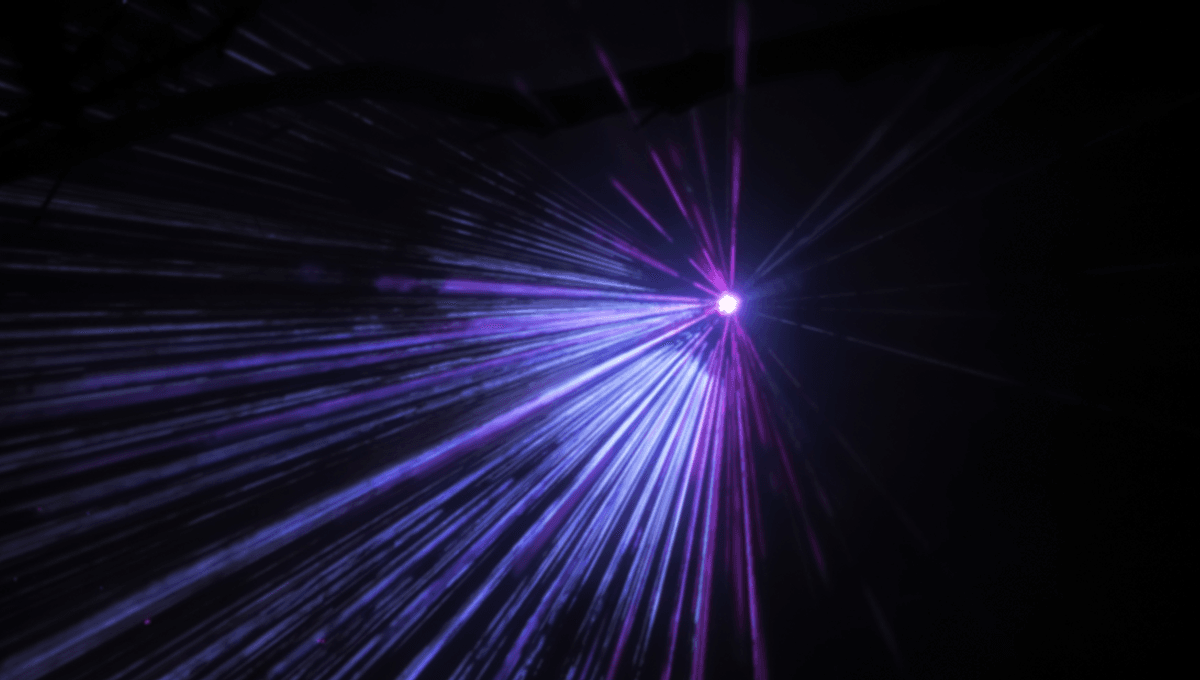
Material scientist Brian Haidet has filmed laser light moving at 2 billion frames per second, showing the results on his YouTube channel AlphaPhoenix.
Haidet has previously attempted to record the speed of light at 1 billion frames per second, using some (fairly) basic equipment available to him in his garage.
The results of that experiment were pretty good, but Haidet thought he could do better and double the number of frames per second, whilst also shooting in HD. In a new video, he attempts that and shows how he made it, whilst also experimenting with catching light as it ricocheted off two angled mirrors and a disco ball.
While it would be nice to directly record light at such high framerates, that is not possible without a huge budget and some very fancy equipment. While The Slow Mo Guys were able to film light at 10 trillion frames per second, Haidet says he was “somewhat put off by the quarter million dollar price tag”. Instead, in the first video, he used some clever tricks to record instants and then piece them all together. That is not the case this time.
“This camera and the new camera over there are literally capable of recording a video at a billion frames per second or 2 billion frames per second,” Haidet explained in the video. “The catch is that it’s only a one by one pixel video.”
By tiling together a whole lot of one pixel videos, Haidet was able to piece together what a “true” 2 billion pixel camera would see when observing the same setup.
“In order to build up a useful image, I have to point the camera in a bunch of different directions and record a bunch of separate one pixel videos,” he explained. “Every one of these videos is a video of a distinct event that did not happen at the exact same moment in time. But if all these videos are synchronized and we take many many many one pixel videos, we can tile these videos next to each other and play them all back at the exact same moment and get something that looks like a video.”
The results, seen above, are pretty astonishing to see, especially in a garage setup. For their part, the Slow Mo Guys used specialized equipment borrowed from Caltech.
“Now, we’ve filmed at some very high frame rates. We’re talking up to about half a million, which is not to be sniffed at,” the host explains in the video. “Their camera puts ours to shame and does 10 trillion frames per second. For reference, that is 20 million times faster than the fastest we’ve ever filmed on this channel.”
With that frame rate, postdoctoral scholar Peng Wang – who assisted them at the Compressed Ultrafast Photography department – assured them that they could see the speed of light. Or more accurately, that they would see light moving the length of a bottle in 2,000 picoseconds of footage.
The team explained that they also used some tricks, thanks to the speed of light being so fast in comparison to everything else. In their setup, the camera only detects light itself, with the bottle being superimposed afterward. The result is nevertheless spectacular: capturing light as it moves, at 10 trillion frames per second, even if they did have access to far fancier equipment than the always excellent AlphaPhoenix.

Source Link: YouTuber Films Laser Light At 2 Billion Frames Per Second In His Garage
