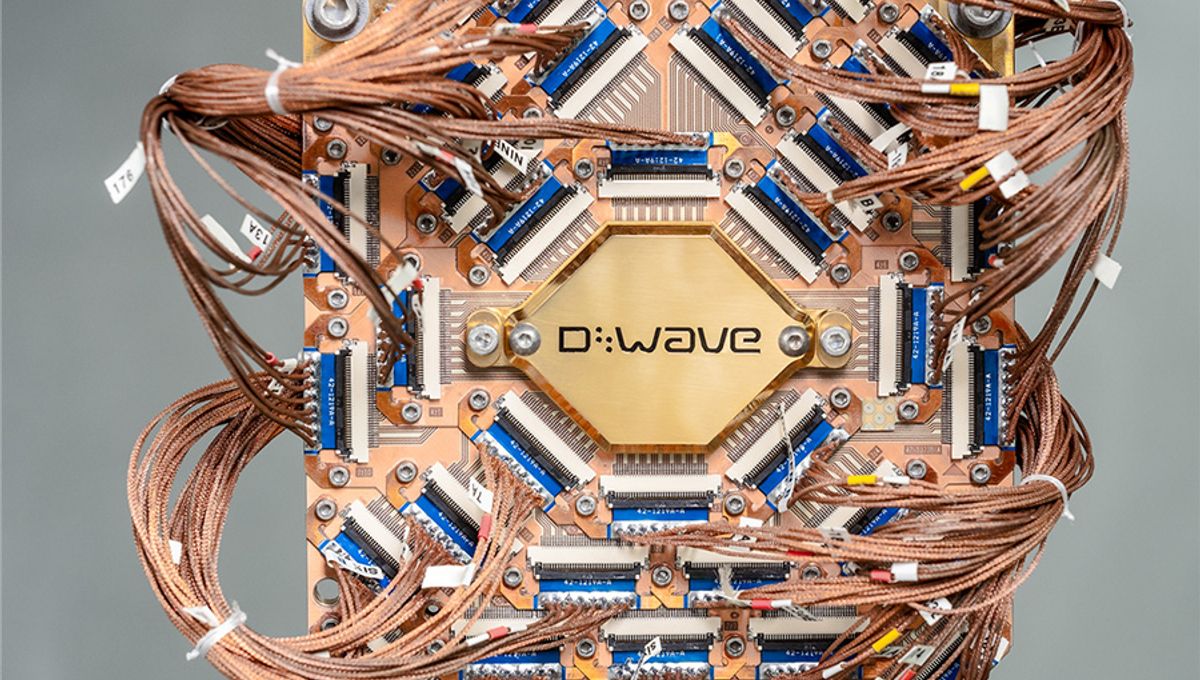
Quantum computing company D-Wave has claimed to have achieved “quantum supremacy” by solving a “useful, real-world problem” more efficiently with their quantum computer than a traditional one for the first time. However, not everyone is convinced by this declaration.
ADVERTISEMENT
Outlining their work in a new study, the North American tech company argues their quantum computer performed a complex magnetic materials simulation in minutes, with a level of accuracy that would take nearly one million years to achieve with a supercomputer.
Using D-Wave’s Advantage2 prototype quantum computer, researchers ran magnetic materials simulations that explore how tiny particles react to external influences. The team says the insights gained from the work could be used to enhance the properties of materials across a range of fields, from superconductors and sensors to medical imaging and motors.
According to D-Wave, their quantum computer was able to complete this “real-world” task faster and more efficiently than any supercomputer could dream of.
“This is a remarkable day for quantum computing. Our demonstration of quantum computational supremacy on a useful problem is an industry first. All other claims of quantum systems outperforming classical computers have been disputed or involved random number generation of no practical value,” Dr Alan Baratz, CEO of D-Wave, said in a statement.
“Our achievement shows, without question, that D-Wave’s annealing quantum computers are now capable of solving useful problems beyond the reach of the world’s most powerful supercomputers,” added Dr Baratz.
ADVERTISEMENT
Quantum computers exploit the strange properties of quantum mechanics – like superpositions and entanglement – to dramatically boost the power of computers. Unlike regular computers that use bits (binary digits, 0s and 1s), quantum computers use qubits. These can exist in multiple states at once, enabling them to solve certain complex problems exponentially faster than even the most powerful supercomputers (at least in theory).
The concept of “quantum supremacy” refers to when a quantum computer surpasses classical computers in solving certain calculations or tasks. While proving this claim can be tricky, many companies have previously claimed to have achieved such milestones.
Back in 2019, Google claimed it had achieved quantum supremacy after showing that its quantum computer took 200 seconds to sample one instance of a quantum circuit a million times. The Google team suggested that the same process would take the best supercomputer roughly 10,000 years.
However, some experts were dubious about Google’s declaration. IBM quickly responded to the claim, saying: “Google’s experiment is an excellent demonstration of the progress in superconducting-based quantum computing […] but it should not be viewed as proof that quantum computers are ‘supreme’ over classical computers.”
ADVERTISEMENT
There have also been some doubts voiced about D-Wave’s latest work, with some saying classical computers can achieve similar results. Speaking to New Scientist, Dries Sels from New York University said he and his colleagues have attempted similar calculations and achieved comparable results with a conventional laptop.
Dr Andrew King, senior distinguished scientist at D-Wave, rebutted this by saying: “They didn’t do all the problems that we did, they didn’t do all the sizes we did, they didn’t do all the observables we did, and they didn’t do all the simulation tests we did.”
Whatever stance you take, D-Wave’s latest research does show that quantum computers are starting to make ripples in the real world.
The new study is published in the journal Science.

Source Link: A Computer Has Achieved "Quantum Supremacy" On Real-World Problem For First Time, Company Claims
