• Email Us: [email protected]
  • Contact Us: +1 718 874 1545
  • Skip to main content
  • Skip to primary sidebar

Medical Market Report

  • Home
  • All Reports
  • About Us
  • Contact Us

Bizarre Insect Filmed In The Amazon Is Strangely Beautiful

May 27, 2023 by Deborah Bloomfield

Planet Earth is full of weird and wonderful creatures, which is never more apparent than in the insect world. Some insects can fly on broomsticks, are surprisingly good thespians, and even fling their pee to conserve energy. And then some, like this alligator bug, just look downright bizarre.

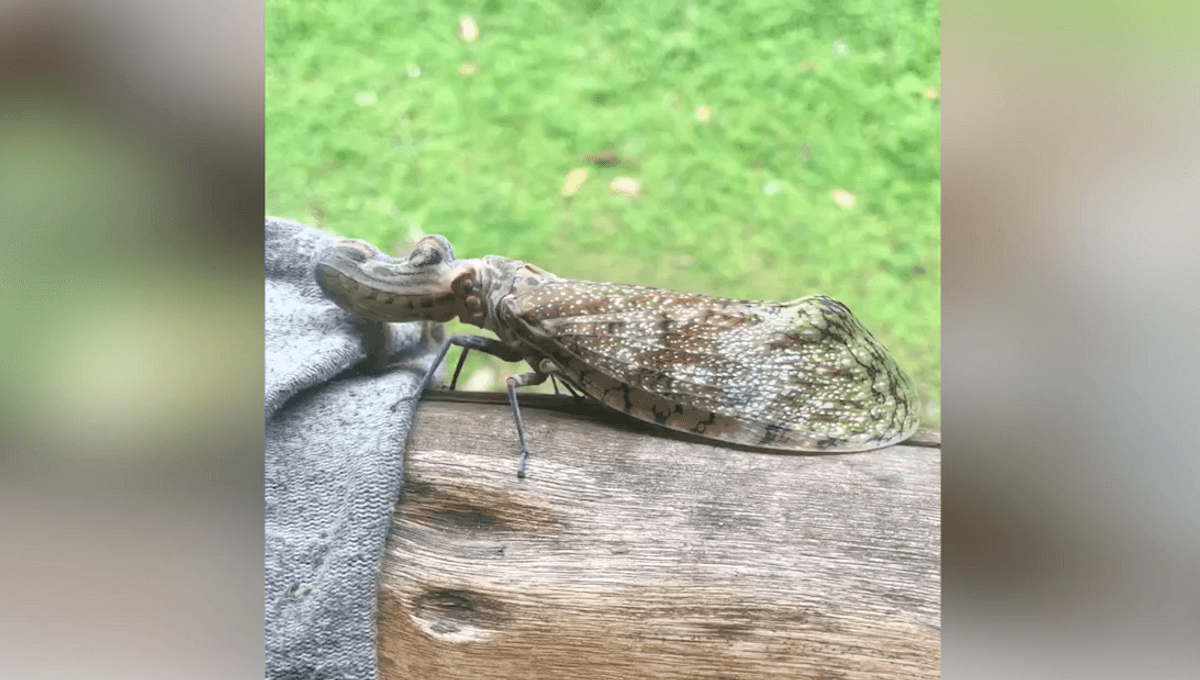
Recently, footage of a very unusual large winged insect was taken by a man living in the Amazon. On closer inspection, the critter turned out to be an alligator bug, also called a peanut-headed bug (Fulgora laternaria), a type of lanternfly. 

Advertisement

ⓘ IFLScience is not responsible for content shared from external sites.

These names are slightly misleading, though. The protrusion on the front of the insect is not the head at all but a structure that is used in predator defense. A closer look, and a bit of imagination when looking at the front of the insect, reveals a false lizard face in the structure that is used to deter other lizards from having a tasty snack on the lanternfly. 

Both male and female lanternflies possess this unusual “peanut” structure which comes in many different forms depending on the species. This also gives rise to the name alligator bug, as some people think the false face resembles that of an alligator or caiman.

Advertisement

There is also some suggestion that the peanut protrusion acts as a sound resonator, amplifying the critters’ sounds through the forest, as they knock their hollow peanuts on tree trunks to make noises. 

The term “lanternfly” is also misleading as these insects have no light-creating abilities like fireflies or bioluminescence. 

As you can see in the video, the alligator bug is a pretty large insect and can measure around 10 centimeters (3.9 inches) long. When the wings are open the creature has a maximum wingspan of around 15 centimeters (5.9 inches). These wings feature false eye spots, another predator defense technique.  

This species is found in Central and South America across, Brazil, Honduras, Mexico, and Panama where they feed on plant sap. This contributes to another predator defense; when threatened the bugs can release a foul-smelling chemical, produced by the resin the lanternfly consumes. 

Deborah Bloomfield
Deborah Bloomfield

Related posts:

  1. Canadian PM Trudeau not sorry for snapping at protester who insulted his wife
  2. Cricket-Kohli becomes first Indian to reach 10,000 runs in T20 cricket
  3. Congo’s $6 billion China mining deal ‘unconscionable’, says draft report
  4. Man Waggling His Willy At Leopards Found On World’s Earliest Narrative Art

Source Link: Bizarre Insect Filmed In The Amazon Is Strangely Beautiful

Filed Under: News

Primary Sidebar

  • In 1940, A Dog Investigated A Hole In A Tree And Discovered A Vast Cave Filled With Ancient Human Artwork
  • “Time Is Not Broken”: US Officials Work To Correct Time, After Discovering It Is 4.8 Microseconds Out
  • The Evolutionary Reason Why Rage Bait Affects Us – And How To Deal With It This Holiday Season
  • Whales Living To 200 May Actually Be The Norm – There’s A Sad Reason Why We Don’t Know Yet
  • IFLScience The Big Questions: Can Magic Be Used As A Tool In Science?
  • Sheep And… Rhinos? There’s A Very Cute Reason You See Them Hanging Out Together
  • Why Does The Latest Sunrise Of The Year Not Fall On The Winter Solstice?
  • Real Or Fake Christmas Trees: Which Is Better For The Environment?
  • “Cosmic Dipole Anomaly” Suggests That Our Universe May Be “Lopsided”, Seriously Challenging Our Understanding Of The Cosmos
  • Which Animals Mate For Life?
  • Why Is Rainbow Mountain So Vibrantly Colorful?
  • “It’s An Incredible Feeling”: Salty Air Bubbles In 1.4-Billion-Year-Old Crystals Reveal Secrets Of Earth’s Early Atmosphere
  • These Were Some Of The Most Significant Scientific Experiments Of 2025
  • Want To Know What 2026 Has In Store? The Mesopotamians Have A Tip, But You’re Not Going To Like It
  • Can Woolly Bear Caterpillars Predict Winter Weather? No – But They Do Have A Clever Way To Survive The Freeze
  • Is Showering More Hygienic Than Bathing – What Does The Science Say?
  • Why Is Christmas Called Xmas?
  • Stardust Didn’t Reach The Solar System The Way We Thought, So How Did It Get Here?
  • This Might Be The First Time We’ve Ever Seen A Gravitational Wave Event Gravitationally Lensed
  • Carnivorous, Enormous, And Corpse-Scented: What Are The Rarest Plants On Earth?
  • Business
  • Health
  • News
  • Science
  • Technology
  • +1 718 874 1545
  • +91 78878 22626
  • [email protected]
Office Address
Prudour Pvt. Ltd. 420 Lexington Avenue Suite 300 New York City, NY 10170.

Powered by Prudour Network

Copyrights © 2025 · Medical Market Report. All Rights Reserved.

Go to mobile version