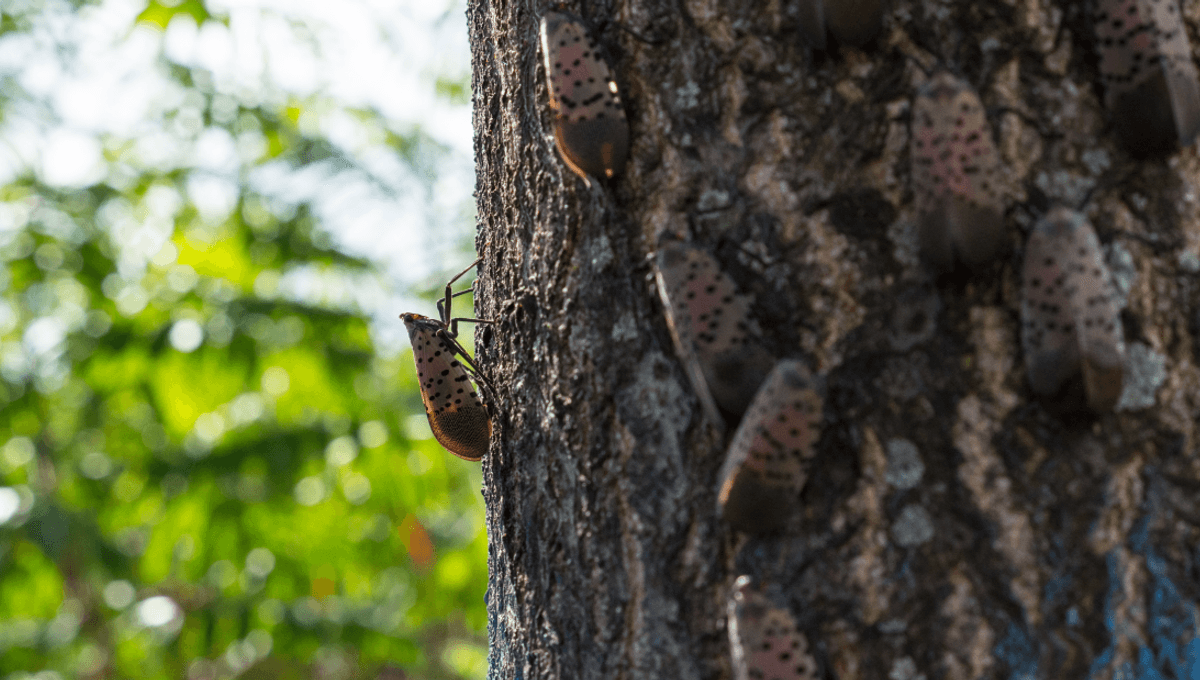
Scientists are upping their game in the fight against a “double invasion” that’s currently sweeping across Virginia in the US. Here, the invasive “tree of heaven” is providing prime real estate for another invader: the spotted lanternfly.
The tree of heaven, known to science as Ailanthus altissima, was brought to the United States back in the 1700s. It was celebrated for its ornamental value, but as a fast-growing species, it has since dominated roadsides, forests, and fields.
“It grows fast, releases chemicals that harm native plants, and now it’s helping the spotted lanternfly spread,” said Carrie Fearer, an assistant professor of forest pathology at Virginia Tech, in a statement sent to IFLScience. “It’s a double invasion.”
“If you remove the tree, you remove their main food source. That directly reduces their numbers and their ability to spread to crops and vineyards.”
The spotted lanternfly (Lycorma delicatula) has become something of an Undesirable Number One when it comes to invasive species. To the untrained eye, their colorful wings might look like those of a butterfly, but these nomadic planthoppers have been causing chaos as they spread from their native home of China.
They leave a wake of destruction in the form of honeydew, which is excreted as a waste product. It encourages the growth of sooty mold, a kind of fungus. Lanternflies can gather in enormous numbers on a single tree of heaven, and the more insects that are present, the worse that fungal growth can become.
Sooty mold is a fungal disease that can inhibit plant growth by hampering their ability to photosynthesize and create the energy they need to grow. Not such a problem if lanternflies were only aggregating on the invasive tree of heaven, but they’re partial to many botanical species in their adopted homes.
That said, they can’t survive without the tree of heaven. Without it, they grow more slowly, reproduce less, and become easier targets because they lose their superpower: diet-derived chemicals that make them toxic to birds.
Fungus may be at the root of the problem, but it could also be a part of the solution.
“We’re studying a native fungus, Verticillium nonalfalfae, that infects and kills tree of heaven,” said Fearer. “It’s a biological control. Instead of cutting or spraying, we use a pathogen already found in our forests to weaken and kill this invasive tree.”
“Managing tree of heaven with a biological control would be more cost-effective than repeated pesticide treatments for spotted lanternflies. Removing tree of heaven makes a field less attractive to spotted lanternfly, so spotted lanternfly populations will be lower and growers will end up using less insecticide and protecting more crops in the long run.”
So, how can Virginia residents help? A good place to start is by learning to identify the tree of heaven and removing it where you can. Being on the lookout for trees showing the symptoms of sooty mould is also a good indicator that spotted lanternflies could be afoot.
Visit the USDA website for more advice on the tree of heaven and spotted lanternfly.

Source Link: Invasive “Tree Of Heaven” Unleashes Hell As “Double Invasion” Sweeps Across Virginia
