• Email Us: [email protected]
  • Contact Us: +1 718 874 1545
  • Skip to main content
  • Skip to primary sidebar

Medical Market Report

  • Home
  • All Reports
  • About Us
  • Contact Us

JWST Delivers Insights Into How The Southern Nebula Was Carved

December 9, 2022 by Deborah Bloomfield

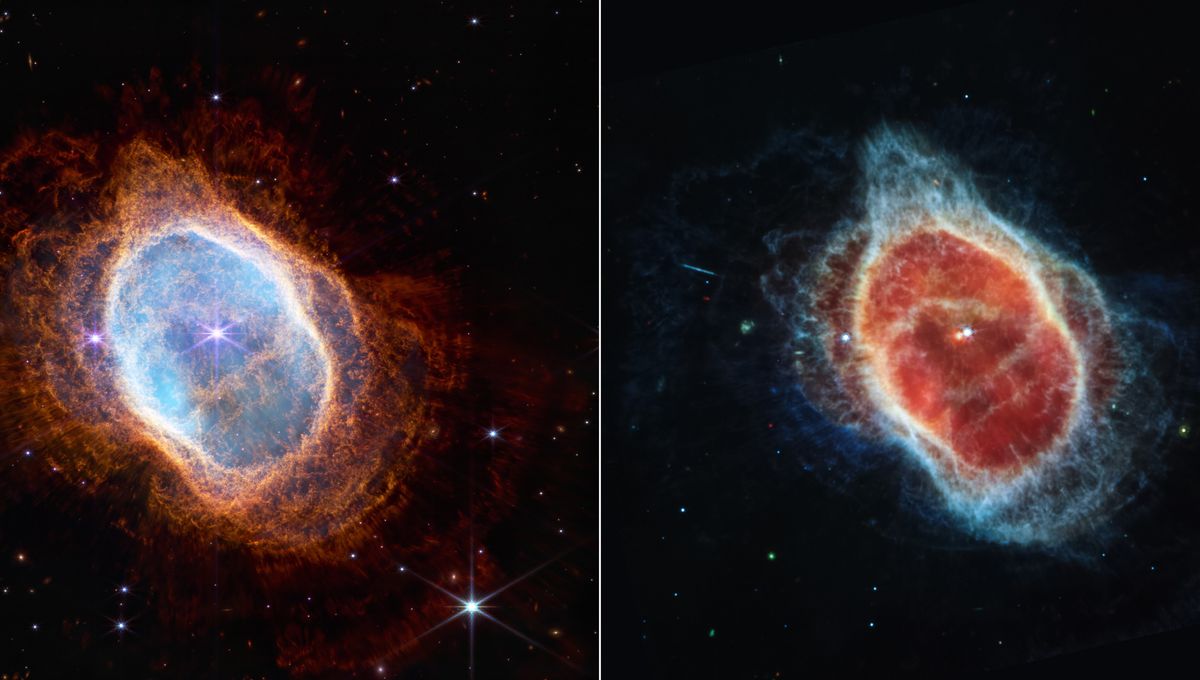
The Southern Ring Nebula was one of the first science targets of JWST. The celestial object is a planetary nebula, created by the release of material from a red giant as it turns into a white dwarf – but a new analysis suggests that is not the whole story. Astronomers now believe that there are more players involved: At least four stars might be behind the structure we see.

The nebula is about 2,000 light-years from Earth. In one of the JWST images, it is possible to see the white dwarf and a companion star. However, there’s more than meets the eye, even with the incredible eye of the latest great space observatory. Two more stars are expected to be around the white dwarf.

Advertisement

“Technically we did not see them, but we inferred their presence. We only ‘see’ the main star and the farthest companion – the one that did not really play an active role in the formation of the nebula,” lead author Dr Orsola De Marco from Macquarie University, told IFLScience. “We are however becoming accustomed to the fact that stars ‘hunt in packs’!”

Detailed analysis of the near-infrared and mid-infrared observations from JWST suggests that a close companion to the white dwarf is presently hidden by a disk around the central star. Past interactions in this disk are evidence of this unseen star. There are also arches inscribed in the large molecular halo of the nebula, attributed to another hidden companion orbiting this close pair.

“Multiple stellar systems are not rare, particularly as the system is more massive (while 0.5 solar mass stars do not often have companions less massive than themselves, 100 solar mass stars always have MANY companions). We know that for a fact now, so it is not surprising that planetary nebulae central stars are also in multiple systems. When the star evolves it expands into the orbits of the companion(s) and an interaction usually ensues,” Dr De Marco told IFLScience.  

Advertisement

The detailed observations, combined with the models, allow a much clearer understanding of the system, plus a precise estimate of the mass of the progenitor star: about 2.86 times the mass of our Sun.

These results can be foundational for future JWST work on planetary nebulae as well as other complex systems of wind interactions, such as supernovae and events that produce strong gravitational waves.

The paper is published in the journal Nature Astronomy.

Deborah Bloomfield
Deborah Bloomfield

Related posts:

  1. Former Germany defender Boateng guilty of bodily harm, fined 1.8 million euros
  2. Soccer-Lukaku a distant memory as free-scoring Inter start in style
  3. Accenture expects strong Q1 as Delta variant delays return-to-work plans
  4. High Alpha opens third venture studio: co-founder calls venture market ‘hot and crazy’

Source Link: JWST Delivers Insights Into How The Southern Nebula Was Carved

Filed Under: News

Primary Sidebar

  • One Of The World’s Rarest, Smallest Dolphins May Have Just Been Spotted Off New Zealand’s Coast
  • Gaming May Be Popular, But Can It Damage A Resume?
  • A Common Condition Makes The Surinam Toad Pure Nightmare Fuel For Some People
  • In 1815, The Largest Eruption In Recorded History Plunged Earth Into A Volcanic Winter
  • JWST Finds The Best Evidence Yet Of A Lava World With A Thick Atmosphere
  • Officially Gone: After 40 Years MIA, Australia’s Only Shrew Has Been Declared “Extinct”
  • Horrifically Disfigured Skeleton Known As “The Prince” Was Likely Mauled To Death By A Bear 27,000 Years Ago
  • Manumea, Dodo’s Closest Living Relative, Seen Alive After 5-Year Disappearance
  • “Globsters” Like The St Augustine Monster Have Been Washing Up For Centuries, But What Are They?
  • ADHD Meds Used By Millions Of Kids And Adults Don’t Work The Way We Thought They Did
  • Finding Diamonds Just Got A Whole Lot Easier Thanks To Science
  • Why Didn’t The World’s Largest Meteorite Leave An Impact Crater?
  • Why Do We Cry? Find Out More In Issue 42 Of CURIOUS – Out Now
  • How Many Senses Do Humans Have? It Could Be As Many As 33
  • 6 Astronomical Events To Look Forward To If You Live Long Enough
  • Atmospheric Rivers Have Shifted Toward Earth’s Poles Over The Past 40 Years, Bringing Big Weather Changes
  • Is It Time To Introduce “Category 6” Hurricanes?
  • At The Peak Of The Ice Age, Humans Built Survival Shelters Out Of Mammoth Bones
  • The World’s Longest Continuously Erupting Volcano Has Been Spewing Lava For At Least 2,000 Years
  • Rare Flat-Headed Cat Rediscovered In Thailand Following First Confirmed Sighting In Almost 30 Years
  • Business
  • Health
  • News
  • Science
  • Technology
  • +1 718 874 1545
  • +91 78878 22626
  • [email protected]
Office Address
Prudour Pvt. Ltd. 420 Lexington Avenue Suite 300 New York City, NY 10170.

Powered by Prudour Network

Copyrights © 2025 · Medical Market Report. All Rights Reserved.

Go to mobile version