• Email Us: [email protected]
  • Contact Us: +1 718 874 1545
  • Skip to main content
  • Skip to primary sidebar

Medical Market Report

  • Home
  • All Reports
  • About Us
  • Contact Us

New Footage Shows 90-Meter-Tall Fiery Fountains Of Lava At Kīlauea In Hawaiʻi

December 24, 2024 by Deborah Bloomfield

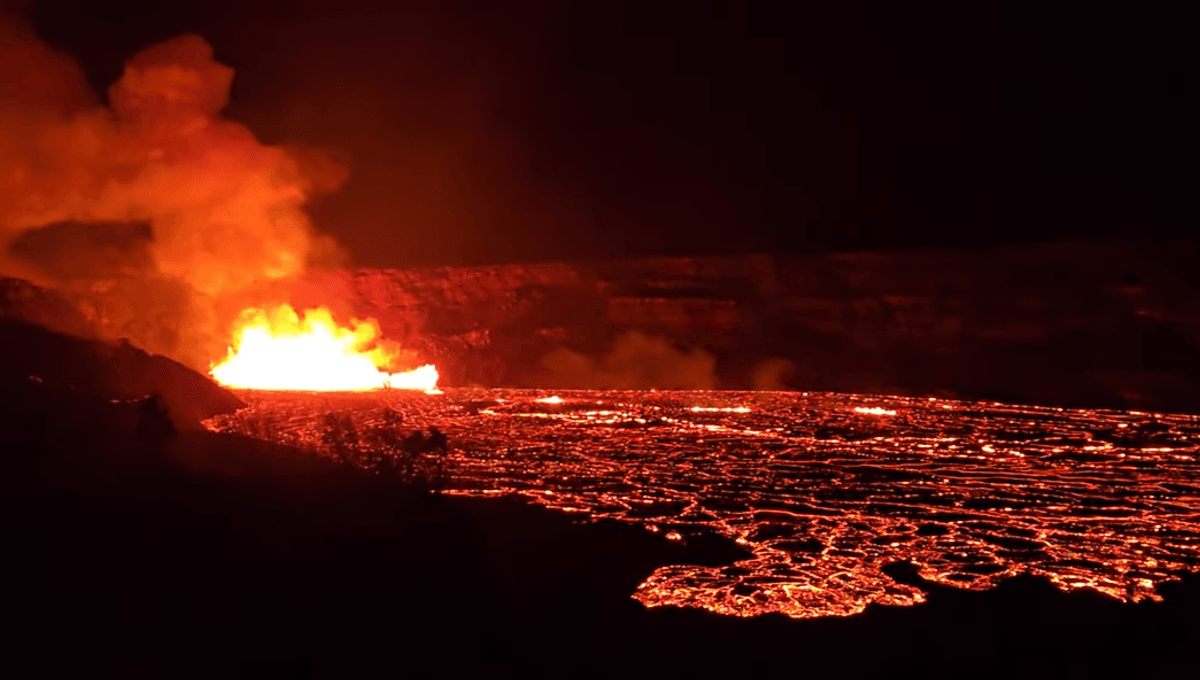
Kīlauea in Hawaiʻi started bursting with lava and belching out volcanic gas in the early hours of Monday morning, providing onlookers with a red-hot spectacle. The eruption began around 2:20 AM local time on December 23, according to the USGS Hawaiian Volcano Observatory.

Lake-loads of lava have already been pumped out of the volcano. The area currently covered is approximately 1 meter (3.3 feet) deep and spans around 2.6 square kilometers (1 square mile) of the caldera, which is named Kaluapele. Elsewhere, fountains of lava have been estimated to spew up to 90 meters (300 feet) in the air.

Advertisement

The current Volcano Alert Level is currently Watch and the Aviation Color Code is Orange, meaning the hazard risk is limited. While there’s likely no immediate threat to human life or infrastructure, the volcano is pumping out a “very high” level of volcanic gas. These fumes can be rich in sulfur dioxide, a toxic gas that can be irritating to the eyes, skin, and respiratory system. As such, people with breathing or heart issues, as well as those who are pregnant, should be particularly wary.

Despite the risk warning, the scene has attracted some significant crowds and packed nearby carparks. You can still visit the area at Hawaiʻi Volcanoes National Park, just be sure to follow the precautions available on the NPS website.


One of those lucky enough to witness the eruption was Aaron Monson, a local man who told Storyful that he and his wife “live close enough to the volcano to see the glow when it starts erupting at night.” His wife spotted the red glow from the volcano in the early hours of Monday, leading them to head to the park to capture some stunning footage (above).

Advertisement

The lava flows from Kīlauea are typically basaltic, which is low in viscosity like thick syrup, and produces glowing red-orange rivers of molten rock that can ooze for long distances.

Located on the southeastern coast of the Big Island of Hawaiʻi, Kīlauea is one of the most active volcanoes on Earth. The volcano erupted nearly continuously from 1983 to 2018 and has since displayed periodic activity, with eruptions occurring sporadically in recent years. Its name means “much spreading” or “to spew” in Hawaiian, reflecting its tendency to frequently erupt. 

The region is also home to the nēnē, a rare Hawaiian goose.  If you’re heading to Hawaiʻi Volcanoes National Park to catch a glimpse of the eruption, be sure to drive carefully and avoid getting too close to the birds, as you could disrupt their precious mating season.

Deborah Bloomfield
Deborah Bloomfield

Related posts:

  1. Cricket-Manchester test likely to be postponed after India COVID-19 case
  2. EU to attend U.S. trade meeting put in doubt by French anger
  3. Soccer-West Ham win again, Leicester and Napoli falter
  4. Lacking Company, A Dolphin In The Baltic Is Talking To Himself

Source Link: New Footage Shows 90-Meter-Tall Fiery Fountains Of Lava At Kīlauea In Hawaiʻi

Filed Under: News

Primary Sidebar

  • IFLScience The Big Questions: Can Magic Be Used As A Tool In Science?
  • Sheep And… Rhinos? There’s A Very Cute Reason You See Them Hanging Out Together
  • Why Does The Latest Sunrise Of The Year Not Fall On The Winter Solstice?
  • Real Or Fake Christmas Trees: Which Is Better For The Environment?
  • “Cosmic Dipole Anomaly” Suggests That Our Universe May Be “Lopsided”, Seriously Challenging Our Understanding Of The Cosmos
  • Which Animals Mate For Life?
  • Why Is Rainbow Mountain So Vibrantly Colorful?
  • “It’s An Incredible Feeling”: Salty Air Bubbles In 1.4-Billion-Year-Old Crystals Reveal Secrets Of Earth’s Early Atmosphere
  • These Were Some Of The Most Significant Scientific Experiments Of 2025
  • Want To Know What 2026 Has In Store? The Mesopotamians Have A Tip, But You’re Not Going To Like It
  • Can Woolly Bear Caterpillars Predict Winter Weather? No – But They Do Have A Clever Way To Survive The Freeze
  • Is Showering More Hygienic Than Bathing – What Does The Science Say?
  • Why Is Christmas Called Xmas?
  • Stardust Didn’t Reach The Solar System The Way We Thought, So How Did It Get Here?
  • This Might Be The First Time We’ve Ever Seen A Gravitational Wave Event Gravitationally Lensed
  • Carnivorous, Enormous, And Corpse-Scented: What Are The Rarest Plants On Earth?
  • What Are Nieves Penitentes? The Strange Icy Spikes Found In Some Of Earth’s Most Alien Landscapes
  • What Killed One Of The World’s Biggest Crocs? A Necropsy Of Cassisus Suggests A Hidden Killer
  • Avi Loeb Says Interstellar Object 3I/ATLAS Is “Most Likely Natural” As It Heads Away From Earth
  • For The First Time, Moths Have Been Captured On Camera Feeding On Moose Tears
  • Business
  • Health
  • News
  • Science
  • Technology
  • +1 718 874 1545
  • +91 78878 22626
  • [email protected]
Office Address
Prudour Pvt. Ltd. 420 Lexington Avenue Suite 300 New York City, NY 10170.

Powered by Prudour Network

Copyrights © 2025 · Medical Market Report. All Rights Reserved.

Go to mobile version