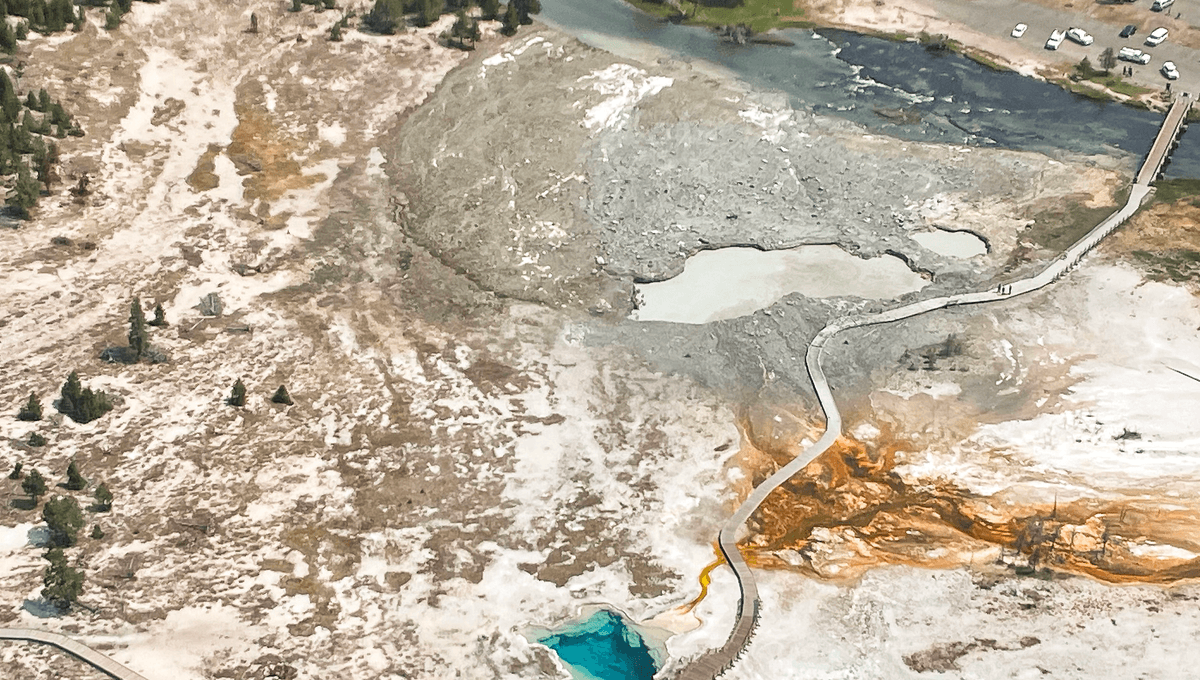
A hydrothermal explosion in the Biscuit Basin thermal area of Yellowstone National Park that sent visitors running has been captured on video. The area has been temporarily closed, and damaged boardwalks need repair, but no injuries have been reported. More importantly, the explosion is unlikely to be a forerunner of anything bigger, with other activity at normal levels. Those hankering for the entire Yellowstone supervolcano to erupt in an event that would block the Sun around the planet will have to wait a little longer.
Yellowstone is one of America’s most popular tourist attractions in large part for the geyser eruptions. Along with these spurts of water up to 90 meters (300 feet into the air), it contains a supervolcano 70 by 45 kilometers wide (43 by 28 miles) that has blown up roughly every 700,000 years, covering half of North America in ash. The geysers are harmless for anyone who stays on the boardwalk, but in between these two extremes of risk assessments are hydrothermal explosions.
“On Tuesday, July 23, at about 10:19 a.m., a localized hydrothermal explosion occurred near Sapphire Pool in Biscuit Basin, located just north of Old Faithful,” the National Park Service confirmed in a statement. “Biscuit Basin, including the parking lot and boardwalks, are temporarily closed for safety reasons.”
The dramatic footage was shot by Steve and Vlada March and shows the eruption, steam, and subsequent damage to the boardwalk by rocks caught in the blast.
The United States Geological Survey (USGS) has been keeping its Facebook page updated on the event. “The Biscuit Basin area is closed temporarily as the Yellowstone National Park staff assess conditions,” the page notes, adding “In Yellowstone, hydrothermal explosions are violent and dramatic events that can occur with little to no warning. They occur in shallow reservoirs of fluids are at or near the boiling point. The fluids can flash to steam if the pressure suddenly drops, hurling boiling water, steam, mud, and rock fragments into the air.”
Lisa Morgan, a research geologist with the USGS described these explosions as “One of the most important and least understood geologic hazards in Yellowstone,” in an article for the Yellowstone Caldera Chronicles, a USGS publication. They’re not to be confused with the more familiar magmatic eruptions that have laid waste to cities and caused global famines. The USGS notes “The deeper magmatic system appears to be unaffected by these spectacular explosions within the hydrothermal system.”
“Hydrothermal explosions require a sudden drop in pressure, which causes rapid expansion of high-temperature fluids, fragmentation, ejection of debris, and crater formation,” Morgan wrote. “The northern Yellowstone Lake area is a locus of numerous past hydrothermal explosions and is an ideal natural laboratory for detailed research into the timing and triggering mechanisms of these poorly understood hazards.”
Being less dangerous than magmatic eruptions does not mean hydrothermal explosions are risk-free, as the video demonstrates. The park’s Mary Bay explosion crater is 2.5 kilometers (1.6 miles) across, the largest crater attributed to a hydrothermal explosion anywhere on the planet. The consequences of being anywhere in the vicinity 13,000 years ago when it was formed can be guessed. Yellowstone has three other large craters from hydrothermal events in the same area, the most recent of which was produced by an eruption 2,900 years ago.
The largest hydrothermal explosion of which we have recorded witnesses came from the late 19th century, leaving rocks the size of houses high in the air.
Clearly, yesterday’s event was not on the same scale. Nevertheless, the steam from the eruption could easily kill anyone too close by. Had some of those seen fleeing the event paused, or simply been unable to run, debris falling from the heights shown could also be lethal.
Smaller hydrothermal explosions happen almost every year somewhere in Yellowstone, but usually not somewhere that attracts as many tourists as the Sapphire Pool, where this occurred, nor at such a peak time.
Consequently, there is a known risk with getting this close to the geysers, even if it is not on the scale of driving into one of Yellowstone’s hot acidic lakes. Even if staying in designated areas does not keep you completely safe, stepping outside them is more dangerous still, which sadly has not stopped some people, including those who seem to think their fame protects them.
Morgan’s research has revealed a variety of triggers for hydrothermal explosions. One of the largest eruptions occurred when an earthquake ruptured a hydrothermal dome. The other followed a sudden dramatic drop in the level of a lake at the surface, although that too could have had seismic activity as its ultimate cause. The change in pressure increased steam production, with disastrous results.
Given that variation, identifying the cause of today’s event may take some time.

Source Link: Watch As Surprise Yellowstone Eruption Sends Rocks Flying And Visitors Fleeing
