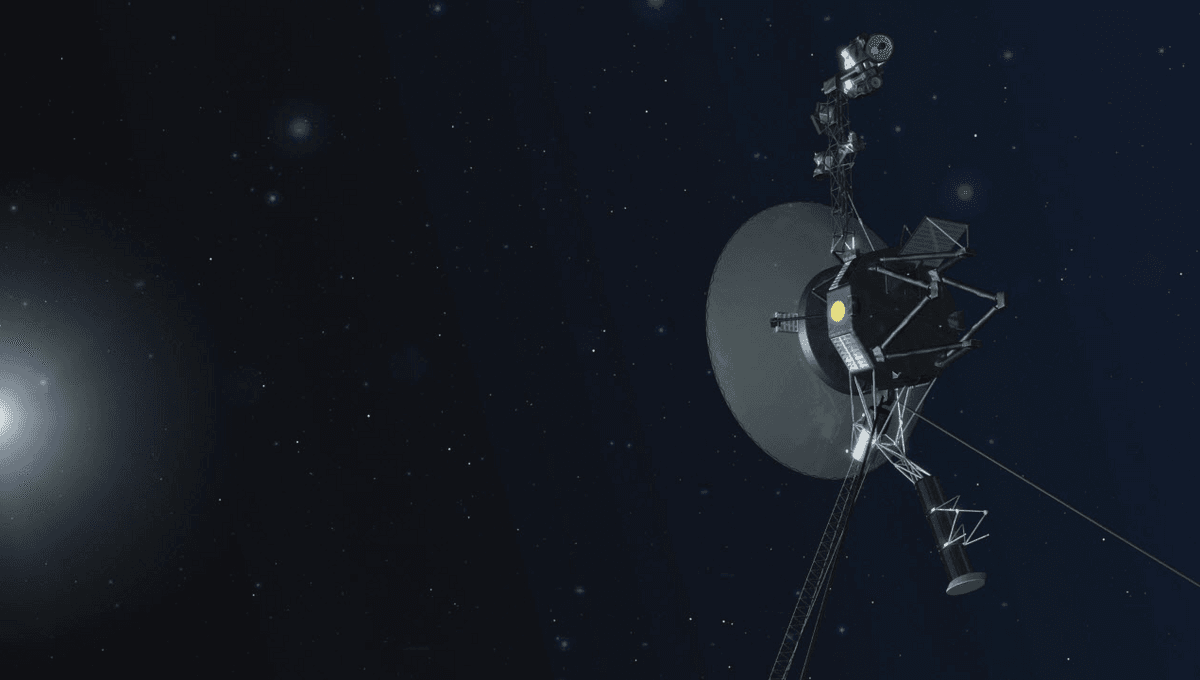
Well, that didn’t take long. Having picked up what they called Voyager 2’ “Heartbeat” on Wednesday, by Friday NASA had restored communications. It seems you can’t keep a good spacecraft down, and Voyager 2 is undoubtedly one of the best.
After visiting Jupiter, Saturn, Uranus, and Neptune and returning arguably the richest treasure trove of scientific data from a single space mission, Voyager 2 has kept on moving out of the Solar System. Its best days may be behind it, but it’s still returning useful information as one of the few spacecraft ever to pass the heliopause into interstellar space, and currently the second most distant of humanity’s emissaries.
On July 11 incorrect instructions were sent to Voyager 2, which led to its reorientating its main antenna by 2 degrees, enough to stop it from sending or receiving messages from Earth. Although programmed to reset its alignment every few months, the next such date is not until October, and waiting that long was considered undesirable.
On August 2, the Jet Propulsion Laboratory (JPL) announced radio telescopes had combined to detect Voyager 2’s carrier signal, despite it no longer being beamed directly at Earth. They referred to this as “A bit like hearing the spacecraft’s heartbeat.”
The carrier signal detection allowed NASA to know precisely where Voyager 2 was (right where expected, funnily enough) and that it was still operating. It was announced that as powerful radio signals as possible would be beamed at the craft in the hope it might pick them up despite the misalignment of the antenna. At the time the engineers responsible didn’t sound all that confident, and it seemed plan B of waiting for October might need to be adopted.
However, on Friday JPL’s page keeping track of the situation announced; “NASA has reestablished full communications with Voyager 2.”
As the page reported; “The agency’s Deep Space Network facility in Canberra, Australia, sent the equivalent of an interstellar “shout” more than 12.3 billion miles (19.9 billion kilometers) to Voyager 2, instructing the spacecraft to reorient itself and turn its antenna back to Earth. With a one-way light time of 18.5 hours for the command to reach Voyager, it took 37 hours for mission controllers to learn whether the command worked.”
The slow decline in power from its radioactive sources means Voyager 2 is losing the capacity to keep all its instruments operating. By the slightly risky move of turning off a regulator, NASA has found a way to keep everything important going until 2026, at which point it will become necessary to decide which instrument to turn off first.
One by one the instruments will have to be abandoned as power production declines until eventually the last one fails and one of humanity’s greatest inventions fails, but this is not that day.

Source Link: We’re Back: Communication With Voyager 2 Re-Established
