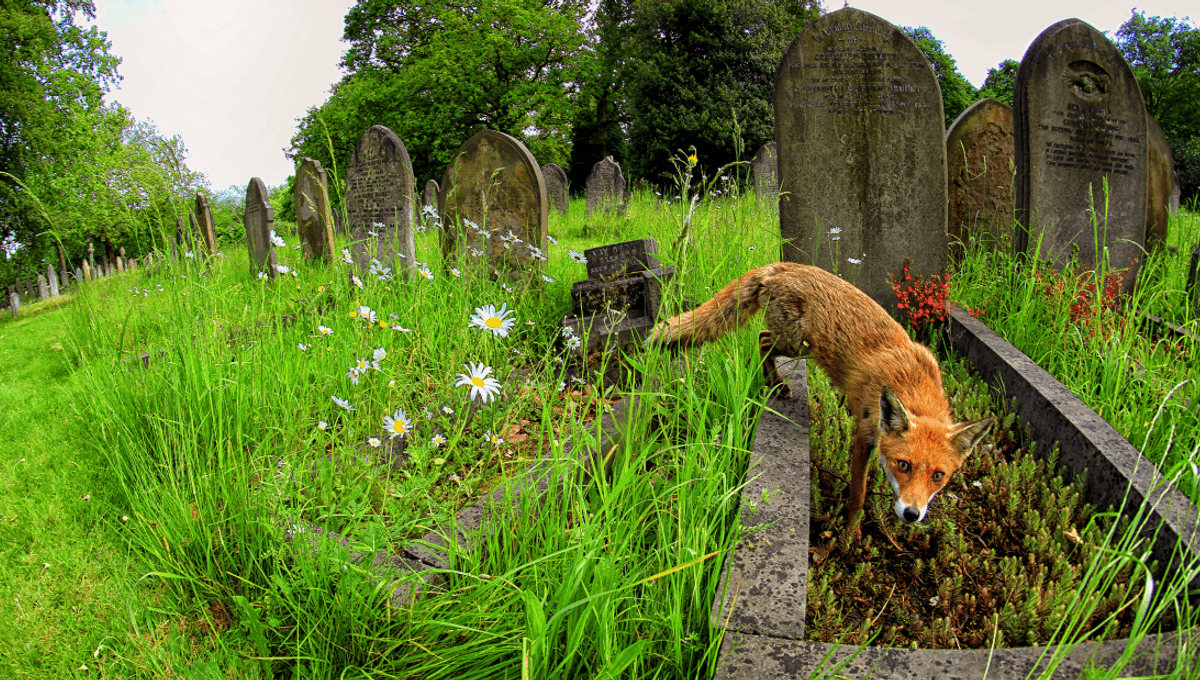
Death might be what first springs to mind when we think of cemeteries, but research has found that these often green, quiet, and undisturbed places can provide a valuable habitat for wildlife in urban areas. A new study has found that they can even be a hit for non-native species, as it revealed how the Italian girdled snail has become well-established in some of the bigger cemeteries in Berlin.
“Hygromia cinctella was found to be already well-established at the two larger studied cemeteries, the Wilmersdorf and Buschkrugallee cemeteries,” wrote the study authors. “At the old garrison cemetery, a single live individual, and at Turiner Strasse cemetery, only one old empty shell were found, indicating that establishment at these smaller cemeteries may be more difficult.”
In a 2022 paper, researchers described how cemeteries “often harbor high biodiversity,” which may actually be a motivation for the living to visit cemeteries. They conducted surveys to find out why people visited, with the top choices including “enjoying nature”, “mourning”, and “historical interest”.
People’s preferred features of cemeteries were the wildlife, solitude, and vegetation, indicating that interacting with nature was a comfort even for people who were grieving. “The results underscore the importance of cemeteries as multidimensional places and indicate tolerance for the inclusion of dead trees as important wildlife habitat,” the authors concluded. “Strategies to develop cemeteries as shared habitats for people and nature should also consider, besides socio-demographic background, the reasons for cemetery visits.”
Cemeteries sometimes represent the most undisturbed patches of land in urban areas, making them a focal point for biodiversity conservation. A 2019 review looked into the role they play using data from five continents and found that cemeteries and churchyards have a considerable conservation role, often acting like sanctuaries for rare and endangered species.
They identified that the key threats to the flora and fauna that rely on cemeteries were decreased grassland, intensified land management through mowing and logging, and the introduction of invasive species. To avoid these, they suggest a return to a more spiritual outlook on cemeteries.
“As conservation and spirituality is tightly interwoven in cemeteries, the preservation of these refuges can be achieved by the reconstruction of their sacred spirituality, by raising the attention of local populations for the natural values of these areas and also by specific, focused management providing proper habitats for the natural flora and fauna,” the authors write.
So, the next time you’re visiting a cemetery, let your gaze stray from the headstones and you might just find that in remembering death you’re also surrounded by life. Finding a few nomadic snails is certainly preferable to the surprise archaeologists found in King Casimir’s tomb…

Source Link: Cemeteries Are Actually Teeming With Life, Acting Like Mini Wildlife Sanctuaries
