• Email Us: [email protected]
  • Contact Us: +1 718 874 1545
  • Skip to main content
  • Skip to primary sidebar

Medical Market Report

  • Home
  • All Reports
  • About Us
  • Contact Us

Is There Life Hiding Out In Ancient Caves On Mars?

August 29, 2023 by Deborah Bloomfield

Our hopes for finding life on Mars have been downgraded significantly over the years, from the 1870s when many believed we’d find a complex system of canals up there (and presumably a creature intelligent enough to have invented barge holidays to build them too). 

Now, we are on the hunt for microbial life on the planet, and sizing up the best place to look. Focus right now is on the Jezero Crater, where the Perseverance rover is currently searching for signs of ancient life. One idea, explored recently by NASA, is that life could be found underneath the Martian surface, in caves hosting similar conditions to caves found on Earth.

Advertisement

On Mars, we know that there are lava tubes, perhaps even large enough to shelter the first human astronauts from cosmic radiation bombarding the Red Planet. When these tubes formed on Mars, conditions were likely more similar to life on Earth, with flowing water, a warmer climate, and an atmosphere. 


Lava tubes in all their glory in this video from OzGeographics.

It’s possible that as conditions on the surface of the planet changed, and it lost its magnetic field and atmosphere, any life may have shifted underground. Here, Daniel Viúdez-Moreiras from Spain’s National Institute for Aerospace Technology calculated that UV radiation levels would be about 2 percent of the radiation levels found at the surface. 

Advertisement

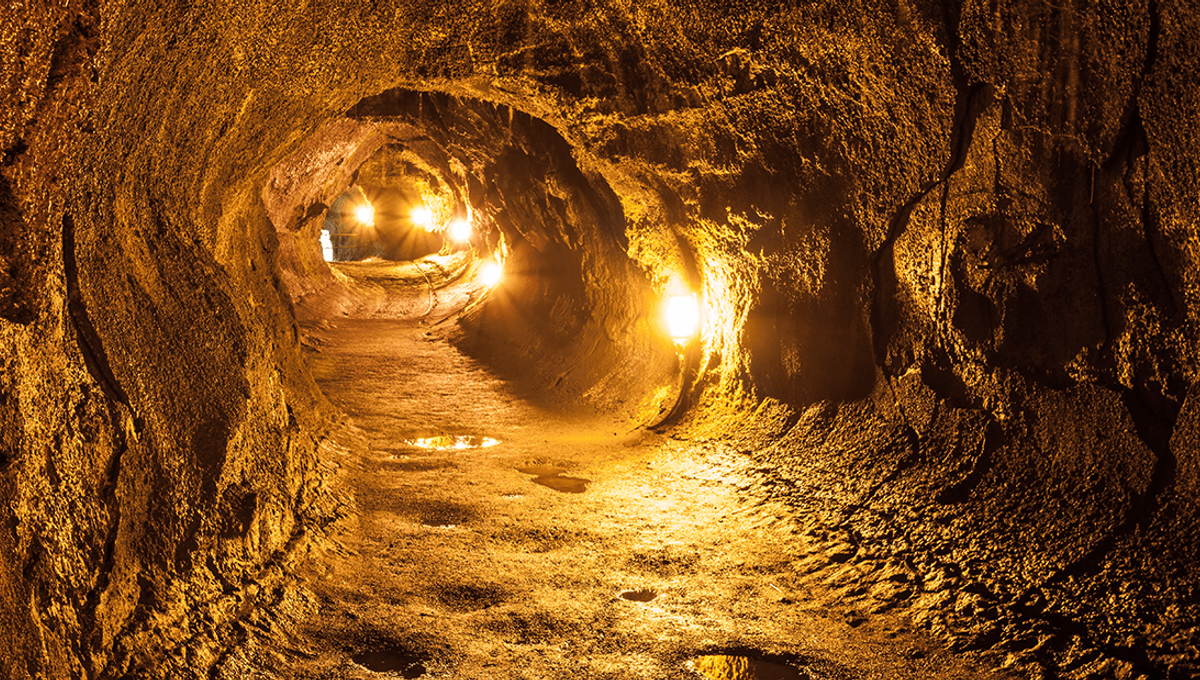
Finding extreme conditions here on Earth could let us know what life may look like in extreme conditions elsewhere in the Solar System, and fortunately for us lava tubes are found on the Earth too, including Hawai’i’s Mauna Loa volcano lava tubes recently explored by NASA. Within these caves, formed by lava flowing through a vent, life may be sheltered from surface conditions (which would be an advantage on Mars) but it is also sheltered from necessities such as sunlight.

Just as microbial life has been found drawing humidity from the air in the dry Atacama desert with similar conditions to Mars, life in caves appears to have, uh, found a way to thrive: existing off chemicals and nutrients inside the rocks.

“The microbes we found in Hawaii could be similar to microbes that once lived on Mars,” researcher Chloe Fishman explained to NASA following a trip to collect samples in April, “or even microbes that live there today.”

The team brought back samples from the cave, in order to sequence the genomes of microbes they found there. There are already plans to explore lava tubes on the Moon, so fingers crossed it won’t be too many decades before we can look for life in Martian caves. 

Advertisement

Of course, there’s a (slim) chance that this is all moot, and we already found life on Mars 50 years ago, before killing it.

Deborah Bloomfield
Deborah Bloomfield

Related posts:

  1. Harvard University to end investment in fossil fuels
  2. North Korea says call to declare end of Korean War is premature
  3. Mozambique president calls on insurgents to surrender after key militant killed
  4. Bomb Detector Rats’ Genitals Will Open And Close Several Times Through Their Lives

Source Link: Is There Life Hiding Out In Ancient Caves On Mars?

Filed Under: News

Primary Sidebar

  • US Just Killed NASA’s Mars Sample Return Mission – So What Happens Now?
  • Art Sleuths May Have Recovered Traces Of Da Vinci’s DNA From One Of His Drawings
  • Countries With The Most Narcissists Identified By 45,000-Person Study, And The Results Might Surprise You
  • World’s Oldest Poison Arrows Were Used By Hunters 60,000 Years Ago
  • The Real Reason You Shouldn’t Eat (Most) Raw Cookie Dough
  • Antarctic Scientists Have Just Moved The South Pole – Literally
  • “What We Have Is A Very Good Candidate”: Has The Ancestor Of Homo Sapiens Finally Been Found In Africa?
  • Europe’s Missing Ceratopsian Dinosaurs Have Been Found And They’re Quite Diverse
  • Why Don’t Snorers Wake Themselves Up?
  • Endangered “Northern Native Cat” Captured On Camera For The First Time In 80 Years At Australian Sanctuary
  • Watch 25 Years Of A Supernova Expanding Into Space Squeezed Into This 40-Second NASA Video
  • “Diet Stacking” Trend Could Be Seriously Bad For Your Health
  • Meet The Psychedelic Earth Tiger, A Funky Addition To “10 Species To Watch” In 2026
  • The Weird Mystery Of The “Einstein Desert” In The Hunt For Rogue Planets
  • NASA Astronaut Charles Duke Left A Touching Photograph And Message On The Moon In 1972
  • How Multilingual Are You? This New Language Calculator Lets You Find Out In A Minute
  • Europa’s Seabed Might Be Too Quiet For Life: “The Energy Just Doesn’t Seem To Be There”
  • Amoebae: The Microscopic Health Threat Lurking In Our Water Supplies. Are We Taking Them Seriously?
  • The Last Dogs In Antarctica Were Kicked Out In April 1994 By An International Treaty
  • Interstellar Comet 3I/ATLAS Snapped By NASA’s Europa Mission: “We’re Still Scratching Our Heads About Some Of The Things We’re Seeing”
  • Business
  • Health
  • News
  • Science
  • Technology
  • +1 718 874 1545
  • +91 78878 22626
  • [email protected]
Office Address
Prudour Pvt. Ltd. 420 Lexington Avenue Suite 300 New York City, NY 10170.

Powered by Prudour Network

Copyrights © 2026 · Medical Market Report. All Rights Reserved.

Go to mobile version