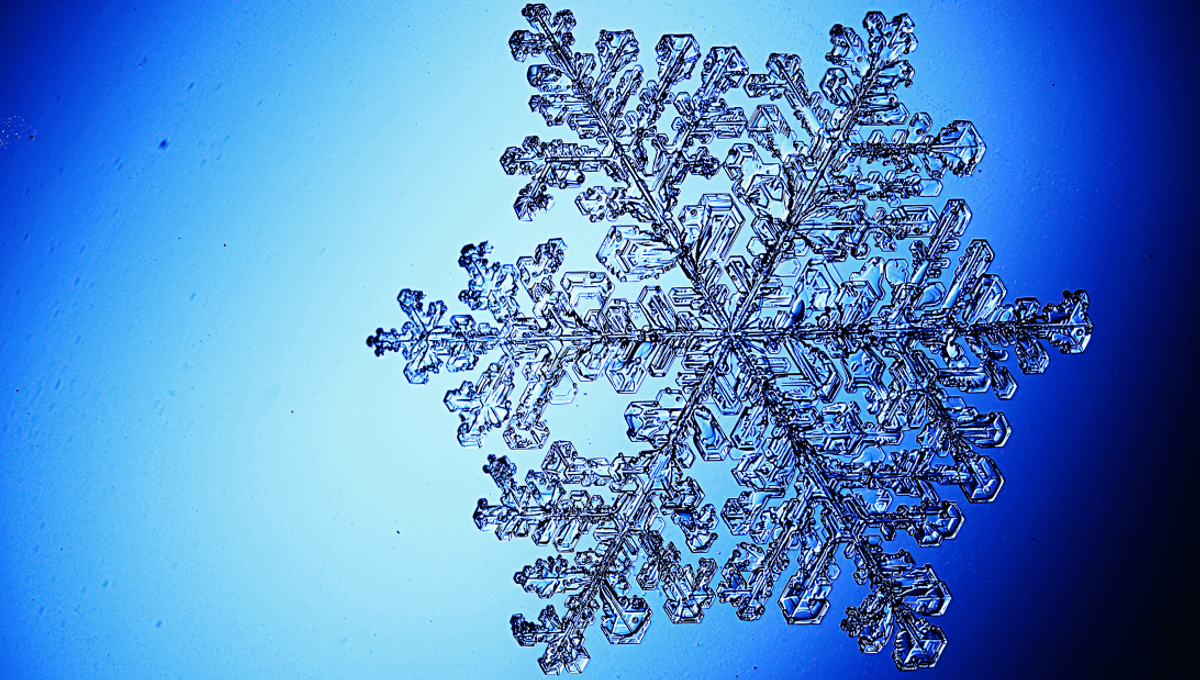
Snowflakes can be any old fleck that falls from a winter cloud, but when we talk about the individual structure that gets slapped all over festive decorations, we’re talking about snow crystals. Their growth pattern is dictated by environmental conditions, typically branching out with six-fold symmetry, but is there a limit to how big they can get? It depends on what you’re talking about.
“On the night of 27 January 1887, a fierce winter storm dropped snowflakes described as ‘larger than milk pans’ over the Clark Fork River valley, in the vicinity of a ranch owned by Matt Coleman, near Missoula in Montana, USA,” says Guinness World Records. “Reports suggest that they were up to 1 ft 3 in (38 cm) wide and 8 in (20 cm) thick.”
Here, the snowflake vs. snow crystal distinction becomes important because these monstrous pan-size snow droppings may have been clumps of many snow crystals smushed together. Snow crystals are the result of water freezing from a gas (vapor) straight to a solid (ice) without first becoming liquid, whereas a snowflake can be any old icy lump falling from the sky.
Someone who is very familiar with snow crystals is Professor of Physics at Caltech Dr Kenneth Libbrecht, whose career has tackled the mystery of why snow crystals form in different shapes. “That was a puzzle it just seemed like somebody should solve,” he told IFLScience. “That’s an embarrassment to the scientific community that we don’t know how that works. I mean, this stuff falls out of the sky.”
In his 20+ year career studying snow crystals, he’s established a model that can explain why different temperatures give rise to different structures, as well as tackling the question “Are no two snowflakes alike?” by creating what he termed “identical twin” crystals in a lab setting.
After looking at so many, it’s no surprise that the record for the largest individual snow crystal is attributed to one of Libbrecht’s observations in the wild. He found a massive crystal that measured 10 millimeters (0.39 inches) from tip to tip. Might not sound that big, but considering your typical stellar dendrite is around 2 to 4 millimeters in diameter, it’s actually pretty enormous.
Just like birdwatching, snow crystal enthusiasts observe snowflakes to see what crystalline structures they can ID. Want to try it and see if you can top Libbrecht’s record?? Here are some of his top tips:
- Wear something warm with a dark sleeve – you need a backdrop for your snow crystal to land on.
- Take a magnifier – 5X should do it and cost less than $5.
- Know your snowflakes – just like how you need to know the species to see the birds, you’ve got to know your snow crystal before you can spot them in the wild. Libbrecht wrote what he calls a “field guide to snowflakes”, or you can find photographs and videos of different kinds on his website.
Then, all you need is some cold weather and a bit of patience.
[H/T: Live Science]

Source Link: The Biggest Snowflake Ever Reported Was As Wide As A Large Pizza
