• Email Us: [email protected]
  • Contact Us: +1 718 874 1545
  • Skip to main content
  • Skip to primary sidebar

Medical Market Report

  • Home
  • All Reports
  • About Us
  • Contact Us

AI Chemist Brings Us One Step Closer To Breathing On Mars

November 14, 2023 by Deborah Bloomfield

“Mars ain’t the kind of place to raise your kids,” sang Elton John. It is not just cold as hell, it lacks a lot of the basic necessities that humans need to survive, including oxygen to breathe. And given that we would like to get humans there at some point, and bringing stuff from Earth is expensive, that is a problem that needs solving.

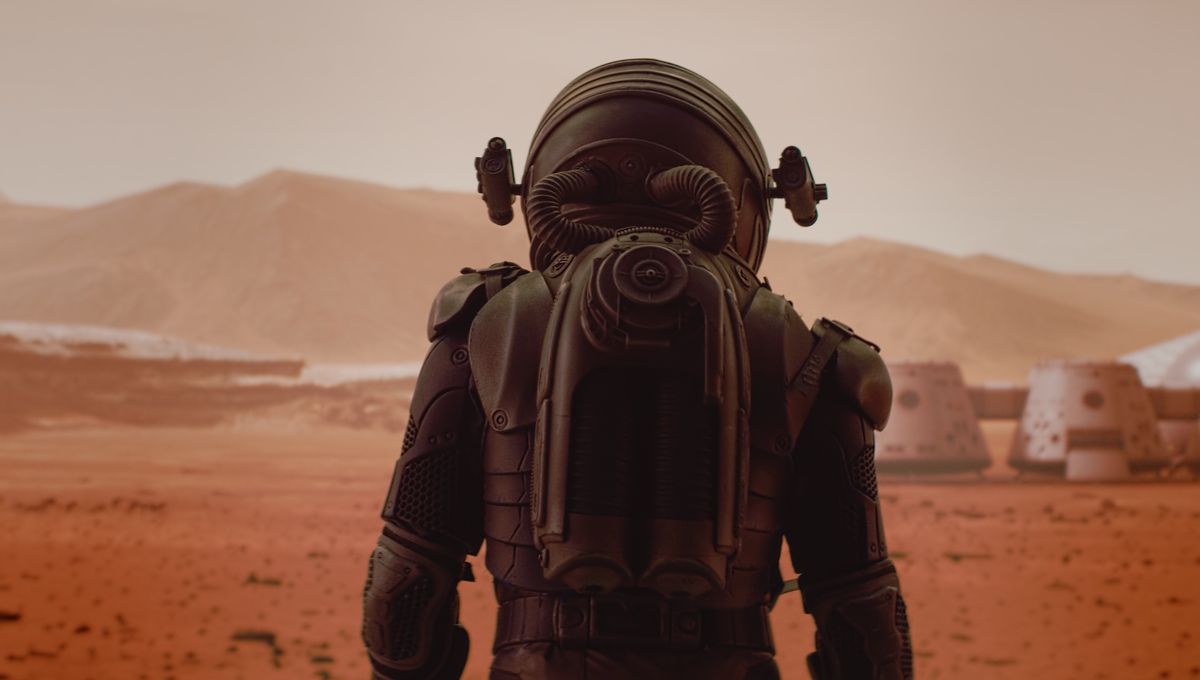
NASA has successfully demonstrated that it is possible to produce oxygen on Mars with the experiment MOXIE, brought over by the Perseverance rover. Now, a Chinese team has shown that it might be possible to produce oxygen on Mars using only material present on the Red Planet.

Advertisement

Since the AI was here on Earth, it did not use actual Martian soil, but meteorites from Mars. The algorithm worked out what molecules could be used to create oxygen evolution reaction (OER) catalysts. These catalysts would be used to turn water into oxygen using solar power. Water is not an abundant resource on Mars, but there are deposits.

The AI chemist analyzed the composition of five types of Martian meteorites by shooting lasers at them. Once potential catalysts were discovered, the system used Bayesian statistics to work out the best possible one. The machine learning system had been readied with simulations for 30,000 hydroxides, and this allowed it to work out what molecules it should be using for the OER catalyst. It then prepared the material from the meteorites to be tested. 

The resulting catalyst was excellent. Researchers report that it could operate steadily for over 550,000 seconds (almost 6 days and 9 hours) with an electric current density of 10 milliamps per square centimeter and an overpotential of 445.1 millivolts. The team also tested it at below-freezing temperatures, consistent with temperatures that are found on Mars, with no apparent degradation. A Mars base could achieve oxygen self-sufficiency with 15 hours of sunlight.

The AI found 3,764,376 possible formulas. For a single human, finding the optimal formula from those would require 2,000 years of labor. The AI chemist was able to do it in two months.

Advertisement

“In the future, humans can establish [an] oxygen factory on Mars with the assistance of AI chemist,” one of the three team leaders Professor Jiang Jun, from the University of Science and Technology of China, said in a statement. “This breakthrough technology brings us one step closer to achieving our dream of living on Mars.”

The team is now looking at applying the AI chemist to more terrestrial challenges in chemical discovery. 

The study is published in the journal Nature Synthesis.

Deborah Bloomfield
Deborah Bloomfield

Related posts:

  1. Oprah’s Harry and Meghan TV interview loses out at Emmys
  2. House Committee on the Budget passes $3.5T reconciliation bill to full House in 20-16 vote
  3. Burro raises $10.9M for autonomous produce field transport
  4. How Much Heat Can A Human Take? Scientists Crack The Critical Limit

Source Link: AI Chemist Brings Us One Step Closer To Breathing On Mars

Filed Under: News

Primary Sidebar

  • The UK’s Tallest Bird Faced Extinction In The 16th Century. Now, It’s Making A Comeback
  • Groundbreaking Discovery Of Two MS Subtypes Could Lead To New Targeted Treatments
  • “We Were So Lucky To Be Able To See This”: 140-Year Mystery Of How The World’s Largest Sea Spider Makes Babies Solved
  • China To Start New Hypergravity Centrifuge To Compress Space-Time – How Does It Work?
  • These Might Be The First Ever Underwater Photos Of A Ross Seal, And They’re Delightful
  • Mysterious 7-Million-Year-Old Ape May Be Earliest Hominin To Walk On Two Feet
  • This Spider-Like Creature Was Walking Around With A Tail 100 Million Years Ago
  • How Do GLP-1 Agonists Like Ozempic and Wegovy Work?
  • Evolution In Action: These Rare Bears Have Adapted To Be Friendlier And Less Aggressive
  • Nearly 100 Years After Debating Bohr On Quantum Mechanics, New Experiment Proves Einstein Wrong – Again
  • 9,500-Year-Old Headless Skeleton Is New World’s Oldest Known Cremated Adult
  • World’s Longest Jellyfish Can Reach A Whopping 36 Meters, Even Bigger Than A Blue Whale
  • In 1994, December 31 Was Wiped From Existence In Kiribati
  • A Giant Volcano Off The Coast Of Oregon Failed To Erupt On Time. Its New Schedule: 2026
  • Here Are 5 Ways In Which Cancer Treatment Advanced In 2025
  • The First Marine Mammal Driven To Extinction By Humans Disappeared Only 27 Years After Being Discovered
  • The Planet’s Oldest Bee Species Has Become The World’s First Insect To Be Granted Legal Rights
  • Facial Disfiguration: Why Has The Face Been The Target Of Punishment Across Time?
  • The World’s Largest Living Reptile Can “Surf” Over 10 Kilometers To Get Between Islands
  • In 1962, A Geologist Went Into A Cave. 2 Months Later, He’d Accidentally Invented A New Field Of Biology.
  • Business
  • Health
  • News
  • Science
  • Technology
  • +1 718 874 1545
  • +91 78878 22626
  • [email protected]
Office Address
Prudour Pvt. Ltd. 420 Lexington Avenue Suite 300 New York City, NY 10170.

Powered by Prudour Network

Copyrights © 2026 · Medical Market Report. All Rights Reserved.

Go to mobile version