• Email Us: [email protected]
  • Contact Us: +1 718 874 1545
  • Skip to main content
  • Skip to primary sidebar

Medical Market Report

  • Home
  • All Reports
  • About Us
  • Contact Us

How Do You Actually Measure The Height Of A Mountain?

August 31, 2024 by Deborah Bloomfield

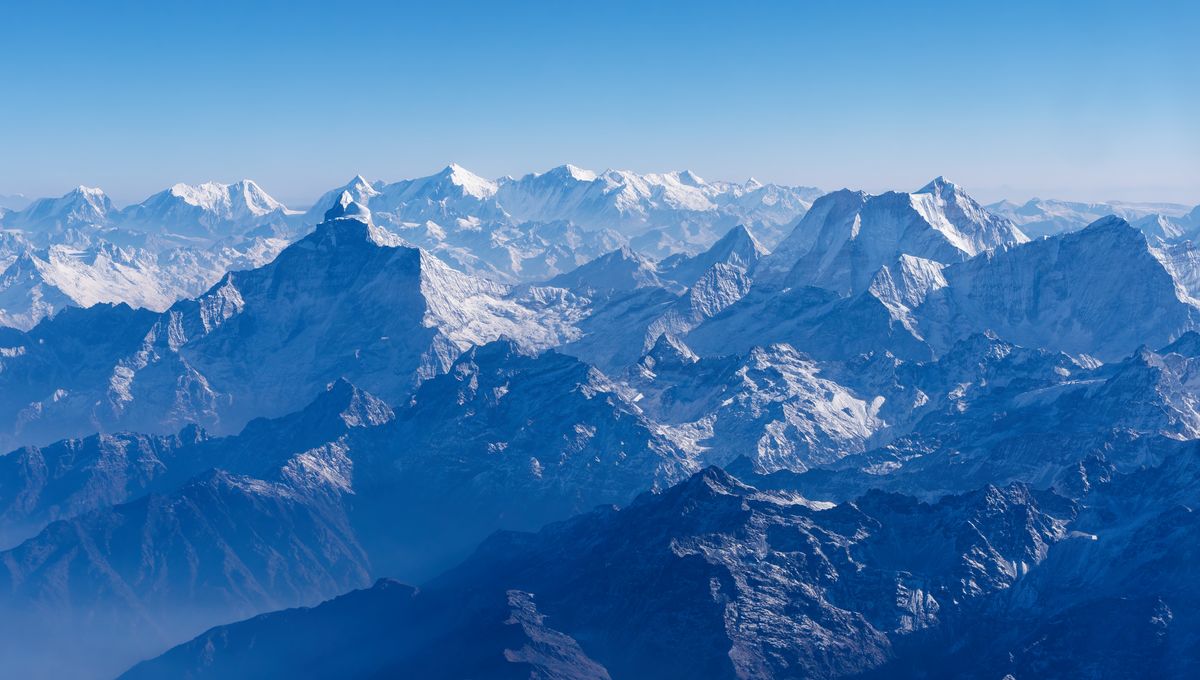
At 8,849 meters (29,032 feet), Mount Everest is the tallest mountain in the world – but how did we figure that out? In fact, how do we know how high any mountain is? They certainly don’t make measuring tapes that long (plus someone would have to be at the top to read it), so how do people actually go about measuring the height of a mountain?

Advertisement

You know when you sat in that math lesson and thought “pffft, I’ll never use trigonometry in real life”? Well, you’d better dust off your protractor because the most traditional way of measuring a mountain’s height most definitely does involve some trig skills.

It’s a method called triangulation, which requires knowing the distance between two points on the ground, and the angle between both of those points and the peak of the mountain. 

The height of mountains, however, is measured from sea level – which, theoretically, should be the same across the planet – so figuring it out also requires the person doing the measuring to know the elevation above sea level of the point they’re measuring from, as well as taking into account the curvature of the Earth.

When it comes to measuring the angles, things need to be a little more exact than holding up a plastic protractor; that’s where a theodolite comes in, a telescope-looking type of optical precision instrument that can measure both horizontal and vertical angles.

With two angles and the length of one side of the “triangle”, you can then bung all those numbers into a few trigonometric formulas (the sine rule and Heron’s formula can help) and shazam, you’ve got the height of the mountain.

Advertisement

However, this historically used method isn’t necessarily the most accurate. When British army officer Sir Andrew Scott Waugh and his team were measuring Mount Everest as part of the Great Trigonometric Survey, for example, Earth’s atmosphere interfered.

Light can bend in the atmosphere, known as atmospheric refraction, due to changes in the density of the air. This can become more pronounced over longer distances, and because it then makes objects appear taller or shorter than they truly are, measurements made can end up being inaccurate.

Nowadays, it can be simpler and far more accurate to measure a mountain’s elevation by making use of GPS. That’s a good thing when it comes to Mount Everest, because its height can actually change – not because of changes in measuring methods, but because geological events like earthquakes.

Deborah Bloomfield
Deborah Bloomfield

Related posts:

  1. Bolivian president calls for global debt relief for poor countries
  2. Five Seasons Ventures pulls in €180M fund to tackle human health and climate via FoodTech
  3. Humanity’s Journey To A Metal-Rich Asteroid Launches Today. Here’s How To Watch
  4. Ancient DNA Reveals People Caught Leprosy From Adorable Woodland Critters In Medieval England

Source Link: How Do You Actually Measure The Height Of A Mountain?

Filed Under: News

Primary Sidebar

  • “Cosmic Dipole Anomaly” Suggests That Our Universe May Be “Lopsided”, Seriously Challenging Our Understanding Of The Cosmos
  • Which Animals Mate For Life?
  • Why Is Rainbow Mountain So Vibrantly Colorful?
  • “It’s An Incredible Feeling”: Salty Air Bubbles In 1.4-Billion-Year-Old Crystals Reveal Secrets Of Earth’s Early Atmosphere
  • These Were Some Of The Most Significant Scientific Experiments Of 2025
  • Want To Know What 2026 Has In Store? The Mesopotamians Have A Tip, But You’re Not Going To Like It
  • Can Woolly Bear Caterpillars Predict Winter Weather? No – But They Do Have A Clever Way To Survive The Freeze
  • Is Showering More Hygienic Than Bathing – What Does The Science Say?
  • Why Is Christmas Called Xmas?
  • Stardust Didn’t Reach The Solar System The Way We Thought, So How Did It Get Here?
  • This Might Be The First Time We’ve Ever Seen A Gravitational Wave Event Gravitationally Lensed
  • Carnivorous, Enormous, And Corpse-Scented: What Are The Rarest Plants On Earth?
  • What Are Nieves Penitentes? The Strange Icy Spikes Found In Some Of Earth’s Most Alien Landscapes
  • What Killed One Of The World’s Biggest Crocs? A Necropsy Of Cassisus Suggests A Hidden Killer
  • Avi Loeb Says Interstellar Object 3I/ATLAS Is “Most Likely Natural” As It Heads Away From Earth
  • For The First Time, Moths Have Been Captured On Camera Feeding On Moose Tears
  • USGS Camera Catches A “Dirty Eruption” At Yellowstone’s Black Diamond Pool
  • This Is Why You Shouldn’t Soak Your Dishes In The Sink Overnight
  • With The Powerful Vera Rubin Observatory, We Could Find Up To 50 Interstellar Objects Like Comet 3I/ATLAS
  • First Evidence For Maternal Care In Plants Reveals Placenta-Like Structure That Sustains Their Offspring
  • Business
  • Health
  • News
  • Science
  • Technology
  • +1 718 874 1545
  • +91 78878 22626
  • [email protected]
Office Address
Prudour Pvt. Ltd. 420 Lexington Avenue Suite 300 New York City, NY 10170.

Powered by Prudour Network

Copyrights © 2025 · Medical Market Report. All Rights Reserved.

Go to mobile version