• Email Us: [email protected]
  • Contact Us: +1 718 874 1545
  • Skip to main content
  • Skip to primary sidebar

Medical Market Report

  • Home
  • All Reports
  • About Us
  • Contact Us

6,000-Year-Old Human Remains Hint At Ancient Funerals In Spanish Cave

August 11, 2023 by Deborah Bloomfield

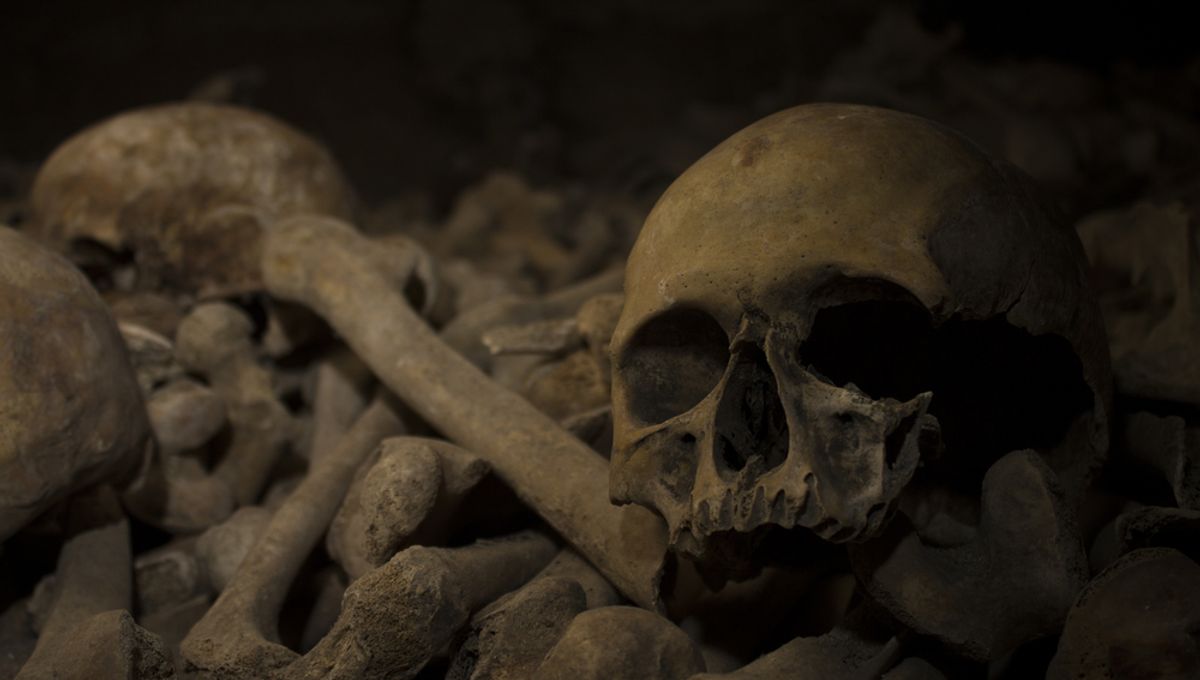
One of the oldest burial chambers in the Iberian Peninsula has been identified in a cave in northern Spain, with bones from within the pit dated to over 6,000 years ago. Representing some of the earliest Neolithic human remains ever discovered in the region, the find provides a rare insight into the funerary customs of the period.

Originally discovered in 1979, the Galería del Sílex was initially believed to have been occupied during the Bronze Age, around 3,000 years ago. However, after noticing six Neolithic ceramic vessels lying alongside human bones in one of the pits, researchers decided to reassess the age of the remains.

Advertisement

Radiocarbon dating conducted on four bones belonging to three separate individuals revealed that the site was used as a burial chamber for a period of about 3,000 years. The oldest of the remains was dated to around 6,250 years ago, while the most recent appears to have been interred approximately 3,450 years ago.

This means that the Galería del Sílex was in use from the Early Neolithic all the way through to the Bronze Age. Fascinatingly, the oldest bones at the site predate the emergence of Neolithic funerary traditions in Iberia by about 1,000 years.

And while some scholars have debated the function of the cave, the study authors provide compelling evidence that it was indeed used as a burial chamber. “The human remains from Galería del Sílex were not found within a domestic context of human occupation of the cave, but rather within two pits (simas) located more than three hundred meters [984 feet] from the ancient entrance,” they write. 

“This suggests that Galería del Sílex could have been an area reserved for depositing deceased humans during the Early Neolithic.”

Advertisement

In classifying the cave as a funerary space, the researchers are able to paint a picture of prehistoric life – and death – in the Sierra de Atapuerca, where the site is located. Noting that the region’s two other notable Neolithic sites – known as El Portalón and El Mirador – were used as living quarters and livestock stables respectively, the study authors are able to present new insights into the spatial dynamics of Stone Age settlements.

Overall, they say that their work “highlights a unique set of occupations in Sierra de Atapuerca during the Early Neolithic, in which the use of different caves was specialized for different purposes: occupational in El Portalón, livestock exploitation in El Mirador, and funerary in [Galería del Sílex].”

The study is published in the journal Quaternary Science Reviews.

Deborah Bloomfield
Deborah Bloomfield

Related posts:

  1. Israeli minister says Iran giving militias drone training near Isfahan
  2. French watchdog chief calls for ban on ‘payment for order flow’ in EU stock market
  3. What Would Happen To Humanity If All Microbes Suddenly Disappeared?
  4. IFLScience The Big Questions: How Is Climate Change Affecting Polar Bear Populations?

Source Link: 6,000-Year-Old Human Remains Hint At Ancient Funerals In Spanish Cave

Filed Under: News

Primary Sidebar

  • US Just Killed NASA’s Mars Sample Return Mission – So What Happens Now?
  • Art Sleuths May Have Recovered Traces Of Da Vinci’s DNA From One Of His Drawings
  • Countries With The Most Narcissists Identified By 45,000-Person Study, And The Results Might Surprise You
  • World’s Oldest Poison Arrows Were Used By Hunters 60,000 Years Ago
  • The Real Reason You Shouldn’t Eat (Most) Raw Cookie Dough
  • Antarctic Scientists Have Just Moved The South Pole – Literally
  • “What We Have Is A Very Good Candidate”: Has The Ancestor Of Homo Sapiens Finally Been Found In Africa?
  • Europe’s Missing Ceratopsian Dinosaurs Have Been Found And They’re Quite Diverse
  • Why Don’t Snorers Wake Themselves Up?
  • Endangered “Northern Native Cat” Captured On Camera For The First Time In 80 Years At Australian Sanctuary
  • Watch 25 Years Of A Supernova Expanding Into Space Squeezed Into This 40-Second NASA Video
  • “Diet Stacking” Trend Could Be Seriously Bad For Your Health
  • Meet The Psychedelic Earth Tiger, A Funky Addition To “10 Species To Watch” In 2026
  • The Weird Mystery Of The “Einstein Desert” In The Hunt For Rogue Planets
  • NASA Astronaut Charles Duke Left A Touching Photograph And Message On The Moon In 1972
  • How Multilingual Are You? This New Language Calculator Lets You Find Out In A Minute
  • Europa’s Seabed Might Be Too Quiet For Life: “The Energy Just Doesn’t Seem To Be There”
  • Amoebae: The Microscopic Health Threat Lurking In Our Water Supplies. Are We Taking Them Seriously?
  • The Last Dogs In Antarctica Were Kicked Out In April 1994 By An International Treaty
  • Interstellar Comet 3I/ATLAS Snapped By NASA’s Europa Mission: “We’re Still Scratching Our Heads About Some Of The Things We’re Seeing”
  • Business
  • Health
  • News
  • Science
  • Technology
  • +1 718 874 1545
  • +91 78878 22626
  • [email protected]
Office Address
Prudour Pvt. Ltd. 420 Lexington Avenue Suite 300 New York City, NY 10170.

Powered by Prudour Network

Copyrights © 2026 · Medical Market Report. All Rights Reserved.

Go to mobile version